THE ADVENTURE COLLECTIVE® · Independent discovery and booking for outdoor travel

Explore the British Museum’s headline objects on a focused 2.5-hour private tour. From the Rosetta Stone to the Parthenon Frieze, a guide condenses centuries of human history into a lively, contextual walkthrough.
Explore the British Museum’s headline objects on a focused 2.5-hour private tour. From the Rosetta Stone to the Parthenon Frieze, a guide condenses centuries of human history into a lively, contextual walkthrough.
Step through the British Museum's grand portico and the bustle of Bloomsbury falls away; the air inside cools and the scale of human history opens before you. Light from the central courtyard washes over stone and glass, while your private guide threads a path through seventy galleries, stopping at objects that changed how we read the past.
Verified experiences and guided adventures in the surrounding area.
Operated by City Wonders UK · London, England
Step through the British Museum's grand portico and the bustle of Bloomsbury falls away; the air inside cools and the scale of human history opens before you. Light from the central courtyard washes over stone and glass, while your private guide threads a path through seventy galleries, stopping at objects that changed how we read the past.
This is a museum of empires and encounters: the Rosetta Stone that unlocked hieroglyphs, Parthenon marble once clinging to the Acropolis, Egyptian mummies that reveal funerary worlds, and Anglo-Saxon treasures salvaged from Suffolk burial mounds. The building itself is Victorian civic architecture layered atop collections sourced across the globe during the 18th–20th centuries — a story of collecting, conquest, and scholarship that visitors will hear alongside object-level detail.
Geology and craft show through in the materials — Egyptian granites, Aegean marble, and bronze casting techniques — each piece a compact lesson in extraction and manufacture. Cultural context matters here: expect discussions of provenance, conservation, and the changing narratives museums tell.
Practical guide: the private 2.5-hour tour condenses highlights efficiently; wear comfortable shoes for roughly 1–2 miles of walking on stone floors. Photography without flash is usually allowed in permanent galleries; check with your guide for exceptions. Mornings are quieter, and winter visits can be pleasantly uncrowded. The museum has step-free access and accessible facilities, but note that baby strollers are not permitted on this tour. Bring a reusable water bottle, allow time to linger at a favorite object, and be ready to trade sweeping context for intimate stories — this tour is about getting below the label to the human stories carved in stone.
easy.
2.5 hours.
Suitable for most fitness levels; involves standing and slow walking on hard floors for a couple of hours.
Yes — admission to the museum and access to permanent galleries are included as part of the private guided experience.
This specific tour does not permit baby strollers; check with the operator for family-friendly alternatives or storage options.
The British Museum provides step-free access, lifts, and accessible facilities; advise your tour operator of any access needs when booking.
Yes — private tours are tailored to interests, so request focuses like Egyptology, classical antiquities, or Anglo-Saxon artifacts when you book.
Founded in 1753 from Sir Hans Sloane’s collection and opened to the public in 1759, the British Museum grew through acquisitions during the British Empire and Victorian collecting practices.
The museum runs active conservation programs for paper, textile and stone artifacts and engages in provenance research; visitors are encouraged to respect display rules to minimize light and contact damage.
City Wonders UK operates guided outdoor trips and adventures with an emphasis on safety, stewardship, and memorable experiences.


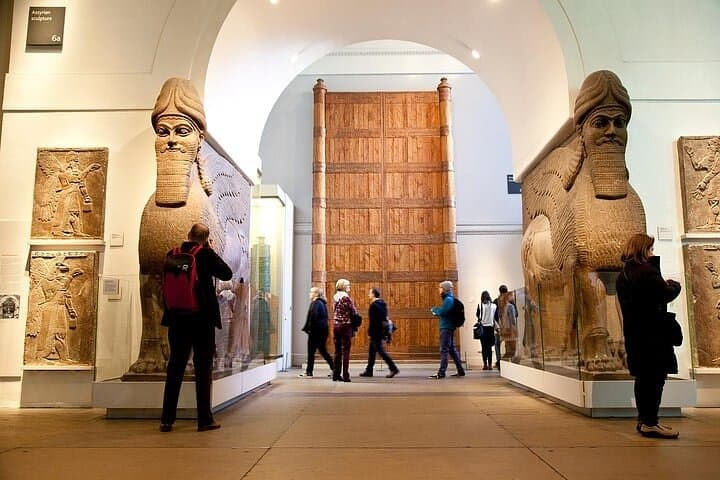
Step through the British Museum's grand portico and the bustle of Bloomsbury falls away; the air inside cools and the scale of human history opens before you. Light from the central courtyard washes over stone and glass, while your private guide threads a path through seventy galleries, stopping at objects that changed how we read the past.
Step through the British Museum's grand portico and the bustle of Bloomsbury falls away; the air inside cools and the scale of human history opens before you. Light from the central courtyard washes over stone and glass, while your private guide threads a path through seventy galleries, stopping at objects that changed how we read the past.
This is a museum of empires and encounters: the Rosetta Stone that unlocked hieroglyphs, Parthenon marble once clinging to the Acropolis, Egyptian mummies that reveal funerary worlds, and Anglo-Saxon treasures salvaged from Suffolk burial mounds. The building itself is Victorian civic architecture layered atop collections sourced across the globe during the 18th–20th centuries — a story of collecting, conquest, and scholarship that visitors will hear alongside object-level detail.
Geology and craft show through in the materials — Egyptian granites, Aegean marble, and bronze casting techniques — each piece a compact lesson in extraction and manufacture. Cultural context matters here: expect discussions of provenance, conservation, and the changing narratives museums tell.
Practical guide: the private 2.5-hour tour condenses highlights efficiently; wear comfortable shoes for roughly 1–2 miles of walking on stone floors. Photography without flash is usually allowed in permanent galleries; check with your guide for exceptions. Mornings are quieter, and winter visits can be pleasantly uncrowded. The museum has step-free access and accessible facilities, but note that baby strollers are not permitted on this tour. Bring a reusable water bottle, allow time to linger at a favorite object, and be ready to trade sweeping context for intimate stories — this tour is about getting below the label to the human stories carved in stone.