THE ADVENTURE COLLECTIVE® · Independent discovery and booking for outdoor travel

Spend a focused half day exploring two of Kathmandu’s UNESCO sites: the towering Boudhanath stupa and the sacred Pashupatinath temple complex. This guided circuit pairs ritual observation with local craft stops and practical tips for respectful visits.
Spend a focused half day exploring two of Kathmandu’s UNESCO sites: the towering Boudhanath stupa and the sacred Pashupatinath temple complex. This guided circuit pairs ritual observation with local craft stops and practical tips for respectful visits.
You arrive into a swirl of prayer flags and bell tones: dust-soft sunlight slides across the white dome of Boudhanath while saffron-robed monks circle prayer wheels, fingers brushing wood and metal in a steady cadence.
Verified experiences and guided adventures in the surrounding area.
Operated by Himalayan Advisor Pvt. Ltd. · Kathmandu, Bagmati Province
You arrive into a swirl of prayer flags and bell tones: dust-soft sunlight slides across the white dome of Boudhanath while saffron-robed monks circle prayer wheels, fingers brushing wood and metal in a steady cadence.
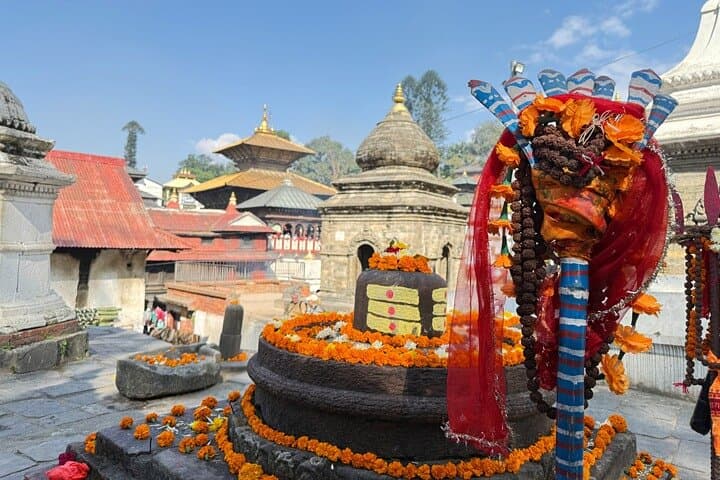
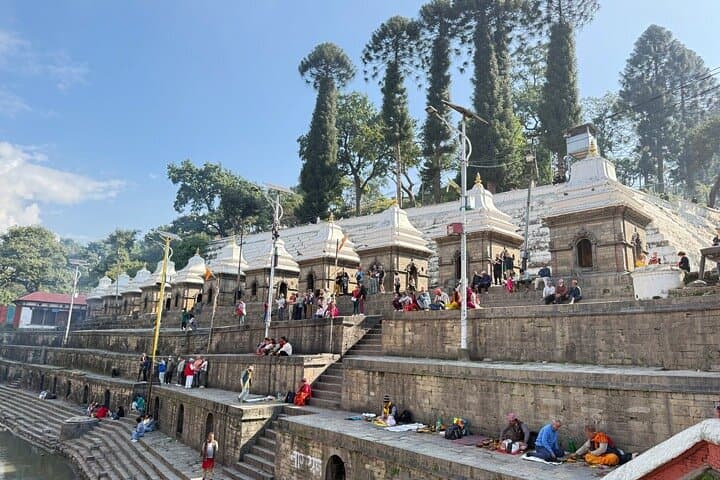
Boudhanath’s enormous mandala—more than 36 meters tall—dominates the plateau, its four painted eyes watching pilgrims perform clockwise kora. A short drive down the Bagmati, Pashupatinath opens as a different world: pagoda roofs, carved eaves and the slow, relentless flow of the river where rites and cremations happen on stone ghats.
These two UNESCO sites encapsulate Kathmandu’s layered spiritual history. Boudhanath evolved as a Tibetan Buddhist focal point after trade routes brought Himalayan communities here; Pashupatinath traces centuries of Shaiva practice, with wooden architecture and stone bulls marking Shiva’s domain.
Geologically, the valley sits on alluvial plains ringed by hills, which concentrates temples along the rivers and ridgelines; culturally, expect interactions with monks, priests and local artisans—thankas, singing bowls and carved woodwork are local crafts to observe.
Practical guide: plan for roughly 3–4 hours door-to-door; modest, formal dress is required at both sites (shoulders and knees covered). Bring a reusable water bottle, small cash for donations and souvenirs, and a respectful camera policy—photography is restricted near some ritual areas. Early morning or late afternoon visits reduce crowds and offer softer light for photos. A guide will speed entry, explain iconography and point out lesser-known gompas and viewing points. This half-day loop is low-effort but high-context: it’s a concentrated primer in Kathmandu’s living religions and temple craftsmanship.
easy.
3–4 hours.
Suitable for most fitness levels; involves light walking on flat to uneven temple grounds
The tour is approximately 3–4 hours total, including hotel pickup and drop-off within Kathmandu’s ring road.
Required entry fees and local taxes are included in the booking per the tour listing.
Photography is generally allowed around the exteriors and public areas, but is restricted inside some gompas and at cremation ghats—follow your guide’s instructions.
Yes; the itinerary is low-physical, stroller accessible, and suitable for most ages, though the sites involve steps and uneven surfaces.
Boudhanath became a Tibetan Buddhist center after Himalayan trade intensified; Pashupatinath has been an important Shaiva pilgrimage site for centuries and the complex grew around the Bagmati ghats.
Both UNESCO sites face pressure from urban growth and pollution of the Bagmati River; responsible visits mean minimizing litter, avoiding incense overuse, and supporting local conservation groups.
Himalayan Advisor Pvt. Ltd. operates guided outdoor trips and adventures with an emphasis on safety, stewardship, and memorable experiences.
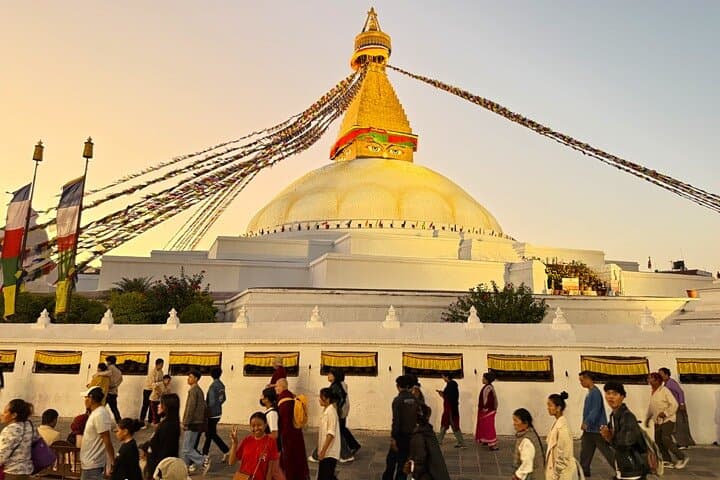
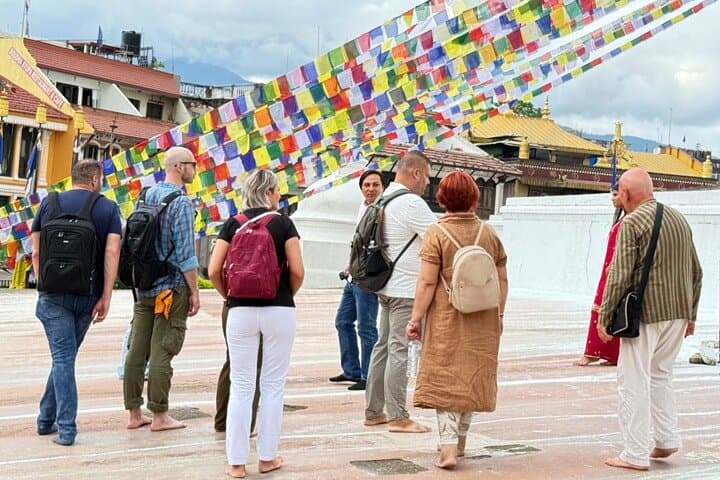
You arrive into a swirl of prayer flags and bell tones: dust-soft sunlight slides across the white dome of Boudhanath while saffron-robed monks circle prayer wheels, fingers brushing wood and metal in a steady cadence.
You arrive into a swirl of prayer flags and bell tones: dust-soft sunlight slides across the white dome of Boudhanath while saffron-robed monks circle prayer wheels, fingers brushing wood and metal in a steady cadence.
Boudhanath’s enormous mandala—more than 36 meters tall—dominates the plateau, its four painted eyes watching pilgrims perform clockwise kora. A short drive down the Bagmati, Pashupatinath opens as a different world: pagoda roofs, carved eaves and the slow, relentless flow of the river where rites and cremations happen on stone ghats.
These two UNESCO sites encapsulate Kathmandu’s layered spiritual history. Boudhanath evolved as a Tibetan Buddhist focal point after trade routes brought Himalayan communities here; Pashupatinath traces centuries of Shaiva practice, with wooden architecture and stone bulls marking Shiva’s domain.
Geologically, the valley sits on alluvial plains ringed by hills, which concentrates temples along the rivers and ridgelines; culturally, expect interactions with monks, priests and local artisans—thankas, singing bowls and carved woodwork are local crafts to observe.
Practical guide: plan for roughly 3–4 hours door-to-door; modest, formal dress is required at both sites (shoulders and knees covered). Bring a reusable water bottle, small cash for donations and souvenirs, and a respectful camera policy—photography is restricted near some ritual areas. Early morning or late afternoon visits reduce crowds and offer softer light for photos. A guide will speed entry, explain iconography and point out lesser-known gompas and viewing points. This half-day loop is low-effort but high-context: it’s a concentrated primer in Kathmandu’s living religions and temple craftsmanship.