THE ADVENTURE COLLECTIVE® · Independent discovery and booking for outdoor travel

Walk the Freedom Trail with a local guide who pairs Revolutionary-era landmarks with neighborhood food stops. This two-hour urban walk blends colonial history, immigrant culture, and optional tastings at classic Boston vendors.
Walk the Freedom Trail with a local guide who pairs Revolutionary-era landmarks with neighborhood food stops. This two-hour urban walk blends colonial history, immigrant culture, and optional tastings at classic Boston vendors.
Morning light hits Hanover Street and the city exhales — a harbor breeze nudges you along red-brick markers that thread the Freedom Trail. Guides in bright hats steer small groups through narrow lanes, past doorways where arguments about liberty once began, and into markets where steam from chowder bowls hangs in the chill air.
Verified experiences and guided adventures in the surrounding area.
Operated by ExperienceFirst · Boston, Massachusetts
Morning light hits Hanover Street and the city exhales — a harbor breeze nudges you along red-brick markers that thread the Freedom Trail. Guides in bright hats steer small groups through narrow lanes, past doorways where arguments about liberty once began, and into markets where steam from chowder bowls hangs in the chill air.
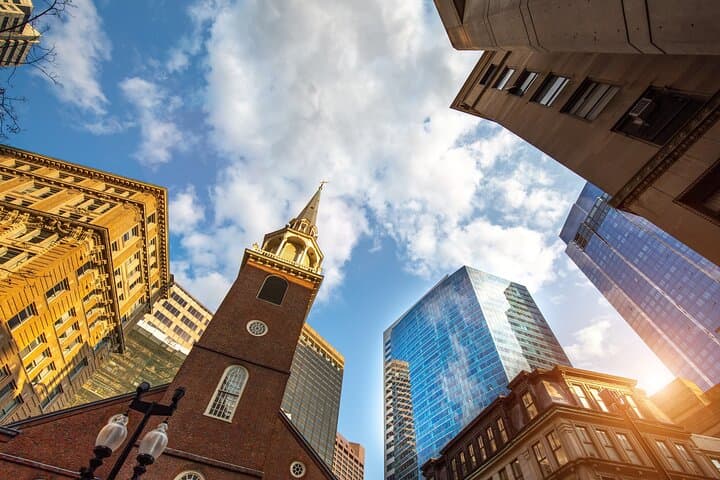
The route stitches together colonial and 19th-century Boston: Faneuil Hall’s Georgian facade, the Paul Revere House, and the bell-towered Old North Church. Beneath the streets is a different story — reclaimed land and fill reshaped by the Big Dig and centuries of maritime trade — a working geology that turned a compact port into the city visitors see today. Culturally, the tour moves through waves of immigrants: Puritan radicals, Revolutionary actors, and later Italian and Irish communities whose bakeries and delis still set the table for this walk.
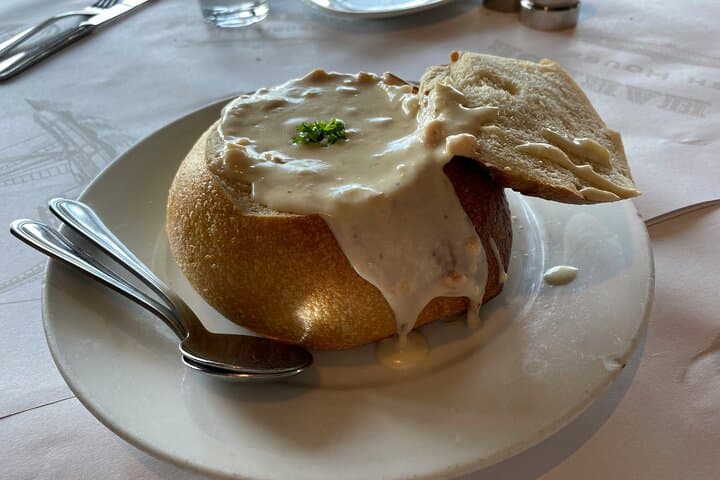
Local color arrives in small bites — clam chowder, baked beans, and filled cannolis — recommended, not required, with sampling running about $30 if you taste everything. Guides mix lesser-known anecdotes with practical notes: which storefronts are originals, where the Haymarket still hums on weekends, and how the Rose Kennedy Greenway reconnected neighborhoods.
Practicalities: the tour meets at the Congress Street entrance of Boston Public Market (arrive 15 minutes early), lasts roughly two hours, and is flat, pavement-heavy walking suitable for most fitness levels. Wear supportive shoes, bring a refillable water bottle, and carry a card or small cash for optional tastings. Public transit drops you nearby; if venues close, guides swap in nearby alternatives. This is an urban walk that reads like living history — noisy, savory, and grounded in the city’s stones and steam.
easy.
2 hours.
Suitable for most fitness levels; should be able to walk 1.5–2 miles on city streets without issue.
No — the guided walk is included; tastings are optional and typically total around $30 if you sample multiple items.
Yes — the operator lists the route as wheelchair and stroller accessible, though some cobblestone sections may be bumpy.
Meet at the Congress Street entrance of the Boston Public Market; the tour ends across from Polcari’s Coffee in the North End.
For a full refund, cancel at least 24 hours before the scheduled departure time; cancellations within 24 hours are not refundable.
The Freedom Trail links 16 sites central to Revolutionary and colonial Boston, highlighting key locations like Faneuil Hall and Paul Revere’s house where civic debate and trade shaped early American history.
Urban preservation keeps these historic buildings active; support local vendors and follow city litter and recycling rules to reduce your footprint.
ExperienceFirst operates guided outdoor trips and adventures with an emphasis on safety, stewardship, and memorable experiences.

Morning light hits Hanover Street and the city exhales — a harbor breeze nudges you along red-brick markers that thread the Freedom Trail. Guides in bright hats steer small groups through narrow lanes, past doorways where arguments about liberty once began, and into markets where steam from chowder bowls hangs in the chill air.
Morning light hits Hanover Street and the city exhales — a harbor breeze nudges you along red-brick markers that thread the Freedom Trail. Guides in bright hats steer small groups through narrow lanes, past doorways where arguments about liberty once began, and into markets where steam from chowder bowls hangs in the chill air.
The route stitches together colonial and 19th-century Boston: Faneuil Hall’s Georgian facade, the Paul Revere House, and the bell-towered Old North Church. Beneath the streets is a different story — reclaimed land and fill reshaped by the Big Dig and centuries of maritime trade — a working geology that turned a compact port into the city visitors see today. Culturally, the tour moves through waves of immigrants: Puritan radicals, Revolutionary actors, and later Italian and Irish communities whose bakeries and delis still set the table for this walk.
Local color arrives in small bites — clam chowder, baked beans, and filled cannolis — recommended, not required, with sampling running about $30 if you taste everything. Guides mix lesser-known anecdotes with practical notes: which storefronts are originals, where the Haymarket still hums on weekends, and how the Rose Kennedy Greenway reconnected neighborhoods.
Practicalities: the tour meets at the Congress Street entrance of Boston Public Market (arrive 15 minutes early), lasts roughly two hours, and is flat, pavement-heavy walking suitable for most fitness levels. Wear supportive shoes, bring a refillable water bottle, and carry a card or small cash for optional tastings. Public transit drops you nearby; if venues close, guides swap in nearby alternatives. This is an urban walk that reads like living history — noisy, savory, and grounded in the city’s stones and steam.