THE ADVENTURE COLLECTIVE® · Independent discovery and booking for outdoor travel

A full-day speedboat loop from Split visiting Biševo’s famed Blue Cave, the fishing town of Komiža on Vis, Stiniva Cove, the Blue Lagoon near Budikovac, Palmizana’s botanical garden and Hvar for lunch. Expect several swim stops, shore visits, and variable timing depending on sea conditions.
A full-day speedboat loop from Split visiting Biševo’s famed Blue Cave, the fishing town of Komiža on Vis, Stiniva Cove, the Blue Lagoon near Budikovac, Palmizana’s botanical garden and Hvar for lunch. Expect several swim stops, shore visits, and variable timing depending on sea conditions.
You step onto the quay in Split as the first light catches the Adriatic; the harbor smells of diesel and salt, and the speedboat hums like a contained storm ready to launch.
Verified experiences and guided adventures in the surrounding area.
You step onto the quay in Split as the first light catches the Adriatic; the harbor smells of diesel and salt, and the speedboat hums like a contained storm ready to launch.
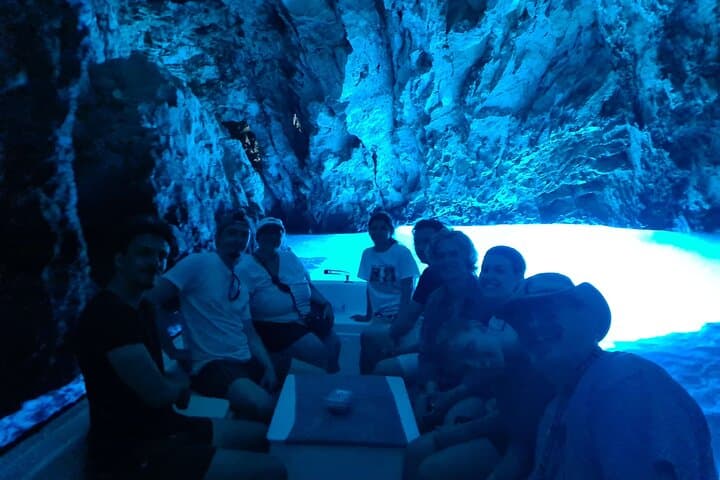
Within an hour the land thins to ragged limestone and the sea opens into postcard-blue channels. The Blue Cave on Biševo announces itself not by size but by light: sunlight funnels through a submerged entrance and paints the chamber an otherworldly electric blue that seems to have its own heartbeat. Nearby, Komiža on Vis still wears its fishing village DNA—stone houses, narrow alleys and a port that remembers Austro-Hungarian and Venetian days.
Geology here is visible history: karst rock carved by millennia of waves produces sea caves like Stiniva, a collapsed roof that creates a sheltered pebble cove, while the Pakleni islands and Budikovac offer shallow bays with Posidonia seagrass and clear snorkel conditions. Hvar town brings a cultural contrast—Venetian facades, a central square and laneways that invite a long lunch.
Practical edge: this is a full-day, 10-hour loop with multiple short stops for swimming and sightseeing. The Blue Cave visit depends on sea state and light; operators may swap order if conditions change. Bring reef-safe sunscreen, a towel, a water-resistant bag and some cash for small harborside cafés. Expect brief climbs on rocky shorelines and stepping up into smaller tenders.
The reward is steady: turquoise coves daring you to dive, winds that push the boat forward, and a mix of geology and old-world coastal culture packed into one active seaside day.
moderate.
10 hours.
Moderate fitness: able to board small tenders, climb short rocky steps, and do repeated swims/snorkeling stops.
No—entry depends on sea state and light; calm seas and sun are needed for the operator to time small-boat access safely.
Some operators include masks and snorkels; confirm before booking or bring your own for fit and hygiene.
Many Hvar restaurants offer vegetarian options, but inform the operator in advance if a specific dietary accommodation is required.
Stops are typically 20–40 minutes each, enough for a swim or snorkel but varying by schedule and sea conditions.
Vis and Biševo have layers of history from ancient Greeks and Romans to Venetian and Austro-Hungarian maritime trade; Hvar retains Gothic and Renaissance architecture.
The central Adriatic hosts sensitive Posidonia meadows and marine life—avoid anchoring on seagrass, use reef-safe sunscreen, and follow local guidelines to minimize impact.
You step onto the quay in Split as the first light catches the Adriatic; the harbor smells of diesel and salt, and the speedboat hums like a contained storm ready to launch.
You step onto the quay in Split as the first light catches the Adriatic; the harbor smells of diesel and salt, and the speedboat hums like a contained storm ready to launch.
Within an hour the land thins to ragged limestone and the sea opens into postcard-blue channels. The Blue Cave on Biševo announces itself not by size but by light: sunlight funnels through a submerged entrance and paints the chamber an otherworldly electric blue that seems to have its own heartbeat. Nearby, Komiža on Vis still wears its fishing village DNA—stone houses, narrow alleys and a port that remembers Austro-Hungarian and Venetian days.
Geology here is visible history: karst rock carved by millennia of waves produces sea caves like Stiniva, a collapsed roof that creates a sheltered pebble cove, while the Pakleni islands and Budikovac offer shallow bays with Posidonia seagrass and clear snorkel conditions. Hvar town brings a cultural contrast—Venetian facades, a central square and laneways that invite a long lunch.
Practical edge: this is a full-day, 10-hour loop with multiple short stops for swimming and sightseeing. The Blue Cave visit depends on sea state and light; operators may swap order if conditions change. Bring reef-safe sunscreen, a towel, a water-resistant bag and some cash for small harborside cafés. Expect brief climbs on rocky shorelines and stepping up into smaller tenders.
The reward is steady: turquoise coves daring you to dive, winds that push the boat forward, and a mix of geology and old-world coastal culture packed into one active seaside day.