THE ADVENTURE COLLECTIVE® · Independent discovery and booking for outdoor travel

Approach the Buna and the Tekija and you meet water that refuses to behave like a stream: it bursts from the cliff and carves a quiet theater for a centuries-old dervish house. This short cultural walk from Mostar combines karst geology, Ottoman-era Sufi history, and easy riverside access.
Approach the Buna and the Tekija and you meet water that refuses to behave like a stream: it bursts from the cliff and carves a quiet theater for a centuries-old dervish house. This short cultural walk from Mostar combines karst geology, Ottoman-era Sufi history, and easy riverside access.
A cool mist rises where the Buna pushes out of the cliff, daring you to step closer. Stone steps lead down to a low-slung dervish house whose white walls cling to the rock above the turquoise mouth of the Buna; glassy water and limestone cliffs frame the first view and pull the walk into focus.
Verified experiences and guided adventures in the surrounding area.
Operated by NowBosnia · Blagaj, Herzegovina-Neretva Canton
A cool mist rises where the Buna pushes out of the cliff, daring you to step closer. Stone steps lead down to a low-slung dervish house whose white walls cling to the rock above the turquoise mouth of the Buna; glassy water and limestone cliffs frame the first view and pull the walk into focus.
This small complex—the Tekija at the source of the Buna—has layers of history: Late Antique remains underfoot, a medieval shrine re-used by Ottoman-era Sufi communities, and the legend of Sari Saltuk whose tomb drew pilgrims for centuries. Geologically, the spring is a karst resurgence where underground water finds an abrupt outlet, feeding the Buna’s cool, fast current that powers old mills downstream.
Culturally the Tekija is still an active place of zikr (Sufi chanting) on set nights, and visits require quiet respect. The atmosphere alternates between hush and the river’s insistence: currents push forward, cliffs hold shadows, small boats drift slowly along the bank.
Practical guidance: allow about 4–6 hours for a private tour from Mostar (roughly 12 km, 20–30 minutes by car) including time for the Tekija, riverside photos, and a short walk to nearby mills. The on-site path is mostly paved with some stone steps and minimal elevation change (under 50 m). Wear sturdy shoes for wet stone, carry water, and bring a light layer—the spring valley is cooler than the town. Guides enhance historical context and help time visits to avoid crowds; the site is generally stroller-accessible but has steps to the riverside.
easy.
4–6 hours.
Light walking ability; mainly short paved sections and stone steps with minimal elevation change
A typical guided visit with time for photos and a short riverside walk lasts 1–2 hours; full private tours from Mostar often run 4–6 hours including transport.
Yes, but visitors should remain respectful and quiet; ask your guide for timing to avoid interrupting zikr nights.
You can visit independently—the site is accessible—but a guide provides historical context and helps navigate timing and etiquette.
The main upper terraces are generally stroller-accessible, but there are stone steps to reach the immediate riverside, so full wheelchair access is limited.
The Tekija occupies a site with Late Antique remains and was a prominent Sufi center in the Ottoman period; local legend links the site to Sari Saltuk.
The Buna is a sensitive karst spring—maintain distance from fragile banks, avoid single-use plastics, and support local businesses that follow low-impact practices.
NowBosnia operates guided outdoor trips and adventures with an emphasis on safety, stewardship, and memorable experiences.

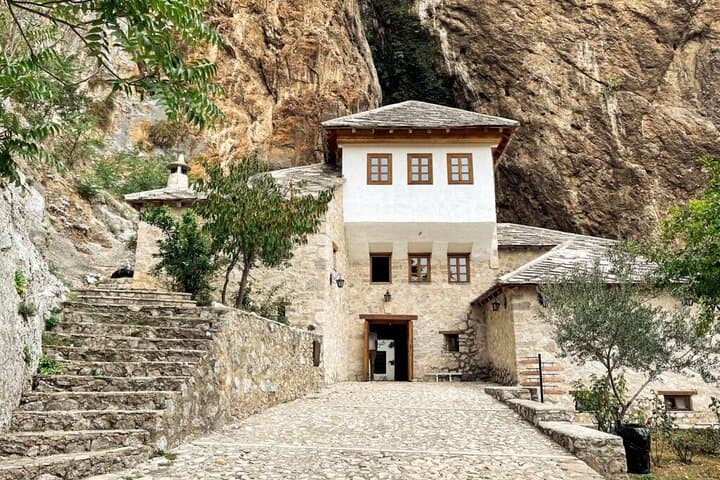
A cool mist rises where the Buna pushes out of the cliff, daring you to step closer. Stone steps lead down to a low-slung dervish house whose white walls cling to the rock above the turquoise mouth of the Buna; glassy water and limestone cliffs frame the first view and pull the walk into focus.
A cool mist rises where the Buna pushes out of the cliff, daring you to step closer. Stone steps lead down to a low-slung dervish house whose white walls cling to the rock above the turquoise mouth of the Buna; glassy water and limestone cliffs frame the first view and pull the walk into focus.
This small complex—the Tekija at the source of the Buna—has layers of history: Late Antique remains underfoot, a medieval shrine re-used by Ottoman-era Sufi communities, and the legend of Sari Saltuk whose tomb drew pilgrims for centuries. Geologically, the spring is a karst resurgence where underground water finds an abrupt outlet, feeding the Buna’s cool, fast current that powers old mills downstream.
Culturally the Tekija is still an active place of zikr (Sufi chanting) on set nights, and visits require quiet respect. The atmosphere alternates between hush and the river’s insistence: currents push forward, cliffs hold shadows, small boats drift slowly along the bank.
Practical guidance: allow about 4–6 hours for a private tour from Mostar (roughly 12 km, 20–30 minutes by car) including time for the Tekija, riverside photos, and a short walk to nearby mills. The on-site path is mostly paved with some stone steps and minimal elevation change (under 50 m). Wear sturdy shoes for wet stone, carry water, and bring a light layer—the spring valley is cooler than the town. Guides enhance historical context and help time visits to avoid crowds; the site is generally stroller-accessible but has steps to the riverside.