THE ADVENTURE COLLECTIVE® · Independent discovery and booking for outdoor travel

Explore Iguazu National Park on two wheels: a guided 13 km circuit that takes riders beyond the main viewpoints into the heart of the Atlantic Forest. Learn natural history, local stories, and park ecology while pedaling at a relaxed pace with stops and support.
Explore Iguazu National Park on two wheels: a guided 13 km circuit that takes riders beyond the main viewpoints into the heart of the Atlantic Forest. Learn natural history, local stories, and park ecology while pedaling at a relaxed pace with stops and support.
Morning light filters through high-ceilinged canopy as riders clip in at the Iguaçu National Park ticket gate. The air smells of wet leaf mold and river spray; the path ahead slips between stout trees and sudden openings that reveal the distant roar of the falls. This is not a race to the cataracts but a paced circuit that teaches the park’s rhythms — each pedal stroke brings another viewpoint, another birdcall, another paragraph of local story.
Verified experiences and guided adventures in the surrounding area.
Operated by Iguassu by Bike · Foz do Iguaçu, Paraná
Morning light filters through high-ceilinged canopy as riders clip in at the Iguaçu National Park ticket gate. The air smells of wet leaf mold and river spray; the path ahead slips between stout trees and sudden openings that reveal the distant roar of the falls. This is not a race to the cataracts but a paced circuit that teaches the park’s rhythms — each pedal stroke brings another viewpoint, another birdcall, another paragraph of local story.
Geologically, Iguazu Falls crowns a basalt plateau where ancient lava flows fractured into the stepped escarpments that force the Iguazu River to plunge. The surrounding Atlantic Forest is one of South America’s most biodiverse remnants; the Brazilian park was created in 1939 and today forms part of a transboundary protected area recognized for its global value.
Culturally, guides weave natural history with human stories — indigenous presence long before European contact, the early 20th-century conservation efforts, and the park’s continuing role in regional identity. Expect to hear local legends and practical anecdotes about park structures and access.
Practical guidance: the guided loop covers about 13 km at a relaxed pace over mostly compacted dirt and park roads, with gentle grades and a few short climbs. Helmets and hybrid bikes are provided; bring a water bottle, sun protection, and a light rain shell. There are scheduled stops and an option to return by park transport if needed, so beginners are welcome but should have moderate fitness. Ride thoughtfully — the forest is active and weather can change quickly; keep cameras ready and respect wildlife by keeping distance.
moderate.
3–3.5 hours.
Suitable for anyone with moderate aerobic fitness who can cycle short climbs and remain on the bike for several hours with breaks
The guided circuit covers about 13 km and runs at a leisurely pace with four planned stops; total duration is roughly 3 to 3.5 hours.
Yes, the tour provides bicycles and helmets; riders should still bring personal items like a water bottle and sunscreen.
Yes—beginners are welcome and the route includes four points where riders can choose to return to the park entrance by bus if they prefer not to finish the loop.
Typically the tour meets at the park entrance but park admission may be charged separately; confirm at booking whether entrance fees are included.
Iguaçu/Iguazú National Park on the Brazilian side was established in 1939 to protect the falls and surrounding Atlantic Forest; the binational area is a long-standing conservation focus.
The park is part of a transboundary conservation area and UNESCO-protected landscapes; visitors are asked to stay on trails, avoid feeding wildlife and minimize waste to protect fragile forest habitats.
Iguassu by Bike operates guided outdoor trips and adventures with an emphasis on safety, stewardship, and memorable experiences.
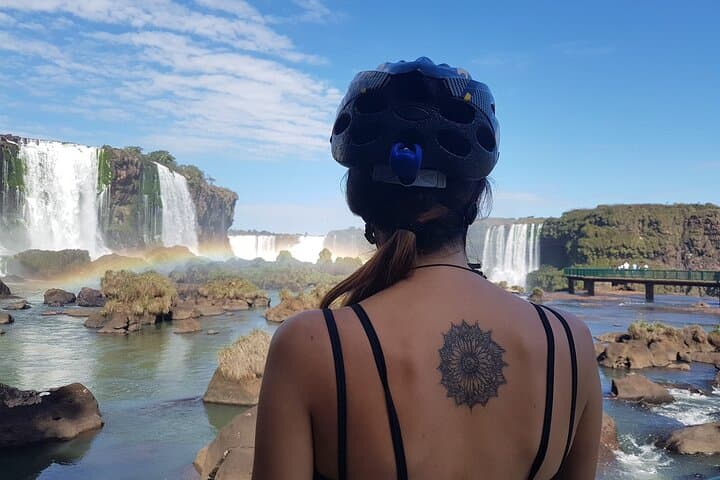


Morning light filters through high-ceilinged canopy as riders clip in at the Iguaçu National Park ticket gate. The air smells of wet leaf mold and river spray; the path ahead slips between stout trees and sudden openings that reveal the distant roar of the falls. This is not a race to the cataracts but a paced circuit that teaches the park’s rhythms — each pedal stroke brings another viewpoint, another birdcall, another paragraph of local story.
Morning light filters through high-ceilinged canopy as riders clip in at the Iguaçu National Park ticket gate. The air smells of wet leaf mold and river spray; the path ahead slips between stout trees and sudden openings that reveal the distant roar of the falls. This is not a race to the cataracts but a paced circuit that teaches the park’s rhythms — each pedal stroke brings another viewpoint, another birdcall, another paragraph of local story.
Geologically, Iguazu Falls crowns a basalt plateau where ancient lava flows fractured into the stepped escarpments that force the Iguazu River to plunge. The surrounding Atlantic Forest is one of South America’s most biodiverse remnants; the Brazilian park was created in 1939 and today forms part of a transboundary protected area recognized for its global value.
Culturally, guides weave natural history with human stories — indigenous presence long before European contact, the early 20th-century conservation efforts, and the park’s continuing role in regional identity. Expect to hear local legends and practical anecdotes about park structures and access.
Practical guidance: the guided loop covers about 13 km at a relaxed pace over mostly compacted dirt and park roads, with gentle grades and a few short climbs. Helmets and hybrid bikes are provided; bring a water bottle, sun protection, and a light rain shell. There are scheduled stops and an option to return by park transport if needed, so beginners are welcome but should have moderate fitness. Ride thoughtfully — the forest is active and weather can change quickly; keep cameras ready and respect wildlife by keeping distance.