THE ADVENTURE COLLECTIVE® · Independent discovery and booking for outdoor travel

Traverse Kyrgyzstan’s high summer pastures and the vast saline basin of Issyk‑Kul on a compact 3‑day tour. Expect yurt stays, gravel passes, horseback options, and high‑altitude landscapes that reward simple preparation.
Traverse Kyrgyzstan’s high summer pastures and the vast saline basin of Issyk‑Kul on a compact 3‑day tour. Expect yurt stays, gravel passes, horseback options, and high‑altitude landscapes that reward simple preparation.
Morning light pours over alpine grass as you crest the pass toward Son-Kul: wind-gnarled horses graze on a broad, blue mirror set at roughly 3,000 m, and yurts punctuate the skyline like temporary villages. The tour threads Kyrgyzstan’s two signature water worlds—Son-Kul’s remote summer pastures and Issyk-Kul’s vast, saline basin—offering contrasts of solitude and scale.
Verified experiences and guided adventures in the surrounding area.
Morning light pours over alpine grass as you crest the pass toward Son-Kul: wind-gnarled horses graze on a broad, blue mirror set at roughly 3,000 m, and yurts punctuate the skyline like temporary villages. The tour threads Kyrgyzstan’s two signature water worlds—Son-Kul’s remote summer pastures and Issyk-Kul’s vast, saline basin—offering contrasts of solitude and scale.
Son-Kul sits on high summer pastures where nomadic life is still practiced; families bring flocks to graze and host overnight in felt yurts. Geologically, Son-Kul is a tectonic basin ringed by ridgelines, while Issyk-Kul is a large, high-altitude saline lake (around 1,600 m elevation) that stays unfrozen year-round, fed by mountain streams and framed by the Tien Shan. Both places carry layers of Silk Road and nomadic history—ancient routes and seasonal migrations shaped the culture you’ll see: horseback riders, cheese-making, and felt craft.
Practically, expect long drives on mixed paved and gravel roads, some rough passes that feel remote, and simple yurt accommodation. Altitude and sun are the constant considerations—thin air and intense UV. Bring layered clothing, sun and wind protection, a refillable water bottle, and sturdy boots. Plan for 3 days of active travel: short hikes, horseback options, cultural stops, and photography windows at dawn and dusk. Local guides manage permits and route choices; summer is the best season for open pastures and accessible passes. Arrive prepared, travel with respect for grazing lands, and you’ll leave with wide skies, quiet shores, and a clear sense of Kyrgyz nomadic landscape.
moderate.
3 days.
Moderate—suitable for travelers who can handle several hours of sightseeing or light hiking per day and occasional horseback riding at altitude.
Son‑Kul is a high alpine basin reached by mountain tracks; accommodations are typically family‑run yurts offering simple bedding and hot meals.
Yes—Son‑Kul sits around 3,000 m. Hydrate, ascend gradually if possible, and inform your guide if you feel severe symptoms.
Many tours offer optional horseback rides to explore pastures; no riding skill is required for short guided rides, but confirm inclusion before booking.
Summer (late June–August) provides open pastures and accessible passes; outside summer some routes can be snowbound or impassable.
The route follows corridors used by nomadic Kyrgyz for seasonal migrations and lies near Silk Road trade paths; local yurt traditions reflect centuries of pastoral culture.
Summer grazing is central to local livelihoods—respect fenced pastures and follow guide advice; pack out waste and avoid disturbing seasonal herds.
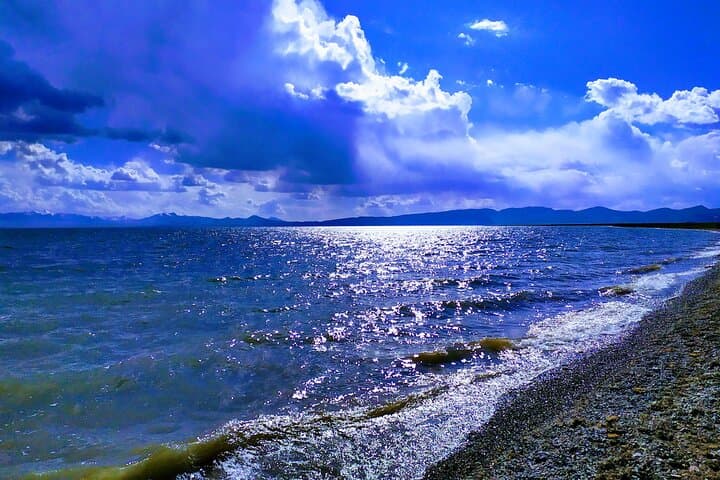
Morning light pours over alpine grass as you crest the pass toward Son-Kul: wind-gnarled horses graze on a broad, blue mirror set at roughly 3,000 m, and yurts punctuate the skyline like temporary villages. The tour threads Kyrgyzstan’s two signature water worlds—Son-Kul’s remote summer pastures and Issyk-Kul’s vast, saline basin—offering contrasts of solitude and scale.
Morning light pours over alpine grass as you crest the pass toward Son-Kul: wind-gnarled horses graze on a broad, blue mirror set at roughly 3,000 m, and yurts punctuate the skyline like temporary villages. The tour threads Kyrgyzstan’s two signature water worlds—Son-Kul’s remote summer pastures and Issyk-Kul’s vast, saline basin—offering contrasts of solitude and scale.
Son-Kul sits on high summer pastures where nomadic life is still practiced; families bring flocks to graze and host overnight in felt yurts. Geologically, Son-Kul is a tectonic basin ringed by ridgelines, while Issyk-Kul is a large, high-altitude saline lake (around 1,600 m elevation) that stays unfrozen year-round, fed by mountain streams and framed by the Tien Shan. Both places carry layers of Silk Road and nomadic history—ancient routes and seasonal migrations shaped the culture you’ll see: horseback riders, cheese-making, and felt craft.
Practically, expect long drives on mixed paved and gravel roads, some rough passes that feel remote, and simple yurt accommodation. Altitude and sun are the constant considerations—thin air and intense UV. Bring layered clothing, sun and wind protection, a refillable water bottle, and sturdy boots. Plan for 3 days of active travel: short hikes, horseback options, cultural stops, and photography windows at dawn and dusk. Local guides manage permits and route choices; summer is the best season for open pastures and accessible passes. Arrive prepared, travel with respect for grazing lands, and you’ll leave with wide skies, quiet shores, and a clear sense of Kyrgyz nomadic landscape.