THE ADVENTURE COLLECTIVE® · Independent discovery and booking for outdoor travel

Step into Beng Mealea’s overgrown corridors where roots pry at ancient stone and village roads open like a prelude. This private half-day tour pairs a scenic countryside drive with two hours to explore a 12th‑century temple largely reclaimed by jungle.
Step into Beng Mealea’s overgrown corridors where roots pry at ancient stone and village roads open like a prelude. This private half-day tour pairs a scenic countryside drive with two hours to explore a 12th‑century temple largely reclaimed by jungle.
You arrive by narrow, shaded road and the heat of the countryside falls away; a thin mist hangs where stone meets undergrowth and tree roots have become scaffolding. Beng Mealea opens like a half-forgotten stage—crumbling sandstone blocks, collapsed galleries, and corridors where roots grip and pry at centuries of masonry. Birdsong threads the silence; a guide’s voice pinpoints carved motifs and architectural quirks while you move through rooms that light and shadow still claim for themselves.
Verified experiences and guided adventures in the surrounding area.
Operated by Bayon Guide · Siem Reap, Siem Reap Province
You arrive by narrow, shaded road and the heat of the countryside falls away; a thin mist hangs where stone meets undergrowth and tree roots have become scaffolding. Beng Mealea opens like a half-forgotten stage—crumbling sandstone blocks, collapsed galleries, and corridors where roots grip and pry at centuries of masonry. Birdsong threads the silence; a guide’s voice pinpoints carved motifs and architectural quirks while you move through rooms that light and shadow still claim for themselves.
Built in the early 12th century around the reign of Suryavarman II, Beng Mealea shares the Angkor-era plan and style but was left largely unrestored, which is why nature appears to have its own conservation plan. The temple sits on laterite and sandstone, its blocks bearing lichen and tool marks that tell stories of quarrying and ancient logistics. The road to Beng Mealea cuts through rice paddies and village life—water buffalo, wooden houses, and roadside stalls selling cold coconut or sticky rice—offering an unvarnished look at rural Cambodia.
For practical travel: expect uneven ground, fallen stones, and roots; allow about 2 hours on-site plus driving time—this private half-day tour runs 3–4 hours total. Morning light is softer for photos; late afternoon offers warmer tones but more insects. Wear grippy shoes, bring water and insect repellent, and keep a respectful distance from fragile carvings. The tour includes air-conditioned transport and an English-speaking guide, which simplifies logistics and local interpretation. Beng Mealea rewards slow exploration: move deliberately, look up at the roots, and let the place reveal its quiet, weathered stories.
easy.
3–4 hours.
Suitable for travelers in average condition who can walk 1–2 miles over uneven terrain and negotiate stairs and low walls.
On this private half-day tour you’ll spend roughly 2 hours exploring the temple, with the full experience (pickup, drive, return) taking about 3–4 hours.
Entrance requirements can change—most visitors use an Angkor pass for nearby sites; your tour provider will confirm ticketing and admission procedures at booking.
Yes, but expect uneven ground and some climbing; children and seniors should move carefully and may prefer shorter exploration loops.
Facilities are limited near the temple; use hotel facilities before departure and carry snacks or cash for vendors encountered en route.
Beng Mealea dates to the early 12th century and reflects Angkor-era architecture similar to Angkor Wat; unlike more restored temples, much of its structure remains collapsed and overgrown.
The site’s overgrowth both protects and stresses fragile stonework; visitors should avoid climbing on delicate areas and follow guide instructions to minimize impact.
Bayon Guide operates guided outdoor trips and adventures with an emphasis on safety, stewardship, and memorable experiences.
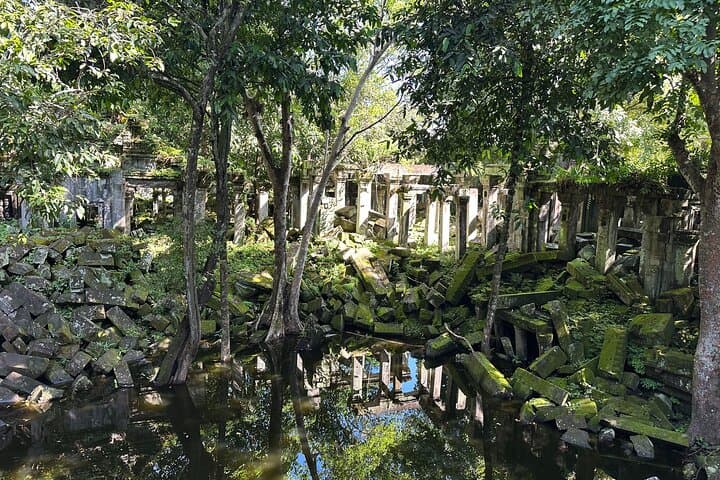


You arrive by narrow, shaded road and the heat of the countryside falls away; a thin mist hangs where stone meets undergrowth and tree roots have become scaffolding. Beng Mealea opens like a half-forgotten stage—crumbling sandstone blocks, collapsed galleries, and corridors where roots grip and pry at centuries of masonry. Birdsong threads the silence; a guide’s voice pinpoints carved motifs and architectural quirks while you move through rooms that light and shadow still claim for themselves.
You arrive by narrow, shaded road and the heat of the countryside falls away; a thin mist hangs where stone meets undergrowth and tree roots have become scaffolding. Beng Mealea opens like a half-forgotten stage—crumbling sandstone blocks, collapsed galleries, and corridors where roots grip and pry at centuries of masonry. Birdsong threads the silence; a guide’s voice pinpoints carved motifs and architectural quirks while you move through rooms that light and shadow still claim for themselves.
Built in the early 12th century around the reign of Suryavarman II, Beng Mealea shares the Angkor-era plan and style but was left largely unrestored, which is why nature appears to have its own conservation plan. The temple sits on laterite and sandstone, its blocks bearing lichen and tool marks that tell stories of quarrying and ancient logistics. The road to Beng Mealea cuts through rice paddies and village life—water buffalo, wooden houses, and roadside stalls selling cold coconut or sticky rice—offering an unvarnished look at rural Cambodia.
For practical travel: expect uneven ground, fallen stones, and roots; allow about 2 hours on-site plus driving time—this private half-day tour runs 3–4 hours total. Morning light is softer for photos; late afternoon offers warmer tones but more insects. Wear grippy shoes, bring water and insect repellent, and keep a respectful distance from fragile carvings. The tour includes air-conditioned transport and an English-speaking guide, which simplifies logistics and local interpretation. Beng Mealea rewards slow exploration: move deliberately, look up at the roots, and let the place reveal its quiet, weathered stories.