THE ADVENTURE COLLECTIVE® · Independent discovery and booking for outdoor travel

Move slowly through a 90-minute private Tai Chi class in Beijing that teaches a 9-step form, standing meditation, push-hands and basic self-massage. Ideal for beginners seeking gentle movement and an introduction to Taoist principles behind the practice.
Move slowly through a 90-minute private Tai Chi class in Beijing that teaches a 9-step form, standing meditation, push-hands and basic self-massage. Ideal for beginners seeking gentle movement and an introduction to Taoist principles behind the practice.
Before the sun fully lifts over a Beijing park, a small group moves in slow, deliberate arcs—arms tracing circles, feet finding rhythm on cracked concrete. The class begins with breathing and standing meditation; the city hums beyond the trees while instructors guide subtle shifts that create balance in body and attention.
Verified experiences and guided adventures in the surrounding area.
Operated by Beijing San Feng Tai Chi Club · Beijing, Beijing
Before the sun fully lifts over a Beijing park, a small group moves in slow, deliberate arcs—arms tracing circles, feet finding rhythm on cracked concrete. The class begins with breathing and standing meditation; the city hums beyond the trees while instructors guide subtle shifts that create balance in body and attention.
Tai Chi (taijiquan) is rooted in Chinese internal martial arts and Taoist ideas of Yin–Yang and Qi. The practice on offer is beginner-focused: a 9-step form to learn core gestures, standing meditation to tune posture, basic push-hands to feel partner sensitivity, and simple self-massage techniques for everyday tension relief. The format reflects modern urban teaching—short, methodical progressions aimed at relaxation, balance, and joint mobility rather than combat.
Expect an accessible pace and practical cultural framing: instructors often explain Taoist concepts that underlie the movements and how Taoist breathing principles inform timing. Beijing’s parks are traditional learning grounds, and mornings bring a mix of elders, joggers, and tai chi groups sharing space.
Practical guidance: the class is 90 minutes and rated easy—no prior experience required. Wear loose, flat-soled shoes and breathable layers; bring water and check Beijing’s air quality index on high-smog days. Arrive 10–15 minutes early to warm up and meet your instructor. Be prepared for gentle partner exercises (push hands) that require respect and clear communication. If mobility or balance is limited, notify the teacher—most exercises have low-impact options. This session is as much cultural orientation as movement practice: you’ll leave with a compact set of techniques to practice on your own and a clearer sense of how Taoist ideas shape tai chi’s economy of motion.
easy.
1.5 hours.
Suitable for all fitness levels; requires basic balance and ability to stand and move slowly for extended periods
No—this class is designed for beginners and teaches a step-by-step 9-step form plus basic standing meditation and push-hands.
Push-hands is a partnered sensitivity drill to feel and redirect force; you will likely practice with one partner under instructor guidance and with clear safety cues.
The activity is labeled easy and suitable for most ages; notify the instructor of mobility or balance concerns for modifications.
Classes are often taught in parks or studios; organizers may move indoors or cancel if weather or AQI is poor—check the booking terms for policies.
Tai Chi evolved in China as an internal martial art with strong links to Taoist philosophy and the interplay of yin and yang; modern public practice became widespread in urban parks during the 20th century.
Practice quietly and follow park rules—keeping to paths and avoiding litter helps preserve shared green spaces for daily public use.
Beijing San Feng Tai Chi Club operates guided outdoor trips and adventures with an emphasis on safety, stewardship, and memorable experiences.


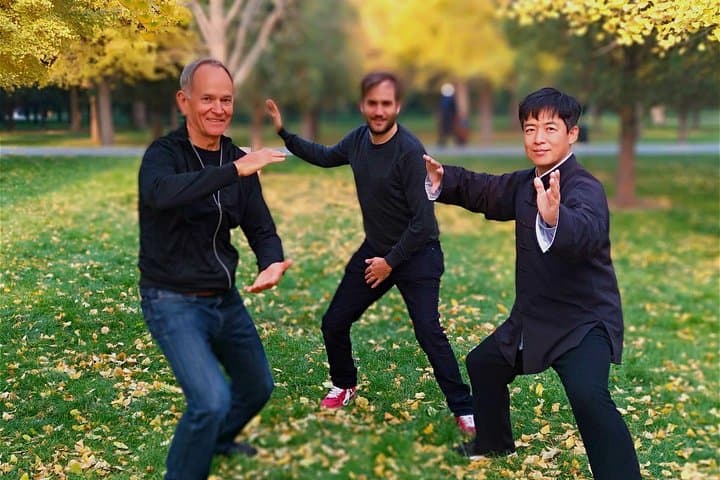

Before the sun fully lifts over a Beijing park, a small group moves in slow, deliberate arcs—arms tracing circles, feet finding rhythm on cracked concrete. The class begins with breathing and standing meditation; the city hums beyond the trees while instructors guide subtle shifts that create balance in body and attention.
Before the sun fully lifts over a Beijing park, a small group moves in slow, deliberate arcs—arms tracing circles, feet finding rhythm on cracked concrete. The class begins with breathing and standing meditation; the city hums beyond the trees while instructors guide subtle shifts that create balance in body and attention.
Tai Chi (taijiquan) is rooted in Chinese internal martial arts and Taoist ideas of Yin–Yang and Qi. The practice on offer is beginner-focused: a 9-step form to learn core gestures, standing meditation to tune posture, basic push-hands to feel partner sensitivity, and simple self-massage techniques for everyday tension relief. The format reflects modern urban teaching—short, methodical progressions aimed at relaxation, balance, and joint mobility rather than combat.
Expect an accessible pace and practical cultural framing: instructors often explain Taoist concepts that underlie the movements and how Taoist breathing principles inform timing. Beijing’s parks are traditional learning grounds, and mornings bring a mix of elders, joggers, and tai chi groups sharing space.
Practical guidance: the class is 90 minutes and rated easy—no prior experience required. Wear loose, flat-soled shoes and breathable layers; bring water and check Beijing’s air quality index on high-smog days. Arrive 10–15 minutes early to warm up and meet your instructor. Be prepared for gentle partner exercises (push hands) that require respect and clear communication. If mobility or balance is limited, notify the teacher—most exercises have low-impact options. This session is as much cultural orientation as movement practice: you’ll leave with a compact set of techniques to practice on your own and a clearer sense of how Taoist ideas shape tai chi’s economy of motion.