THE ADVENTURE COLLECTIVE® · Independent discovery and booking for outdoor travel

Step into Georgian Bath with guides who wear period costume and tell the city’s stories with wit, role play, and scholarly detail. This private 90–120 minute walking tour covers major landmarks and trades theatricality for historical insight.
Step into Georgian Bath with guides who wear period costume and tell the city’s stories with wit, role play, and scholarly detail. This private 90–120 minute walking tour covers major landmarks and trades theatricality for historical insight.
You meet outside the carved west front of Bath Abbey under a sky that curls like old paper. Two guides—Alasdair and Theresa—appear in Regency coats and empire-waist gowns, the fabric quiet against Bath’s honeyed stone. They don’t just point out facades; they animate the city: a street corner becomes an assembly room, a shopfront a flirtation, and the river Avon dares you to imagine the carriage roads where social fortunes turned.
Verified experiences and guided adventures in the surrounding area.
Operated by Bath Walking Tours Foodie Tours · Bath, Somerset
You meet outside the carved west front of Bath Abbey under a sky that curls like old paper. Two guides—Alasdair and Theresa—appear in Regency coats and empire-waist gowns, the fabric quiet against Bath’s honeyed stone. They don’t just point out facades; they animate the city: a street corner becomes an assembly room, a shopfront a flirtation, and the river Avon dares you to imagine the carriage roads where social fortunes turned.
Bath’s story is written in limestone. The city rose where hot springs pierced Jurassic oolite; Roman engineers channelled those waters and left a ritual core that Georgian builders reworked into an elegant stage. John Wood’s terraces and the Royal Crescent define a civic performance of class and aspiration, and Jane Austen, living here between 1801–1806, captured that choreography—its chatter, its calculations, its comic cruelty.
On this private 90–120 minute walk the guides blend costume, role-play, and historian’s rigor. You’ll pass the Roman Baths (entry not included), the sweep of the Circus, the manicured parade of Milsom Street, and pockets of quieter life—tea rooms and narrow alleys where Austen might have glanced at a prospect. The tour is deliberately flexible; the route is shaped to your group’s curiosity and the weather’s temperament.
Practicalities are simple: meet at the Abbey entrance adjacent to the Roman Baths, wear comfortable shoes, and expect roughly 1.5–2 miles (2.5–3.5 km) of easy walking with negligible elevation. The guides are wheelchair-accessible and the program suits a wide range of fitness levels. Because they perform in costume for effect, you can request a non-costumed historian for a more conventional briefing.
Bring a light jacket—Bath’s microclimate turns quickly—and allow extra time if you plan to visit the Roman Baths afterward; the tour does not include entry. Booking ahead is recommended during summer and bank holidays when the city hums and photography opportunities are crowded.
What the itinerary gives you beyond facts is texture: the rustle of a silk skirt becomes a cue to explain Regency etiquette; a dark doorway reveals how class and commerce braided the city’s fortunes. Whether you’re a Janeite tracing a favorite phrase or a first-time visitor wanting the architecture explained without museum distance, this guided walk makes history conversational and practical—an active, human map of Bath’s social landscape.
easy.
1.5–2 hours.
Suitable for most visitors who can walk 1.5–2 miles on mostly flat city pavements
No, the tour passes the Roman Baths and explains their history from outside; entry requires a separate ticket and time slot.
Yes—this is a private group tour. The guides may accommodate specific start or end points by arrangement.
Alasdair and Theresa typically perform in Regency costume for a theatrical experience, but non-costumed local historians are available on request.
The meeting point and most streets are accessible; guides note that some narrow passages and historic surfaces may present challenges—contact the operator to discuss specific needs.
Expect about 1.5–2 miles of easy walking across mostly flat, paved streets; it’s suitable for most fitness levels.
Tours are delivered in English; inquire about other language options when booking.
Bath grew around hot springs exploited by Romans and was reshaped into a fashionable Georgian city where Jane Austen lived and observed social life firsthand.
Bath’s limestone buildings require active conservation; visitors can help by staying on paths, respecting private courtyards, and supporting local museums and conservation charities.
Bath Walking Tours Foodie Tours operates guided outdoor trips and adventures with an emphasis on safety, stewardship, and memorable experiences.
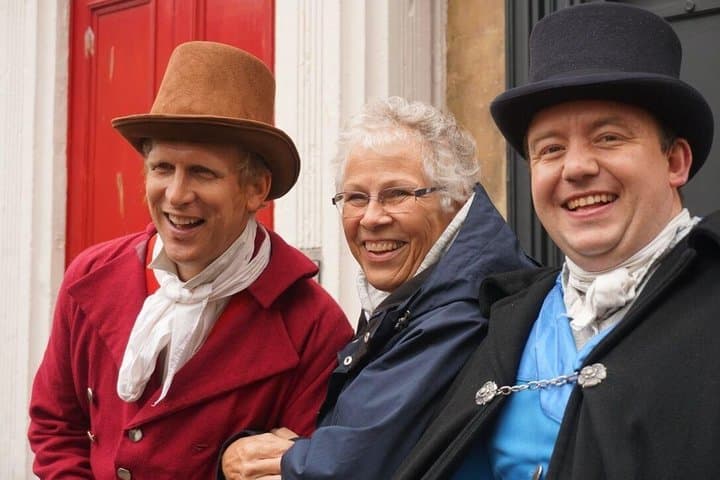
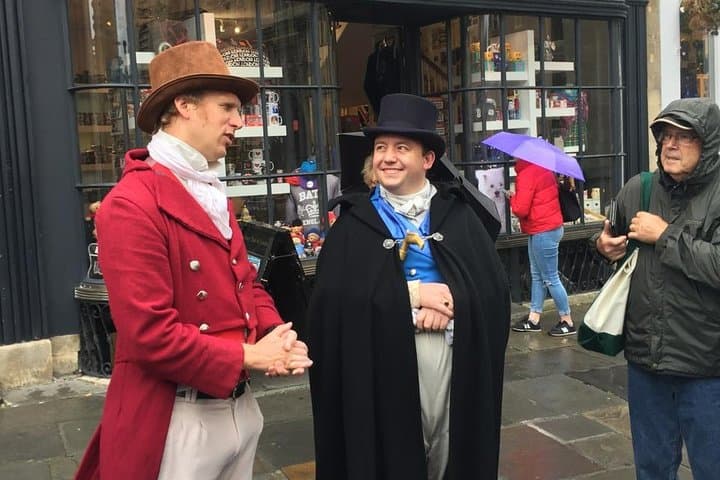
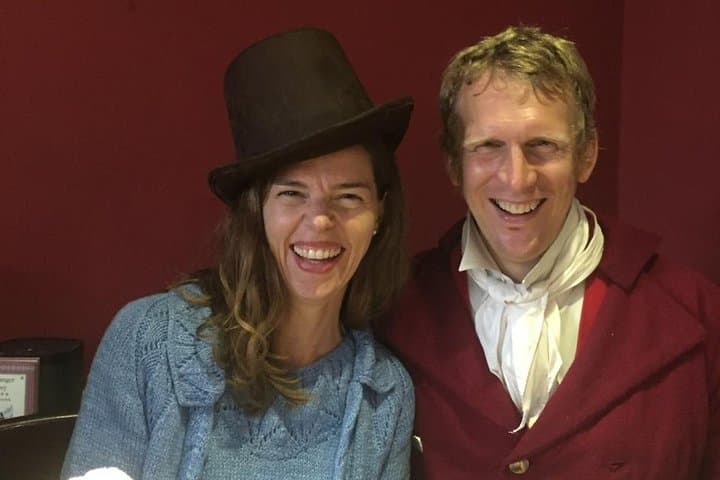
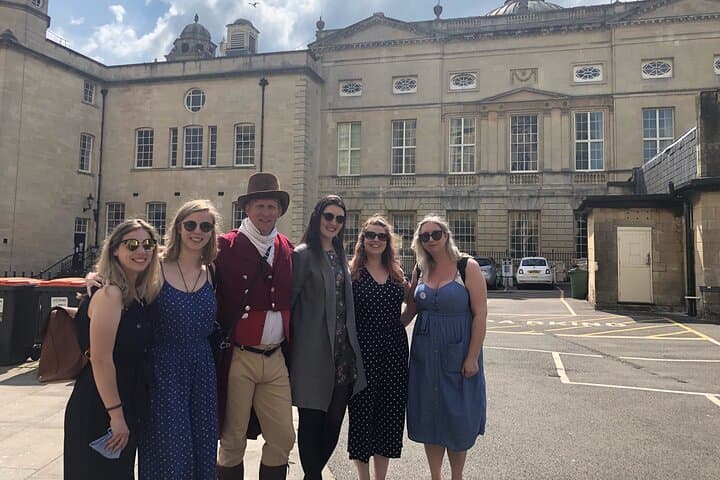
You meet outside the carved west front of Bath Abbey under a sky that curls like old paper. Two guides—Alasdair and Theresa—appear in Regency coats and empire-waist gowns, the fabric quiet against Bath’s honeyed stone. They don’t just point out facades; they animate the city: a street corner becomes an assembly room, a shopfront a flirtation, and the river Avon dares you to imagine the carriage roads where social fortunes turned.
You meet outside the carved west front of Bath Abbey under a sky that curls like old paper. Two guides—Alasdair and Theresa—appear in Regency coats and empire-waist gowns, the fabric quiet against Bath’s honeyed stone. They don’t just point out facades; they animate the city: a street corner becomes an assembly room, a shopfront a flirtation, and the river Avon dares you to imagine the carriage roads where social fortunes turned.
Bath’s story is written in limestone. The city rose where hot springs pierced Jurassic oolite; Roman engineers channelled those waters and left a ritual core that Georgian builders reworked into an elegant stage. John Wood’s terraces and the Royal Crescent define a civic performance of class and aspiration, and Jane Austen, living here between 1801–1806, captured that choreography—its chatter, its calculations, its comic cruelty.
On this private 90–120 minute walk the guides blend costume, role-play, and historian’s rigor. You’ll pass the Roman Baths (entry not included), the sweep of the Circus, the manicured parade of Milsom Street, and pockets of quieter life—tea rooms and narrow alleys where Austen might have glanced at a prospect. The tour is deliberately flexible; the route is shaped to your group’s curiosity and the weather’s temperament.
Practicalities are simple: meet at the Abbey entrance adjacent to the Roman Baths, wear comfortable shoes, and expect roughly 1.5–2 miles (2.5–3.5 km) of easy walking with negligible elevation. The guides are wheelchair-accessible and the program suits a wide range of fitness levels. Because they perform in costume for effect, you can request a non-costumed historian for a more conventional briefing.
Bring a light jacket—Bath’s microclimate turns quickly—and allow extra time if you plan to visit the Roman Baths afterward; the tour does not include entry. Booking ahead is recommended during summer and bank holidays when the city hums and photography opportunities are crowded.
What the itinerary gives you beyond facts is texture: the rustle of a silk skirt becomes a cue to explain Regency etiquette; a dark doorway reveals how class and commerce braided the city’s fortunes. Whether you’re a Janeite tracing a favorite phrase or a first-time visitor wanting the architecture explained without museum distance, this guided walk makes history conversational and practical—an active, human map of Bath’s social landscape.