THE ADVENTURE COLLECTIVE® · Independent discovery and booking for outdoor travel

Banteay Chhmar is a remote, powerful remnant of Jayavarman VII’s Angkor-era reach. This full-day private tour from Siem Reap pairs rugged archaeology with quiet rural scenes — best for travelers ready for a long day and uneven temple walks.
Banteay Chhmar is a remote, powerful remnant of Jayavarman VII’s Angkor-era reach. This full-day private tour from Siem Reap pairs rugged archaeology with quiet rural scenes — best for travelers ready for a long day and uneven temple walks.
You arrive before the crowds, the road giving way to red-dust tracks and rice paddies that seem to watch as you pass. The moat rounds the temple like a patient guard; stone faces peer from towers with a slow, watchful grace. Wind moves across the Baray and tugs at tall reeds, as if encouraging you to step closer.
Verified experiences and guided adventures in the surrounding area.
Operated by Day Trip Cambodia · Banteay Chhmar, Banteay Meanchey Province
You arrive before the crowds, the road giving way to red-dust tracks and rice paddies that seem to watch as you pass. The moat rounds the temple like a patient guard; stone faces peer from towers with a slow, watchful grace. Wind moves across the Baray and tugs at tall reeds, as if encouraging you to step closer.
Built under Jayavarman VII in the late 12th–early 13th century, Banteay Chhmar is one of the Khmer Empire’s largest and least-deciphered complexes. Sandstone and laterite walls hold bas-reliefs of warriors, processions and celestial dancers — fragments of a political and devotional landscape that once linked temples, shrines and reservoirs. Geologically, the site uses regional laterite foundations with transported sandstone blocks, leaving exposed weathering patterns that tell the story of centuries of monsoon and sun.
Local village life frames the visit: children guiding water buffalo, households cultivating the Baray’s margins, and oral histories about the crown prince once honored here. Facilities are basic — the site remains partly conserved rather than fully restored, which is part of its appeal and its fragility.
Practical guidance: expect a long day (roughly 9–12 hours door-to-door from Siem Reap). Walking is on uneven paths and temple stone; bring sturdy shoes, sun protection, insect repellent and cash for entrance and local purchases. Move respectfully around shrine areas and follow your guide; some sections are under conservation and are restricted. Timing a visit for morning light will reward you with crisper relief in the carvings and cooler temperatures for exploring the Baray and satellite shrines.
moderate.
9–12 hours (door-to-door from Siem Reap).
Moderate fitness — must be able to walk on uneven ground for several hours and tolerate a long vehicle transfer.
Typical operator schedules list about a 3-hour drive each way, making this a 9–12 hour round trip including site time.
Entrance fees are charged at the site and are usually payable in cash (riel or USD); confirm with your tour operator if they include tickets.
No — many paths and temple areas have uneven stones and steps; accessibility is limited and requires assistance in most sections.
Private tours commonly provide English-speaking guides; confirm availability of other languages when booking.
Constructed under Jayavarman VII in the late 12th–early 13th century, Banteay Chhmar was a regional administrative and devotional center with shrines honoring royalty and the Khmer army.
The complex is partially conserved and remains fragile; responsible visitation helps protect carved reliefs and local ecosystems while supporting ongoing restoration efforts.
Day Trip Cambodia operates guided outdoor trips and adventures with an emphasis on safety, stewardship, and memorable experiences.
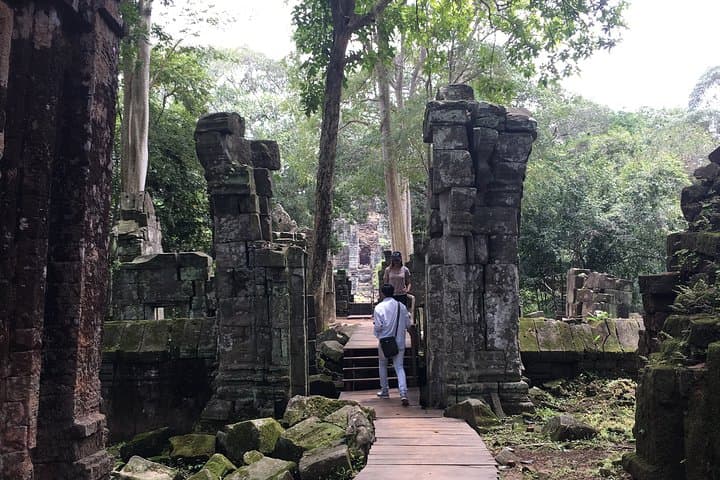
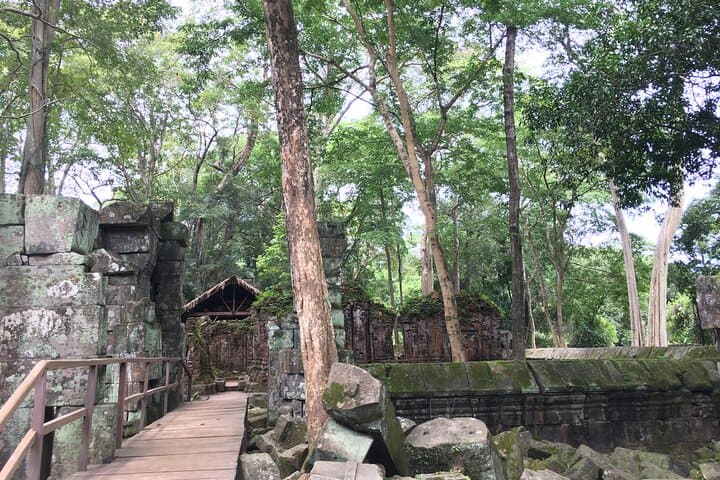
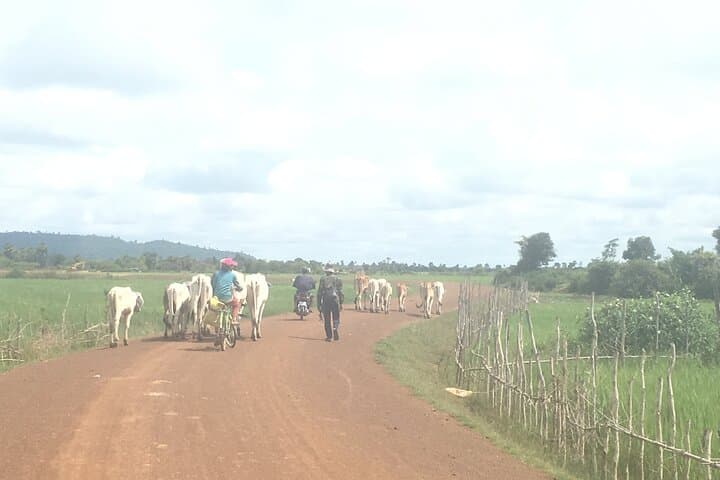
You arrive before the crowds, the road giving way to red-dust tracks and rice paddies that seem to watch as you pass. The moat rounds the temple like a patient guard; stone faces peer from towers with a slow, watchful grace. Wind moves across the Baray and tugs at tall reeds, as if encouraging you to step closer.
You arrive before the crowds, the road giving way to red-dust tracks and rice paddies that seem to watch as you pass. The moat rounds the temple like a patient guard; stone faces peer from towers with a slow, watchful grace. Wind moves across the Baray and tugs at tall reeds, as if encouraging you to step closer.
Built under Jayavarman VII in the late 12th–early 13th century, Banteay Chhmar is one of the Khmer Empire’s largest and least-deciphered complexes. Sandstone and laterite walls hold bas-reliefs of warriors, processions and celestial dancers — fragments of a political and devotional landscape that once linked temples, shrines and reservoirs. Geologically, the site uses regional laterite foundations with transported sandstone blocks, leaving exposed weathering patterns that tell the story of centuries of monsoon and sun.
Local village life frames the visit: children guiding water buffalo, households cultivating the Baray’s margins, and oral histories about the crown prince once honored here. Facilities are basic — the site remains partly conserved rather than fully restored, which is part of its appeal and its fragility.
Practical guidance: expect a long day (roughly 9–12 hours door-to-door from Siem Reap). Walking is on uneven paths and temple stone; bring sturdy shoes, sun protection, insect repellent and cash for entrance and local purchases. Move respectfully around shrine areas and follow your guide; some sections are under conservation and are restricted. Timing a visit for morning light will reward you with crisper relief in the carvings and cooler temperatures for exploring the Baray and satellite shrines.