THE ADVENTURE COLLECTIVE® · Independent discovery and booking for outdoor travel

Drive from Baku to the volcanic desert and stand before rock art older than written history, steaming mud volcanoes, and a hill that burns without end. This full-day private tour combines Gobustan’s petroglyphs, mud cones, Ateshgah Fire Temple and Yanardag for a concentrated look at Azerbaijan’s elemental landscapes.
Drive from Baku to the volcanic desert and stand before rock art older than written history, steaming mud volcanoes, and a hill that burns without end. This full-day private tour combines Gobustan’s petroglyphs, mud cones, Ateshgah Fire Temple and Yanardag for a concentrated look at Azerbaijan’s elemental landscapes.
The van eases away from Baku's coastal boulevard while the Caspian slips past like a sheet of pewter. For an hour the city recedes—blocky Soviet apartment faces give way to low scrub and flat salt-pan country—until the road climbs into the volcanic desert of Gobustan and the landscape begins to speak in stone.
Verified experiences and guided adventures in the surrounding area.
Operated by Baku Tour Packages · Baku, Baku
The van eases away from Baku's coastal boulevard while the Caspian slips past like a sheet of pewter. For an hour the city recedes—blocky Soviet apartment faces give way to low scrub and flat salt-pan country—until the road climbs into the volcanic desert of Gobustan and the landscape begins to speak in stone.
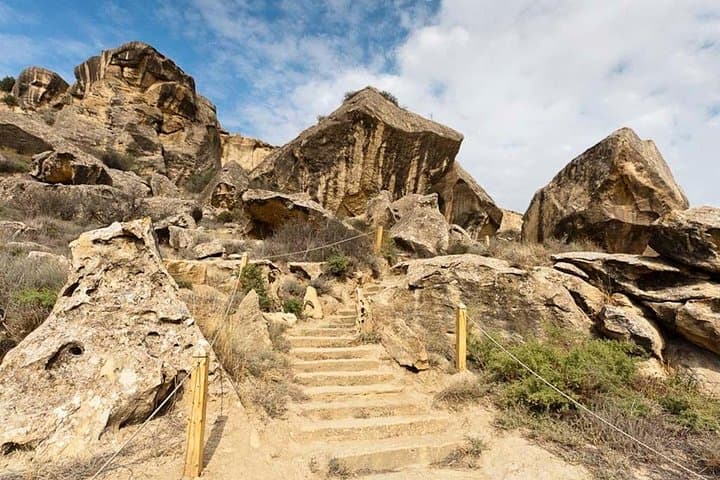
You step out onto a plate of sunbaked rock and the first thing you notice is how human the place feels: grooves and stick-figure hunters carved four millennia ago, herds of grazing animals frozen mid-stride. Gobustan’s petroglyphs, protected inside the State Historical-Artistic Reserve and a UNESCO World Heritage site since 2007, are not scenic props but conversations—images left by Neolithic people about hunting, boats, and ritual life. The short trails here are rocky and exposed, with gentle climbs totaling only a few hundred meters, but each panel rewards patient scanning.
A short drive brings the mud volcanoes—Azerbaijan hosts nearly half of the world's mud cones. They are geological mouths, belching cool mud and, occasionally, flame when trapped hydrocarbons ignite. The ground is soft, the colors raw: rust-red clays, pearly gray mud, and steam that rises like breath. Respect the hazard signs; edges can be unstable and vents unpredictable.
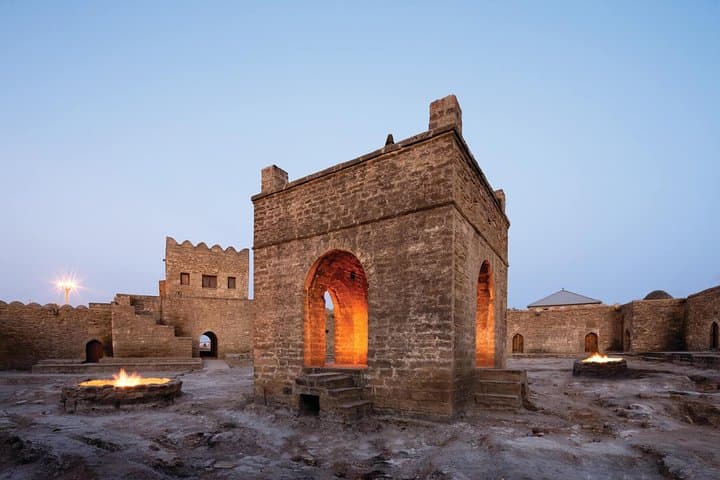
The afternoon pivots from geology to culture. Ateshgah, the Fire Temple of Surakhani, is a cross-cultural site where Zoroastrian fire-worship mingled with Hindu merchant influence. Its stone courtyard and hexagonal altar feel more modern than ancient—the temple you see dates to the 17th–19th centuries—but the rituals it represents reach deeper into the region’s identity as a place permanently lit by subterranean gas.
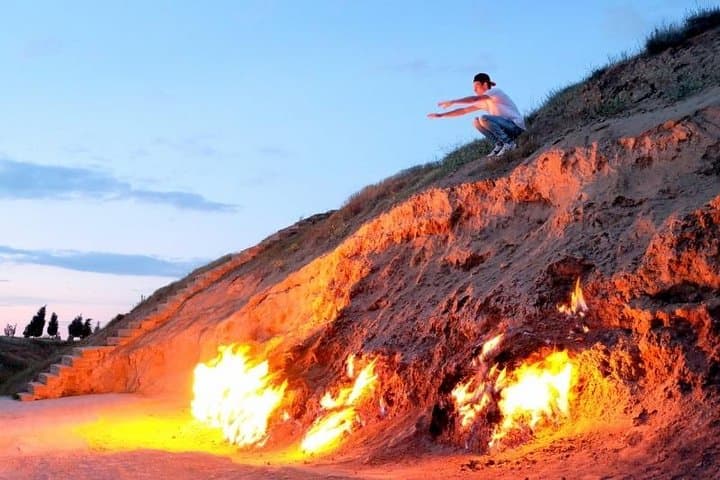
Yanardag, or Fire Mountain, is a final, cinematic stop: a cliffside seam of natural gas that has burned for decades. Standing before that orange ribbon of flame is to experience a landscape that literally refuses to go dark. On return to Baku you pass Bibi-Heybat Mosque, a 20th-century reconstruction on a medieval site, which offers a quieter closure to a day of elemental spectacle.
Practical notes: this is a 7–8 hour private tour with hotel pickup and all entrance fees included. Expect several short walks—most sites require 10–40 minutes of on-foot exploration on uneven terrain. Bring sun protection, 1.5–2 liters of water, sturdy shoes, and a light wind layer; conditions shift quickly between sun-baked flats and breezy coastlines. If you’re prone to motion sickness, the southbound road has rolling stretches; take medication beforehand.
Logistics are straightforward: the tour is suitable for most fitness levels, runs year-round, and is best scheduled early in the day during summer to avoid the strongest heat. Guides typically allow time for photos, visits to small on-site museums, and a relaxed pace between attractions—ideal for travelers who want geology, archaeology, and a tactile sense of the land in a single full day.
moderate.
7–8 hours.
Basic fitness for walking short, uneven trails and getting in/out of vehicles throughout the day
The trip lasts about 7–8 hours (420–480 minutes) including hotel pickup and drop-off in central Baku.
Yes—this private tour includes all entrance fees to Gobustan, Ateshgah and Yanardag as listed in the itinerary.
Yes; the tour is rated suitable for all fitness levels, but be aware of uneven terrain and open flames at Yanardag and mud volcanoes.
Mud volcanoes typically emit mud and gas; flames are less common but have occurred historically—Yanardag is the reliably burning site.
No meals are included. Guides usually schedule a break where you can buy snacks or eat in a local café—bring energy bars for convenience.
The operator’s policy allows full refund if canceled at least 24 hours before departure; check with the supplier for last-minute weather-related changes.
Gobustan preserves petroglyphs spanning Paleolithic to medieval periods; the region’s natural gas seeps shaped both ritual practice and trade routes for centuries.
Sites are protected reserves—stick to marked trails, avoid touching rock art, and carry out any litter; local authorities monitor foot traffic to limit erosion.
Baku Tour Packages operates guided outdoor trips and adventures with an emphasis on safety, stewardship, and memorable experiences.
The van eases away from Baku's coastal boulevard while the Caspian slips past like a sheet of pewter. For an hour the city recedes—blocky Soviet apartment faces give way to low scrub and flat salt-pan country—until the road climbs into the volcanic desert of Gobustan and the landscape begins to speak in stone.
The van eases away from Baku's coastal boulevard while the Caspian slips past like a sheet of pewter. For an hour the city recedes—blocky Soviet apartment faces give way to low scrub and flat salt-pan country—until the road climbs into the volcanic desert of Gobustan and the landscape begins to speak in stone.
You step out onto a plate of sunbaked rock and the first thing you notice is how human the place feels: grooves and stick-figure hunters carved four millennia ago, herds of grazing animals frozen mid-stride. Gobustan’s petroglyphs, protected inside the State Historical-Artistic Reserve and a UNESCO World Heritage site since 2007, are not scenic props but conversations—images left by Neolithic people about hunting, boats, and ritual life. The short trails here are rocky and exposed, with gentle climbs totaling only a few hundred meters, but each panel rewards patient scanning.
A short drive brings the mud volcanoes—Azerbaijan hosts nearly half of the world's mud cones. They are geological mouths, belching cool mud and, occasionally, flame when trapped hydrocarbons ignite. The ground is soft, the colors raw: rust-red clays, pearly gray mud, and steam that rises like breath. Respect the hazard signs; edges can be unstable and vents unpredictable.
The afternoon pivots from geology to culture. Ateshgah, the Fire Temple of Surakhani, is a cross-cultural site where Zoroastrian fire-worship mingled with Hindu merchant influence. Its stone courtyard and hexagonal altar feel more modern than ancient—the temple you see dates to the 17th–19th centuries—but the rituals it represents reach deeper into the region’s identity as a place permanently lit by subterranean gas.
Yanardag, or Fire Mountain, is a final, cinematic stop: a cliffside seam of natural gas that has burned for decades. Standing before that orange ribbon of flame is to experience a landscape that literally refuses to go dark. On return to Baku you pass Bibi-Heybat Mosque, a 20th-century reconstruction on a medieval site, which offers a quieter closure to a day of elemental spectacle.
Practical notes: this is a 7–8 hour private tour with hotel pickup and all entrance fees included. Expect several short walks—most sites require 10–40 minutes of on-foot exploration on uneven terrain. Bring sun protection, 1.5–2 liters of water, sturdy shoes, and a light wind layer; conditions shift quickly between sun-baked flats and breezy coastlines. If you’re prone to motion sickness, the southbound road has rolling stretches; take medication beforehand.
Logistics are straightforward: the tour is suitable for most fitness levels, runs year-round, and is best scheduled early in the day during summer to avoid the strongest heat. Guides typically allow time for photos, visits to small on-site museums, and a relaxed pace between attractions—ideal for travelers who want geology, archaeology, and a tactile sense of the land in a single full day.