THE ADVENTURE COLLECTIVE® · Independent discovery and booking for outdoor travel

Step behind Broadway’s marquees with a small group and a professional guide. In 90 minutes you’ll walk Shubert Alley, peer into storied lobbies like the New Amsterdam, and learn where today’s stars are discovered.
Step behind Broadway’s marquees with a small group and a professional guide. In 90 minutes you’ll walk Shubert Alley, peer into storied lobbies like the New Amsterdam, and learn where today’s stars are discovered.
You meet beside the bronze of George M. Cohan and the city’s neon takes a breath — lights leaning in, traffic murmuring like a restless audience. For 90 minutes a small group threads the blocks of Broadway: under marquee arcs, down the narrow drama of Shubert Alley, and into the quieter lobbies where plaster angels still watch opening nights.
Verified experiences and guided adventures in the surrounding area.
Operated by Unscripted Tours · New York, NY
You meet beside the bronze of George M. Cohan and the city’s neon takes a breath — lights leaning in, traffic murmuring like a restless audience. For 90 minutes a small group threads the blocks of Broadway: under marquee arcs, down the narrow drama of Shubert Alley, and into the quieter lobbies where plaster angels still watch opening nights.
Broadway is urban geology as much as culture: a dense cluster of early 20th‑century theaters built on landfill and ambition, later reshaped by developers, producers, and the Shubert brothers who turned single stages into an industry. The tour mixes those institutional histories with neighborhood color — Sardi’s caricatures and 54 Below’s low‑ceilinged cabaret — showing how restaurants and bars doubled as scouting grounds for talent.
Expect storyteller guides who balance archival facts with backstage lore: anecdotes about the New Amsterdam’s Disney-era rebirth, rituals that mark dressing rooms, and where to snag last‑minute house seats. The walk covers roughly a half‑mile with stops inside or just outside historic theater lobbies; most surfaces are flat but there are curbs and steps.
Practical guidance: arrive at the statue on 7th Avenue and 46th Street 10 minutes early, bring a charged phone for mobile tickets, and wear comfortable shoes for standing. If you’ve got an evening curtain, your guide can point you toward the theater entrance and best door for cast sightlines. This is a compact, history‑rich way to read the city’s stagecraft and plan a night out informed by the people who work it.
moderate.
1–2 hours.
Suitable for travelers who can stand and walk short distances in an urban setting; moderate fitness recommended for frequent stops and standing.
Yes — meeting point and most stops are wheelchair accessible; notify the operator of special requirements when booking.
No — this is a walking and backstage‑story tour; individual show tickets are not provided but guides can advise on last‑minute options.
Yes — strollers are allowed and the material suits older children, though some anecdotes may be more adult‑oriented.
If you have tickets for an evening performance, the guide will direct you to the appropriate theater entrance at tour end to make curtain time easier.
Broadway grew as a theater district in the early 1900s; the Shubert brothers and producers concentrated stages within a few blocks, creating the commercial hub we recognize today.
The theater district relies on public transit and pedestrian flows — favoring mass transit over cars reduces street congestion and supports local small businesses; please avoid littering in historic lobbies.
Unscripted Tours operates guided outdoor trips and adventures with an emphasis on safety, stewardship, and memorable experiences.
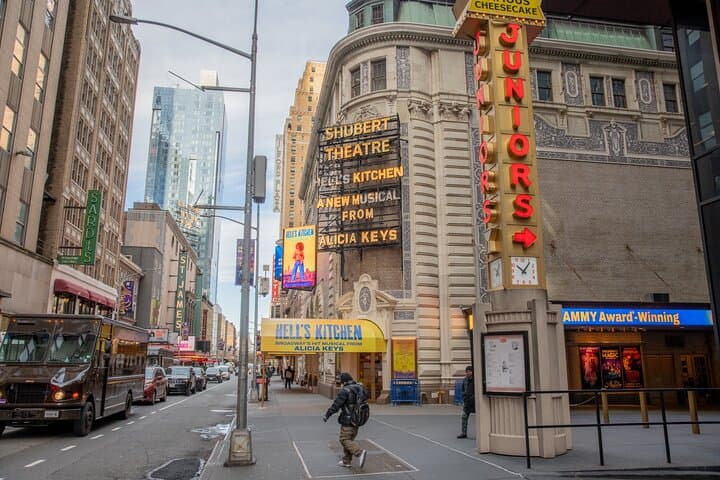
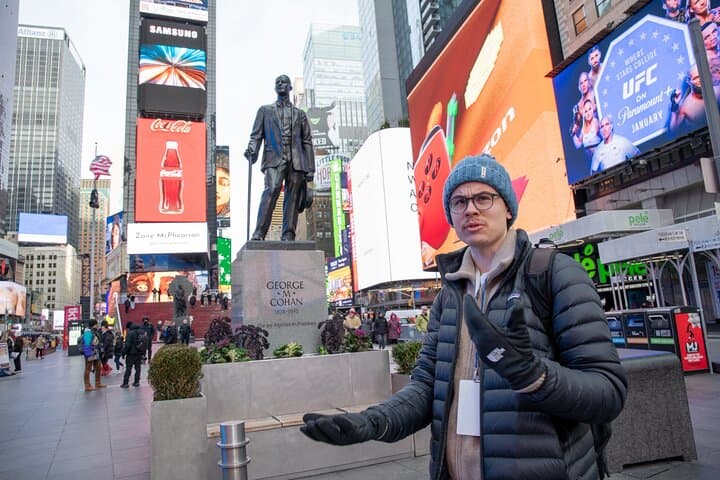

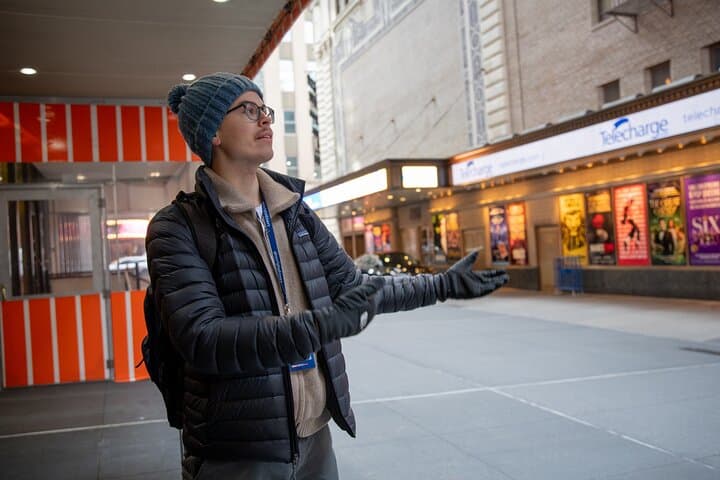
You meet beside the bronze of George M. Cohan and the city’s neon takes a breath — lights leaning in, traffic murmuring like a restless audience. For 90 minutes a small group threads the blocks of Broadway: under marquee arcs, down the narrow drama of Shubert Alley, and into the quieter lobbies where plaster angels still watch opening nights.
You meet beside the bronze of George M. Cohan and the city’s neon takes a breath — lights leaning in, traffic murmuring like a restless audience. For 90 minutes a small group threads the blocks of Broadway: under marquee arcs, down the narrow drama of Shubert Alley, and into the quieter lobbies where plaster angels still watch opening nights.
Broadway is urban geology as much as culture: a dense cluster of early 20th‑century theaters built on landfill and ambition, later reshaped by developers, producers, and the Shubert brothers who turned single stages into an industry. The tour mixes those institutional histories with neighborhood color — Sardi’s caricatures and 54 Below’s low‑ceilinged cabaret — showing how restaurants and bars doubled as scouting grounds for talent.
Expect storyteller guides who balance archival facts with backstage lore: anecdotes about the New Amsterdam’s Disney-era rebirth, rituals that mark dressing rooms, and where to snag last‑minute house seats. The walk covers roughly a half‑mile with stops inside or just outside historic theater lobbies; most surfaces are flat but there are curbs and steps.
Practical guidance: arrive at the statue on 7th Avenue and 46th Street 10 minutes early, bring a charged phone for mobile tickets, and wear comfortable shoes for standing. If you’ve got an evening curtain, your guide can point you toward the theater entrance and best door for cast sightlines. This is a compact, history‑rich way to read the city’s stagecraft and plan a night out informed by the people who work it.