THE ADVENTURE COLLECTIVE® · Independent discovery and booking for outdoor travel

Combine cinematic charm and subterranean wonder on a three-day loop from Auckland to Hobbiton’s movie set and the Waitomo glowworm caves. This guided tour pairs easy, well-marked walks with instructive local interpretation—ideal for travelers wanting hands-on access without heavy hiking.
Combine cinematic charm and subterranean wonder on a three-day loop from Auckland to Hobbiton’s movie set and the Waitomo glowworm caves. This guided tour pairs easy, well-marked walks with instructive local interpretation—ideal for travelers wanting hands-on access without heavy hiking.
You step off the coach into pastoral Waikato air: green pastures slope away to round hills, sheep graze under the watchful Party Tree replica and the road hums faintly toward limestone country. The Hobbiton Movie Set sits like a stage set made whole—hobbit holes, a mill, and the Green Dragon—while further inland Waitomo’s caves wait below the surface, thousands of glowworms puncturing darkness like a low, deliberate constellation.
Verified experiences and guided adventures in the surrounding area.
Operated by Leisure Tours · Matamata, Waikato
You step off the coach into pastoral Waikato air: green pastures slope away to round hills, sheep graze under the watchful Party Tree replica and the road hums faintly toward limestone country. The Hobbiton Movie Set sits like a stage set made whole—hobbit holes, a mill, and the Green Dragon—while further inland Waitomo’s caves wait below the surface, thousands of glowworms puncturing darkness like a low, deliberate constellation.
The route threads colonial farming history with deeper Māori connection to these lands. The rolling volcanic soils that shaped Matamata are part of the greater Central North Island volcanic field; limestone in Waitomo was laid down millions of years ago and sculpted by subterranean rivers into caverns and stalactite formations. Culturally, both sites operate as careful interpretations of place: Hobbiton as a reconstructed film set on private farmland, Waitomo as a conserved cave system with guided access negotiated with local iwi and landowners.
On a practical level this is an easy, guided multi-day itinerary: most of the tour’s walking is on maintained paths—expect a 3-hour guided Hobbiton visit and roughly 1.5–2 hours in Ruakuri/Waitomo cave walkways. Wear sturdy shoes for uneven surfaces, a warm layer for cool cave air, and bring a compact rain jacket for changeable Waikato weather. Allow time between stops for rural driving (Auckland–Matamata ~2 hours; Matamata–Waitomo ~1 hour). Photography is welcomed outside the caves; follow guide rules inside. Bring cash or card for optional lunches and souvenir ales at Hobbiton, and respect biosecurity and guided-route restrictions to help protect fragile cave formations and farmland.
easy.
3 days (approx. 72 hours including transfers).
Minimal fitness required; participants should be able to walk 1–2 hours on uneven ground and climb short stair sections.
The guided Hobbiton Movie Set visit is approximately 3 hours and includes entry and a drink at the Green Dragon; lunch is extra.
The itinerary includes a guided visit to the Ruakuri/Waitomo cave system with its limestone features and glowworm displays; time in the caves is typically around 1.5–2 hours.
The tour notes stroller and wheelchair accessibility in parts; however some cave sections include steps—check accessibility details with the operator for specific needs.
Yes—airport pickup, in-vehicle air conditioning, and two nights’ accommodation in Auckland are included as stated in the itinerary.
Matamata and Waitomo sit on lands long used by Māori iwi; the caves have been significant for travel and resource use, and the Hobbiton set was built on working farmland for film production.
Waitomo caves are fragile—guided access limits impact and prevents damage to formations and glowworm habitats; visitors are asked to stick to paths and follow guide instructions.
Leisure Tours operates guided outdoor trips and adventures with an emphasis on safety, stewardship, and memorable experiences.
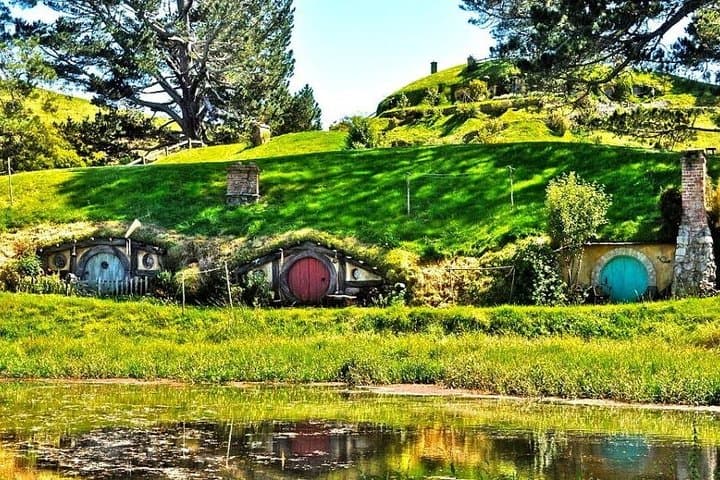



You step off the coach into pastoral Waikato air: green pastures slope away to round hills, sheep graze under the watchful Party Tree replica and the road hums faintly toward limestone country. The Hobbiton Movie Set sits like a stage set made whole—hobbit holes, a mill, and the Green Dragon—while further inland Waitomo’s caves wait below the surface, thousands of glowworms puncturing darkness like a low, deliberate constellation.
You step off the coach into pastoral Waikato air: green pastures slope away to round hills, sheep graze under the watchful Party Tree replica and the road hums faintly toward limestone country. The Hobbiton Movie Set sits like a stage set made whole—hobbit holes, a mill, and the Green Dragon—while further inland Waitomo’s caves wait below the surface, thousands of glowworms puncturing darkness like a low, deliberate constellation.
The route threads colonial farming history with deeper Māori connection to these lands. The rolling volcanic soils that shaped Matamata are part of the greater Central North Island volcanic field; limestone in Waitomo was laid down millions of years ago and sculpted by subterranean rivers into caverns and stalactite formations. Culturally, both sites operate as careful interpretations of place: Hobbiton as a reconstructed film set on private farmland, Waitomo as a conserved cave system with guided access negotiated with local iwi and landowners.
On a practical level this is an easy, guided multi-day itinerary: most of the tour’s walking is on maintained paths—expect a 3-hour guided Hobbiton visit and roughly 1.5–2 hours in Ruakuri/Waitomo cave walkways. Wear sturdy shoes for uneven surfaces, a warm layer for cool cave air, and bring a compact rain jacket for changeable Waikato weather. Allow time between stops for rural driving (Auckland–Matamata ~2 hours; Matamata–Waitomo ~1 hour). Photography is welcomed outside the caves; follow guide rules inside. Bring cash or card for optional lunches and souvenir ales at Hobbiton, and respect biosecurity and guided-route restrictions to help protect fragile cave formations and farmland.