THE ADVENTURE COLLECTIVE® · Independent discovery and booking for outdoor travel

Experience world-class stargazing in the Atacama Desert with EVScope-assisted viewing and astrophotography. This private 2‑hour night tour pairs technological optics with the desert’s famously clear skies.
Experience world-class stargazing in the Atacama Desert with EVScope-assisted viewing and astrophotography. This private 2‑hour night tour pairs technological optics with the desert’s famously clear skies.
The desert night takes charge as soon as the sun drops behind the volcanoes — the sky sharpens and the Milky Way dares you to look closer. On a private San Pedro de Atacama astronomical tour you stand on a salt-stiff plain or low scrub, the air so dry it seems to peel away atmospheric haze, while guides set up EVScopes that bring nebulae and galaxies forward in surprising color.
Verified experiences and guided adventures in the surrounding area.
Operated by Whim Travel · San Pedro de Atacama, Antofagasta Region
The desert night takes charge as soon as the sun drops behind the volcanoes — the sky sharpens and the Milky Way dares you to look closer. On a private San Pedro de Atacama astronomical tour you stand on a salt-stiff plain or low scrub, the air so dry it seems to peel away atmospheric haze, while guides set up EVScopes that bring nebulae and galaxies forward in surprising color.
The Atacama’s clarity is geological: a rain-shadowed basin between the Andes and the Coastal Cordillera, with soil and salt flats carved by ancient lakes and volcanic ash. Human history here stretches from the Atacameño peoples, who read the heavens for planting and ritual, to nineteenth-century mining outposts — cultural layers that add quiet context to a night under the stars.
Practically, the tour is about pairing technology with place. EVScopes magnify and photograph deep-sky objects in real time, so even novices leave with images. Guides often point out constellations used by indigenous cosmologies and explain how altitude (San Pedro ≈2,400 m) and aridity sharpen views.
Expect brisk nights: temperatures fall quickly, so dress in insulated layers and bring a headlamp with a red filter. Cameras are welcome — guides can advise on exposure and framing — but avoid bright screens and flash photography during viewing. Tours typically start around 9:00 p.m. and run two hours; small-group or private formats mean plenty of time at each instrument.
If you want photogenic horizons, ask about vantage points with salt-lake reflections or volcanic silhouettes. The experience is equal parts science and place — cold, silent desert and an assertive, colorful sky that rewards patience and curiosity.
easy.
2 hours.
Minimal fitness required; participants should be able to walk short distances over flat or compacted desert surface and stand for extended viewing.
The experience runs about two hours and commonly departs from the meeting point around 9:00 p.m.; exact start time is confirmed after booking.
Yes — the tour is rated easy and suitable for most fitness levels; however, participants should be able to stand and walk short distances over flat terrain.
Yes — EVScope technology allows live viewing and captures color images of nebulae and galaxies; guides typically include individual or group photography as part of the experience.
Tours may be canceled if weather prevents observations; this operator's policy states all sales are final, and cancellations for bad weather are possible per booking terms.
The Atacama has been home to Atacameño (Likan Antai) communities for millennia, who integrated celestial observations into agricultural and ritual calendars.
The high desert is ecologically fragile; limit light pollution, pack out waste, and follow guide instructions to protect salt flats and native vegetation.
Whim Travel operates guided outdoor trips and adventures with an emphasis on safety, stewardship, and memorable experiences.
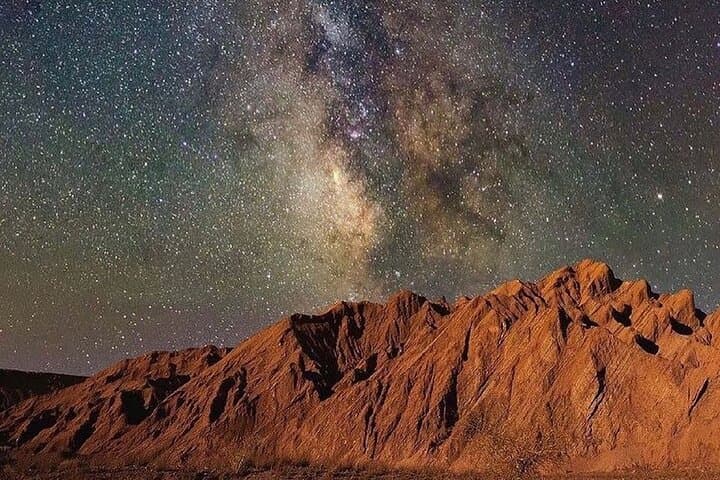


The desert night takes charge as soon as the sun drops behind the volcanoes — the sky sharpens and the Milky Way dares you to look closer. On a private San Pedro de Atacama astronomical tour you stand on a salt-stiff plain or low scrub, the air so dry it seems to peel away atmospheric haze, while guides set up EVScopes that bring nebulae and galaxies forward in surprising color.
The desert night takes charge as soon as the sun drops behind the volcanoes — the sky sharpens and the Milky Way dares you to look closer. On a private San Pedro de Atacama astronomical tour you stand on a salt-stiff plain or low scrub, the air so dry it seems to peel away atmospheric haze, while guides set up EVScopes that bring nebulae and galaxies forward in surprising color.
The Atacama’s clarity is geological: a rain-shadowed basin between the Andes and the Coastal Cordillera, with soil and salt flats carved by ancient lakes and volcanic ash. Human history here stretches from the Atacameño peoples, who read the heavens for planting and ritual, to nineteenth-century mining outposts — cultural layers that add quiet context to a night under the stars.
Practically, the tour is about pairing technology with place. EVScopes magnify and photograph deep-sky objects in real time, so even novices leave with images. Guides often point out constellations used by indigenous cosmologies and explain how altitude (San Pedro ≈2,400 m) and aridity sharpen views.
Expect brisk nights: temperatures fall quickly, so dress in insulated layers and bring a headlamp with a red filter. Cameras are welcome — guides can advise on exposure and framing — but avoid bright screens and flash photography during viewing. Tours typically start around 9:00 p.m. and run two hours; small-group or private formats mean plenty of time at each instrument.
If you want photogenic horizons, ask about vantage points with salt-lake reflections or volcanic silhouettes. The experience is equal parts science and place — cold, silent desert and an assertive, colorful sky that rewards patience and curiosity.