THE ADVENTURE COLLECTIVE® · Independent discovery and booking for outdoor travel

A full-day loop from Arequipa that pairs the Puruña stone forest with dramatic waterfalls and high-Andean puna. Expect dusty dirt roads, short walks on uneven volcanic terrain, and close views of vicuñas on the plains.
A full-day loop from Arequipa that pairs the Puruña stone forest with dramatic waterfalls and high-Andean puna. Expect dusty dirt roads, short walks on uneven volcanic terrain, and close views of vicuñas on the plains.
You step out of the van into cold, clear air and the high plain spreads away like a rough sea of stone. Wind whistles across volcanic spires, carving the Puruña rock forest into shapes that look almost deliberate—birds, faces, odd columns—each silhouette telling the story of long abrasion. The falls arrive as a sudden green cut through the puna: water forcing its way down terraces of lava and loose rock, dozens of small cascades scattering light and mist.
Verified experiences and guided adventures in the surrounding area.
Operated by AREQUIPA EXPLORER · Arequipa, Arequipa
You step out of the van into cold, clear air and the high plain spreads away like a rough sea of stone. Wind whistles across volcanic spires, carving the Puruña rock forest into shapes that look almost deliberate—birds, faces, odd columns—each silhouette telling the story of long abrasion. The falls arrive as a sudden green cut through the puna: water forcing its way down terraces of lava and loose rock, dozens of small cascades scattering light and mist.
This full-day loop from Arequipa threads together geology, pastoral history and high-Andean wildlife. The rock forest owes its forms to volcanic ash and ignimbrite sculpted over millennia by wind and freeze-thaw. Pampa Cañahuas sits on the open plain where colonial and pre-Columbian herding traditions converged; here vicuñas and alpacas graze the short, salty grasses. Pampa de Arrieros adds human texture — an offbeat village with stone corrals and a ghostly feel from past caravan routes.
Expect long dirt-road drives at 3,500–4,200 m elevation, a short 20-minute walk across uneven terrain to explore the rock formations, and a steeper, rocky descent to view the main waterfall. Terrain is loose, often dusty; trails are informal rather than engineered.
Practical edge: acclimatize in Arequipa beforehand, carry 2–3 liters of water, sun protection and warm layers for wind and sudden temperature swings. Good ankle-support shoes and trekking poles make the 20–40 minute on-foot sections far easier. The day rewards with dramatic geological forms, frequent camelids, and a clear sense of the Andes’ raw shaping forces.
moderate.
10–11 hours.
Moderate fitness — comfortable being on your feet for short hikes, able to tolerate long vehicle transfers and high altitude.
The tour is a full day (about 10–11 hours) and includes several drives into the high plain; total driving time can be several hours round trip depending on stops.
Infants may be carried but the operator does not recommend the trip for pregnant travelers or those with serious heart issues due to altitude and uneven terrain.
Yes—Pampa Cañahuas is a reserve area where vicuñas, alpacas and llamas are commonly observed at relatively close range.
Walks are short (20–40 minutes) and on informal paths across volcanic rock; they are not technically difficult but can be uneven and require good footwear.
The area sits on volcanic deposits from Pliocene–Quaternary eruptions; pastoralism has shaped the puna for centuries with colonial-era corrals still visible.
The puna is ecologically fragile—stay on informal paths when possible, don’t feed wildlife, and respect grazing areas to limit disturbance.
AREQUIPA EXPLORER operates guided outdoor trips and adventures with an emphasis on safety, stewardship, and memorable experiences.
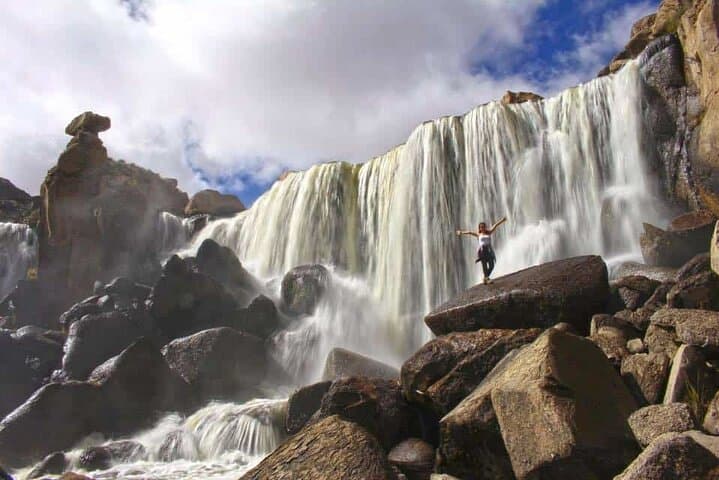


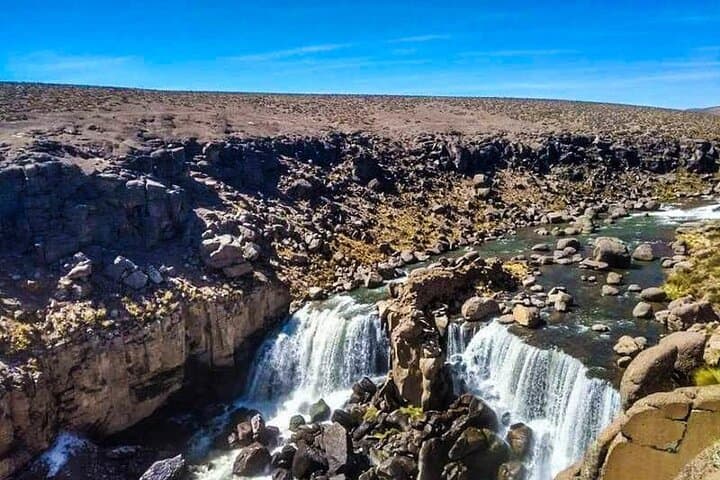
You step out of the van into cold, clear air and the high plain spreads away like a rough sea of stone. Wind whistles across volcanic spires, carving the Puruña rock forest into shapes that look almost deliberate—birds, faces, odd columns—each silhouette telling the story of long abrasion. The falls arrive as a sudden green cut through the puna: water forcing its way down terraces of lava and loose rock, dozens of small cascades scattering light and mist.
You step out of the van into cold, clear air and the high plain spreads away like a rough sea of stone. Wind whistles across volcanic spires, carving the Puruña rock forest into shapes that look almost deliberate—birds, faces, odd columns—each silhouette telling the story of long abrasion. The falls arrive as a sudden green cut through the puna: water forcing its way down terraces of lava and loose rock, dozens of small cascades scattering light and mist.
This full-day loop from Arequipa threads together geology, pastoral history and high-Andean wildlife. The rock forest owes its forms to volcanic ash and ignimbrite sculpted over millennia by wind and freeze-thaw. Pampa Cañahuas sits on the open plain where colonial and pre-Columbian herding traditions converged; here vicuñas and alpacas graze the short, salty grasses. Pampa de Arrieros adds human texture — an offbeat village with stone corrals and a ghostly feel from past caravan routes.
Expect long dirt-road drives at 3,500–4,200 m elevation, a short 20-minute walk across uneven terrain to explore the rock formations, and a steeper, rocky descent to view the main waterfall. Terrain is loose, often dusty; trails are informal rather than engineered.
Practical edge: acclimatize in Arequipa beforehand, carry 2–3 liters of water, sun protection and warm layers for wind and sudden temperature swings. Good ankle-support shoes and trekking poles make the 20–40 minute on-foot sections far easier. The day rewards with dramatic geological forms, frequent camelids, and a clear sense of the Andes’ raw shaping forces.