THE ADVENTURE COLLECTIVE® · Independent discovery and booking for outdoor travel

Climb the Arc de Triomphe terrace for one of Paris’s clearest panoramic views—Champs-Élysées below, Eiffel Tower to the left, and La Défense on the horizon. Priority tickets speed entry; visits take about 1–3 hours depending on lines and linger time.
Climb the Arc de Triomphe terrace for one of Paris’s clearest panoramic views—Champs-Élysées below, Eiffel Tower to the left, and La Défense on the horizon. Priority tickets speed entry; visits take about 1–3 hours depending on lines and linger time.
Standing on the stone rim of the Arc de Triomphe, the city opens in precise geometry: avenues fanning away like spokes, the Eiffel Tower puncturing the skyline to the southwest, La Défense rising to the west. The terrace is a wind-swept platform where the rhythm of Paris—cars humming, voices drifting—meets the weight of history beneath your feet.
Verified experiences and guided adventures in the surrounding area.
Operated by Trip Knox Ltd · Paris, Île-de-France
Standing on the stone rim of the Arc de Triomphe, the city opens in precise geometry: avenues fanning away like spokes, the Eiffel Tower puncturing the skyline to the southwest, La Défense rising to the west. The terrace is a wind-swept platform where the rhythm of Paris—cars humming, voices drifting—meets the weight of history beneath your feet.
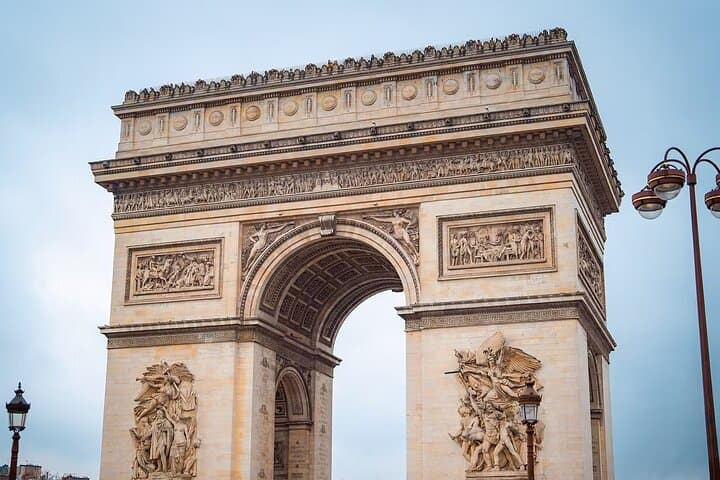
Commissioned by Napoleon after Austerlitz in 1806 and completed in 1836, the Arc marks military victories and lists names of generals. The Tomb of the Unknown Soldier lies at its base, its eternal flame a quiet counterpoint to the panoramic terrace above. Stone reliefs around the monument record scenes of 19th-century France; the monument itself sits at Place Charles de Gaulle at the western end of the Champs-Élysées.
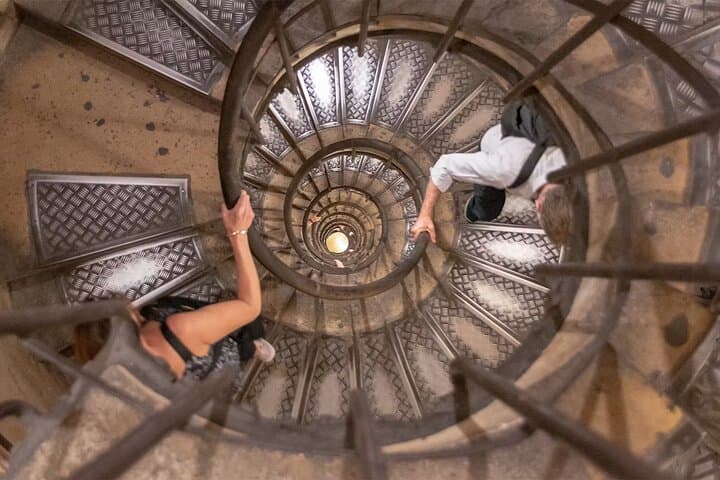
Expect a compact, urban climb: roughly 284 steps to the viewing platform and sweeping 360-degree sightlines across the Seine, Sacré-Cœur on Montmartre, and the grid of Parisian rooftops. Mornings and late afternoons offer the softest light; sunset draws crowds but delivers the strongest color. Security screening is standard, and priority entry minimizes wait times.
Practical tips: wear sturdy walking shoes for the staircase, bring a compact camera or binoculars, and layer for wind on the terrace. Peak season fills early—book advance tickets to secure a time slot. For travelers with reduced mobility, check accessibility options before arrival; parts of the site are historic and involve stairs. The Arc de Triomphe is short on trail but long on perspective: a quick, powerful way to read Paris from above.
easy.
1–3 hours.
Minimal cardiovascular fitness required; able to climb multiple flights of stairs
Plan 1 to 3 hours depending on lines, the time spent on the terrace, and whether you explore the base and memorial.
The terrace requires climbing many steps (about 284). Accessibility is limited—contact the operator in advance for current assistance options.
Yes—the Eiffel Tower is a prominent feature of the western skyline and is easily visible from the terrace on clear days.
Yes. Expect standard security screening before entry; avoid large bags to speed the process.
Commissioned by Napoleon in 1806 and completed in 1836, the Arc commemorates French military victories; the Tomb of the Unknown Soldier was added after World War I.
Ongoing stone conservation preserves carved reliefs and façades; visitors are asked to respect the memorial and avoid touching sensitive surfaces.
Trip Knox Ltd operates guided outdoor trips and adventures with an emphasis on safety, stewardship, and memorable experiences.


Standing on the stone rim of the Arc de Triomphe, the city opens in precise geometry: avenues fanning away like spokes, the Eiffel Tower puncturing the skyline to the southwest, La Défense rising to the west. The terrace is a wind-swept platform where the rhythm of Paris—cars humming, voices drifting—meets the weight of history beneath your feet.
Standing on the stone rim of the Arc de Triomphe, the city opens in precise geometry: avenues fanning away like spokes, the Eiffel Tower puncturing the skyline to the southwest, La Défense rising to the west. The terrace is a wind-swept platform where the rhythm of Paris—cars humming, voices drifting—meets the weight of history beneath your feet.
Commissioned by Napoleon after Austerlitz in 1806 and completed in 1836, the Arc marks military victories and lists names of generals. The Tomb of the Unknown Soldier lies at its base, its eternal flame a quiet counterpoint to the panoramic terrace above. Stone reliefs around the monument record scenes of 19th-century France; the monument itself sits at Place Charles de Gaulle at the western end of the Champs-Élysées.
Expect a compact, urban climb: roughly 284 steps to the viewing platform and sweeping 360-degree sightlines across the Seine, Sacré-Cœur on Montmartre, and the grid of Parisian rooftops. Mornings and late afternoons offer the softest light; sunset draws crowds but delivers the strongest color. Security screening is standard, and priority entry minimizes wait times.
Practical tips: wear sturdy walking shoes for the staircase, bring a compact camera or binoculars, and layer for wind on the terrace. Peak season fills early—book advance tickets to secure a time slot. For travelers with reduced mobility, check accessibility options before arrival; parts of the site are historic and involve stairs. The Arc de Triomphe is short on trail but long on perspective: a quick, powerful way to read Paris from above.