THE ADVENTURE COLLECTIVE® · Independent discovery and booking for outdoor travel

An eight-day trek from Pokhara to Poon Hill that delivers sunrise panoramas of the Annapurna range, traditional Gurung villages, and mixed forest-to-alpine terrain. Expect full days on stone steps, basic teahouses, and steady elevation gain to 3,210 m.
An eight-day trek from Pokhara to Poon Hill that delivers sunrise panoramas of the Annapurna range, traditional Gurung villages, and mixed forest-to-alpine terrain. Expect full days on stone steps, basic teahouses, and steady elevation gain to 3,210 m.
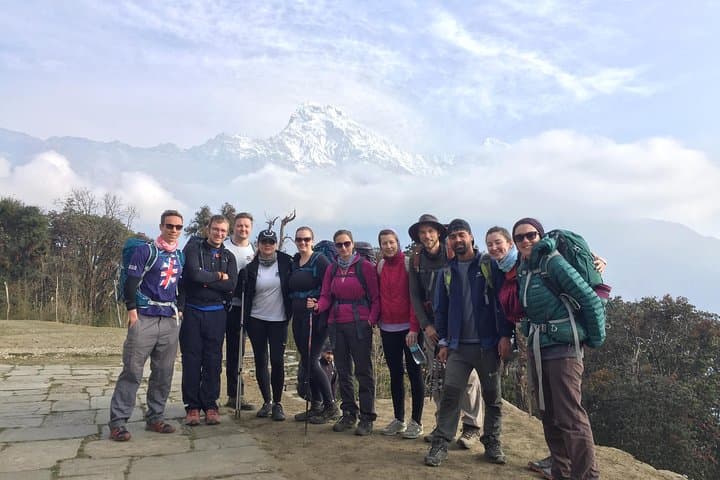
Dawn at Poon Hill arrives like a slow exhale: headlamps fade, the cold sky lightens, and Annapurna’s serrated ridgeline catches the first color. You watch layers of peaks clarify as rhododendron forests hush around you and the valley below holds its breath.
Verified experiences and guided adventures in the surrounding area.
Operated by Nepal Mountain Club Pvt Ltd · Pokhara, Gandaki Province
Dawn at Poon Hill arrives like a slow exhale: headlamps fade, the cold sky lightens, and Annapurna’s serrated ridgeline catches the first color. You watch layers of peaks clarify as rhododendron forests hush around you and the valley below holds its breath.
This eight-day circuit moves between Pokhara and Kathmandu, tracing old mule trails that have linked Gurung villages for centuries. Geologically, the Annapurna Massif is young Himalaya—steep metamorphic and sedimentary strata thrust skyward—so trails shift from terraced farmland into thick oak and rhododendron, then into stony alpine pastures as you climb toward Poon Hill (≈3,210 m).
Ghandruk and other villages provide cultural checkpoints: traditional Gurung houses, a small museum of local life, and highland farming rhythms that still hinge on seasonal migration and yak grazing. Wildlife is subtle but present—Himalayan thar on rocky slopes, and pheasants threading the understory.
Expect full-day hikes of 4–8 hours on stone steps and single-track, with early pre-dawn starts for the best summit views. Lodging is in teahouse-style guesthouses with basic beds and shared facilities; hot meals are available but carry a water purifier and cash for tips and snacks. Altitude gain is gradual, but acclimatize: keep hydrated, pace the climbs, and watch for headache or nausea.
Practical: pack warm layers for nights and pre-dawn summits, sturdy boots for uneven stone steps, and a headlamp for early starts. Timing is everything—clear autumn and spring mornings deliver the best visibility for Annapurna’s panorama.
moderate.
8 days (daily hikes 4–8 hours).
Moderate aerobic fitness recommended; comfortable walking on uneven stone steps and sustained uphill sections
Yes—Annapurna Conservation Area Permit (ACAP) and TIMS are required; tour operator usually arranges these before departure.
Poon Hill is accessible with steady walking and stairs; altitude is moderate but can affect those sensitive to higher elevations—acclimatize and monitor symptoms.
Teahouse guesthouses are basic: shared bathrooms, simple hot meals, and dorm or twin rooms; hotels are available in Pokhara and Kathmandu pre- and post-trek.
Autumn (Sept–Nov) and spring (Mar–May) offer the clearest views and stable weather; monsoon months bring heavy rain and winter brings snow at higher passes.
The trails follow centuries-old trans-Himalayan routes used by Gurung communities for trade and seasonal grazing, with villages preserving traditional architecture and festivals.
Annapurna is part of a managed conservation area; stick to trails, avoid single-use plastics, and buy local meals to support village economies.
Nepal Mountain Club Pvt Ltd operates guided outdoor trips and adventures with an emphasis on safety, stewardship, and memorable experiences.

Dawn at Poon Hill arrives like a slow exhale: headlamps fade, the cold sky lightens, and Annapurna’s serrated ridgeline catches the first color. You watch layers of peaks clarify as rhododendron forests hush around you and the valley below holds its breath.
Dawn at Poon Hill arrives like a slow exhale: headlamps fade, the cold sky lightens, and Annapurna’s serrated ridgeline catches the first color. You watch layers of peaks clarify as rhododendron forests hush around you and the valley below holds its breath.
This eight-day circuit moves between Pokhara and Kathmandu, tracing old mule trails that have linked Gurung villages for centuries. Geologically, the Annapurna Massif is young Himalaya—steep metamorphic and sedimentary strata thrust skyward—so trails shift from terraced farmland into thick oak and rhododendron, then into stony alpine pastures as you climb toward Poon Hill (≈3,210 m).
Ghandruk and other villages provide cultural checkpoints: traditional Gurung houses, a small museum of local life, and highland farming rhythms that still hinge on seasonal migration and yak grazing. Wildlife is subtle but present—Himalayan thar on rocky slopes, and pheasants threading the understory.
Expect full-day hikes of 4–8 hours on stone steps and single-track, with early pre-dawn starts for the best summit views. Lodging is in teahouse-style guesthouses with basic beds and shared facilities; hot meals are available but carry a water purifier and cash for tips and snacks. Altitude gain is gradual, but acclimatize: keep hydrated, pace the climbs, and watch for headache or nausea.
Practical: pack warm layers for nights and pre-dawn summits, sturdy boots for uneven stone steps, and a headlamp for early starts. Timing is everything—clear autumn and spring mornings deliver the best visibility for Annapurna’s panorama.