THE ADVENTURE COLLECTIVE® · Independent discovery and booking for outdoor travel

A focused seven-day tea-house trek from Pokhara to Annapurna Base Camp (4,130 m) that moves through Gurung villages, rhododendron forests, and the glacial amphitheatre of the Sanctuary. Expect steep stone trails, daily tea-house stays, and commanding mountain panoramas.
A focused seven-day tea-house trek from Pokhara to Annapurna Base Camp (4,130 m) that moves through Gurung villages, rhododendron forests, and the glacial amphitheatre of the Sanctuary. Expect steep stone trails, daily tea-house stays, and commanding mountain panoramas.
Dawn on the trail feels close to a different world: prayer flags snap on a ridge, the ravine below hisses with meltwater, and the Annapurna massif looms ahead, daring you up through pine and rhododendron.
Verified experiences and guided adventures in the surrounding area.
Operated by Happyland Treks · Pokhara, Gandaki Province
Dawn on the trail feels close to a different world: prayer flags snap on a ridge, the ravine below hisses with meltwater, and the Annapurna massif looms ahead, daring you up through pine and rhododendron.
This seven-day tea-house trek threads traditional Gurung villages, waterfalls, and high alpine bowl country to reach Annapurna Base Camp (4,130 m). Geologically, the route climbs from terraced farmland on low metamorphic rock into the glacially carved amphitheatre of the Annapurna Sanctuary—an open bowl ringed by jagged, snow-scoured ridgelines. Culturally the trek passes through Ghandruk, a Gurung stronghold with a small museum where local dress and music are preserved; trades like terrace farming and yak grazing remain visible daily.
Practical guide: expect 4–7 hours of walking most days, with steep stone staircases and muddy stretches after rain. The highest point is ABC at 4,130 m; acclimatize gradually—Deurali (≈2,945 m) to ABC is the longest altitude change. Tea houses provide simple rooms and hot meals; three cups of tea or coffee per day are commonly included. Permits (ACAP and TIMS) are required and usually arranged by operators. Porters are available to share loads; guide support helps with navigation and local logistics.
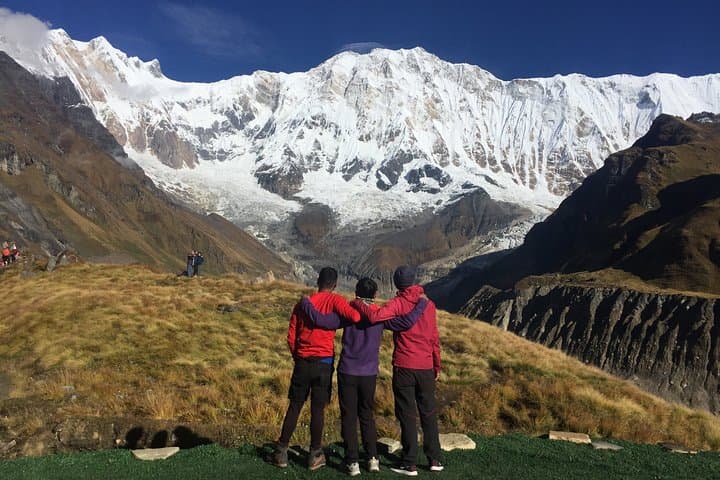
Hydrate and pace your ascent to reduce altitude risks; layers are essential as temperatures swing. The reward is immediate: a panorama of Annapurna I, Hiunchuli and Machapuchare that reads like a geology lesson and a challenge answered—raw, direct, and eminently reachable with preparation.
challenging.
6–7 days.
Good aerobic fitness with experience hiking 4–7 hours per day; comfortable on steep, rocky terrain and long descents.
Annapurna Conservation Area Permit (ACAP) and TIMS card are required; operators typically arrange these before or at the trailhead.
The route reaches 4,130 m at ABC; altitude effects are possible—allow gradual ascent, stay hydrated, and discuss symptoms with your guide.
Tea houses offer basic rooms with shared or private options, hot meals, and limited electricity; expect simple bedding and communal dining.
A guide is strongly recommended for navigation, local liaison, and safety; porters are common to share loads and speed up daily travel.
The Annapurna Sanctuary has long been inhabited and traveled by Gurung and Magar communities; the Annapurna Conservation Area (est. 1986) was Nepal's first conservation-managed cultural landscape.
Visitors enter a protected zone with ACAP fees that support trail maintenance, local conservation, and community development; minimize waste and use refillable containers.
Happyland Treks operates guided outdoor trips and adventures with an emphasis on safety, stewardship, and memorable experiences.

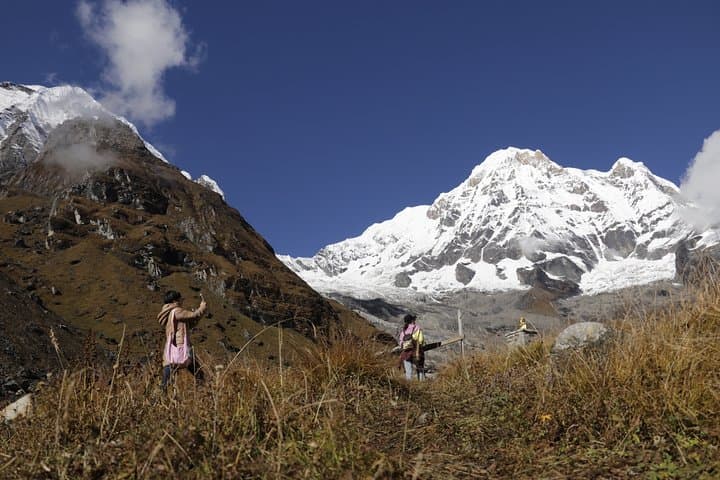

Dawn on the trail feels close to a different world: prayer flags snap on a ridge, the ravine below hisses with meltwater, and the Annapurna massif looms ahead, daring you up through pine and rhododendron.
Dawn on the trail feels close to a different world: prayer flags snap on a ridge, the ravine below hisses with meltwater, and the Annapurna massif looms ahead, daring you up through pine and rhododendron.
This seven-day tea-house trek threads traditional Gurung villages, waterfalls, and high alpine bowl country to reach Annapurna Base Camp (4,130 m). Geologically, the route climbs from terraced farmland on low metamorphic rock into the glacially carved amphitheatre of the Annapurna Sanctuary—an open bowl ringed by jagged, snow-scoured ridgelines. Culturally the trek passes through Ghandruk, a Gurung stronghold with a small museum where local dress and music are preserved; trades like terrace farming and yak grazing remain visible daily.
Practical guide: expect 4–7 hours of walking most days, with steep stone staircases and muddy stretches after rain. The highest point is ABC at 4,130 m; acclimatize gradually—Deurali (≈2,945 m) to ABC is the longest altitude change. Tea houses provide simple rooms and hot meals; three cups of tea or coffee per day are commonly included. Permits (ACAP and TIMS) are required and usually arranged by operators. Porters are available to share loads; guide support helps with navigation and local logistics.
Hydrate and pace your ascent to reduce altitude risks; layers are essential as temperatures swing. The reward is immediate: a panorama of Annapurna I, Hiunchuli and Machapuchare that reads like a geology lesson and a challenge answered—raw, direct, and eminently reachable with preparation.