THE ADVENTURE COLLECTIVE® · Independent discovery and booking for outdoor travel

Walk the harborfront and campus lanes of Annapolis on a focused two-hour tour that blends maritime life, colonial architecture, and military pageantry. Expect water views, photo stops, and insider stories about the Treaty of Paris and Washington’s resignation.
Walk the harborfront and campus lanes of Annapolis on a focused two-hour tour that blends maritime life, colonial architecture, and military pageantry. Expect water views, photo stops, and insider stories about the Treaty of Paris and Washington’s resignation.
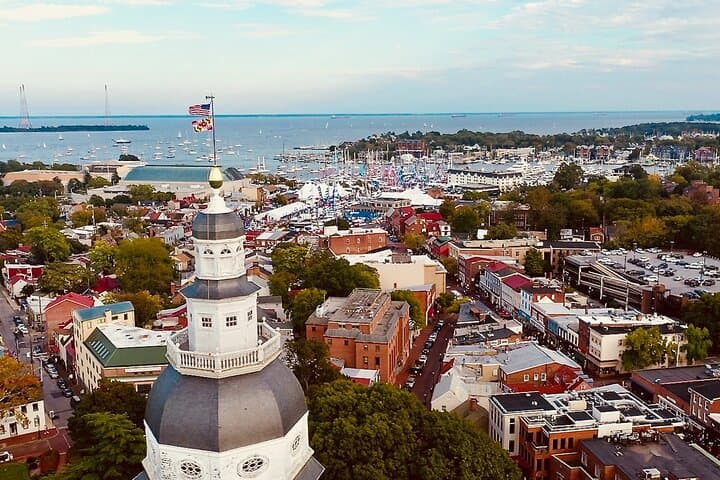
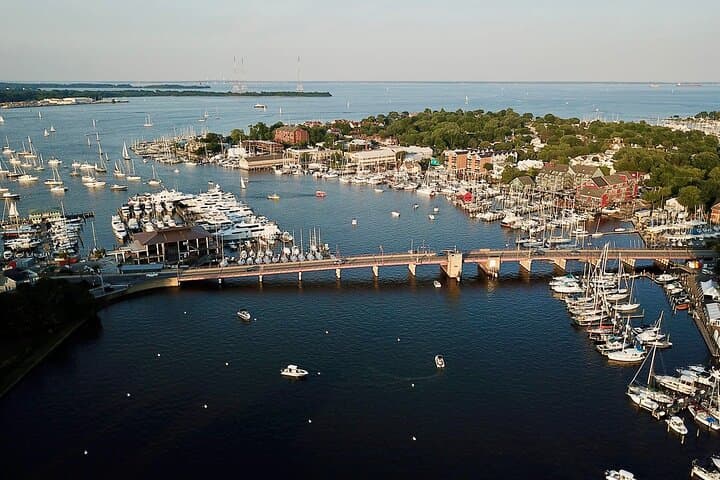
A salty wind slips through the rigging and cuts across the cobbles as the tour steps off from the west side of the Market House. The harbor hunches against the city—lobster boats and schooners bob like punctuation marks—and the Naval Academy’s spires puncture the skyline, a promise of stories both public and private. Over the next two hours the walking route threads Georgian facades, narrow alleys, and the broad marble face of the Maryland State House, each stop a chapter in a city that once hosted treaty signings and the resignation of George Washington.
Verified experiences and guided adventures in the surrounding area.
Operated by Michael · Annapolis, Maryland
A salty wind slips through the rigging and cuts across the cobbles as the tour steps off from the west side of the Market House. The harbor hunches against the city—lobster boats and schooners bob like punctuation marks—and the Naval Academy’s spires puncture the skyline, a promise of stories both public and private. Over the next two hours the walking route threads Georgian facades, narrow alleys, and the broad marble face of the Maryland State House, each stop a chapter in a city that once hosted treaty signings and the resignation of George Washington.
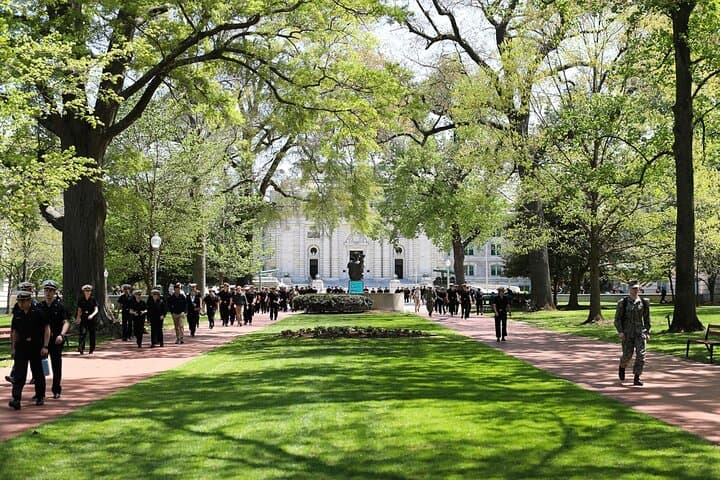
Annapolis is compact geology: a low-lying coastline where tidal forces shaped commerce and culture. The Severn River and the Chesapeake Bay pushed settlement inland while creating a nautical economy that endures. The State House (1772) is America’s oldest continuously used state capitol and a civic anchor; nearby, St. John’s College preserves a colonial campus frame and an education experiment dating to 1696. The Naval Academy’s parade ground and cathedral introduce a different American story—military discipline and maritime tradition—backed by stained glass, the crypt of John Paul Jones, and stories of midshipmen life.
Cultural color arrives in small things: seafood smoke from a waterfront restaurant, a shopkeeper repairing a brass binnacle, a docent pointing out carved fanlights above doorways. The city dock dares visitors to slow down and watch boats slip past Ego Alley, where captains nod to onlookers as if acknowledging an audience.
Practicalities are simple but important. Expect roughly 1.5–2 miles of mostly flat walking over cobbles and sidewalks with minimal elevation—an easy itinerary suited to a broad range of fitness levels. The tour meets at 25 Market Space; arrive 10 minutes early to grab a bench and orient yourself. Note: visitors 18 and older must present a REAL ID or U.S. passport to enter Naval Academy security checkpoints. The guide is open to customization and will take photos on request. Restroom stops are available at public houses and the Naval Academy visitor center (post-security).
For gear, bring comfortable walking shoes with good soles, a refillable water bottle, a compact camera or phone for harbor and architecture shots, and a light rain jacket depending on the forecast. Morning light makes for the best photos on the water; late afternoon softens brick and marble for portraits.
The route is wheelchair accessible on paved sections, but cobbles and docks can be uneven—call ahead if you need accommodations. With its mix of seafaring energy, civic history, and small‑town rhythms, this two-hour walk gives a clear, textured view of why Annapolis still looks and moves like a port city.
easy.
2 hours.
Suitable for most fitness levels; requires steady walking on flat to cobbled surfaces for 1.5–2 miles.
About 1.5–2 miles over two hours, mostly flat with short stops for commentary and photos.
Yes—visitors 18 and older must show a REAL ID or U.S. passport to pass Academy security checkpoints.
Much of the route uses paved sidewalks and ramps; cobblestone sections and docks can be uneven—inform the guide beforehand so they can adjust stops.
Yes; there are public restrooms near City Dock and at the Naval Academy visitor center (access may depend on security rules).
Yes—the guide welcomes requests in advance and can emphasize maritime history, architecture, or family anecdotes on a private tour.
Full refund for cancellations made at least 24 hours before the tour; no refund within 24 hours of the start time.
Annapolis served as a brief U.S. capital where the Treaty of Paris was welcomed and where George Washington resigned his commission in 1783.
The tour highlights the city’s relationship with the Chesapeake; avoid single‑use plastics, stay on paved paths, and support local efforts to improve bay water quality.
Michael operates guided outdoor trips and adventures with an emphasis on safety, stewardship, and memorable experiences.

A salty wind slips through the rigging and cuts across the cobbles as the tour steps off from the west side of the Market House. The harbor hunches against the city—lobster boats and schooners bob like punctuation marks—and the Naval Academy’s spires puncture the skyline, a promise of stories both public and private. Over the next two hours the walking route threads Georgian facades, narrow alleys, and the broad marble face of the Maryland State House, each stop a chapter in a city that once hosted treaty signings and the resignation of George Washington.
A salty wind slips through the rigging and cuts across the cobbles as the tour steps off from the west side of the Market House. The harbor hunches against the city—lobster boats and schooners bob like punctuation marks—and the Naval Academy’s spires puncture the skyline, a promise of stories both public and private. Over the next two hours the walking route threads Georgian facades, narrow alleys, and the broad marble face of the Maryland State House, each stop a chapter in a city that once hosted treaty signings and the resignation of George Washington.
Annapolis is compact geology: a low-lying coastline where tidal forces shaped commerce and culture. The Severn River and the Chesapeake Bay pushed settlement inland while creating a nautical economy that endures. The State House (1772) is America’s oldest continuously used state capitol and a civic anchor; nearby, St. John’s College preserves a colonial campus frame and an education experiment dating to 1696. The Naval Academy’s parade ground and cathedral introduce a different American story—military discipline and maritime tradition—backed by stained glass, the crypt of John Paul Jones, and stories of midshipmen life.
Cultural color arrives in small things: seafood smoke from a waterfront restaurant, a shopkeeper repairing a brass binnacle, a docent pointing out carved fanlights above doorways. The city dock dares visitors to slow down and watch boats slip past Ego Alley, where captains nod to onlookers as if acknowledging an audience.
Practicalities are simple but important. Expect roughly 1.5–2 miles of mostly flat walking over cobbles and sidewalks with minimal elevation—an easy itinerary suited to a broad range of fitness levels. The tour meets at 25 Market Space; arrive 10 minutes early to grab a bench and orient yourself. Note: visitors 18 and older must present a REAL ID or U.S. passport to enter Naval Academy security checkpoints. The guide is open to customization and will take photos on request. Restroom stops are available at public houses and the Naval Academy visitor center (post-security).
For gear, bring comfortable walking shoes with good soles, a refillable water bottle, a compact camera or phone for harbor and architecture shots, and a light rain jacket depending on the forecast. Morning light makes for the best photos on the water; late afternoon softens brick and marble for portraits.
The route is wheelchair accessible on paved sections, but cobbles and docks can be uneven—call ahead if you need accommodations. With its mix of seafaring energy, civic history, and small‑town rhythms, this two-hour walk gives a clear, textured view of why Annapolis still looks and moves like a port city.