THE ADVENTURE COLLECTIVE® · Independent discovery and booking for outdoor travel

Explore Angkor Wat, Bayon and Ta Prohm in a private, air‑conditioned day tour from Siem Reap. This long but accessible circuit mixes monumental architecture, jungle‑reclaimed ruins and a memorable Phnom Bakheng sunset.
Explore Angkor Wat, Bayon and Ta Prohm in a private, air‑conditioned day tour from Siem Reap. This long but accessible circuit mixes monumental architecture, jungle‑reclaimed ruins and a memorable Phnom Bakheng sunset.
You step from an air-conditioned car into the heat and the hush of stone — Angkor Wat's silhouette hangs above the reflecting pool like a challenge. Rice paddies flash green as the driver threads familiar roads, and by the time you approach the causeway the scale of the complex makes conversation fall away.
Verified experiences and guided adventures in the surrounding area.
Operated by Angkor Dynasty Travel · Siem Reap, Siem Reap Province
You step from an air-conditioned car into the heat and the hush of stone — Angkor Wat's silhouette hangs above the reflecting pool like a challenge. Rice paddies flash green as the driver threads familiar roads, and by the time you approach the causeway the scale of the complex makes conversation fall away.
Angkor Wat was raised in the early 12th century under King Suryavarman II as a monumental Hindu temple that later took on Buddhist significance; its walls are cut from sandstone and laterite, and the bas‑reliefs still hold scenes of court life and myth. Angkor Thom’s Bayon presents more than 200 hulking carved faces that seem to watch the horizon, while Ta Prohm’s strangler figs press roots through lintels and dare you to find order in the ruin.
The landscapes here are both cultural and geological: seasonal floodplains feed temple moats, and jungle regrowth accelerates decay if visitors ignore pathways. Local guides will note caste histories and the Khmer Empire’s reach; temple crews and conservationists work under UNESCO protections to stabilize carvings and control erosion.
Practically, this private small‑circuit tour is a long day — expect 7–8 hours of stops, walking over uneven stone and steps. Angkor Park admission is not included, so buy your Angkor Pass at the ticket center before arrival. Dress respectfully (shoulders and knees covered), wear grippy shoes, and carry sun protection and plenty of water even though bottled water is normally provided. Time your visit early or aim for Phnom Bakheng at sunset for dramatic light, but arrive early to beat crowds and steep access paths.
easy.
7–8 hours.
Basic fitness for walking on uneven, stepped temple surfaces; able to stand and climb short flights of stairs.
No—the Angkor Archaeological Park pass (daily, three‑day or seven‑day) is purchased separately at the official ticket center near the park entrance.
The tour is physically easy but involves several hours of walking over uneven surfaces and short stair sections; wear supportive shoes and bring water.
This private transfer includes hotel pick‑up and drop‑off with time at each stop as per itinerary; confirm any special timing requests when booking.
Many major temples have uneven paths and steps; some areas are reachable by vehicle and can be viewed from a short walk, but full access may be limited for visitors with mobility constraints.
Angkor was the center of the Khmer Empire from the 9th to 15th centuries; Angkor Wat itself was built in the early 1100s under Suryavarman II and later converted to a Buddhist site.
UNESCO protection and local conservation teams manage visitor impact—stick to marked paths, avoid touching carvings and carry out litter to help preserve the stone and surrounding wetlands.
Angkor Dynasty Travel operates guided outdoor trips and adventures with an emphasis on safety, stewardship, and memorable experiences.
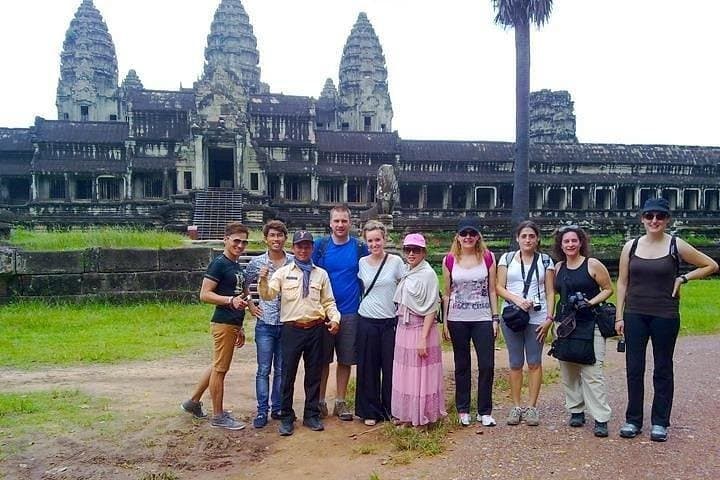



You step from an air-conditioned car into the heat and the hush of stone — Angkor Wat's silhouette hangs above the reflecting pool like a challenge. Rice paddies flash green as the driver threads familiar roads, and by the time you approach the causeway the scale of the complex makes conversation fall away.
You step from an air-conditioned car into the heat and the hush of stone — Angkor Wat's silhouette hangs above the reflecting pool like a challenge. Rice paddies flash green as the driver threads familiar roads, and by the time you approach the causeway the scale of the complex makes conversation fall away.
Angkor Wat was raised in the early 12th century under King Suryavarman II as a monumental Hindu temple that later took on Buddhist significance; its walls are cut from sandstone and laterite, and the bas‑reliefs still hold scenes of court life and myth. Angkor Thom’s Bayon presents more than 200 hulking carved faces that seem to watch the horizon, while Ta Prohm’s strangler figs press roots through lintels and dare you to find order in the ruin.
The landscapes here are both cultural and geological: seasonal floodplains feed temple moats, and jungle regrowth accelerates decay if visitors ignore pathways. Local guides will note caste histories and the Khmer Empire’s reach; temple crews and conservationists work under UNESCO protections to stabilize carvings and control erosion.
Practically, this private small‑circuit tour is a long day — expect 7–8 hours of stops, walking over uneven stone and steps. Angkor Park admission is not included, so buy your Angkor Pass at the ticket center before arrival. Dress respectfully (shoulders and knees covered), wear grippy shoes, and carry sun protection and plenty of water even though bottled water is normally provided. Time your visit early or aim for Phnom Bakheng at sunset for dramatic light, but arrive early to beat crowds and steep access paths.