THE ADVENTURE COLLECTIVE® · Independent discovery and booking for outdoor travel

Watch Angkor Wat at sunrise and spend a full day moving between the complex’s signature temples with a local guide. This guided tour mixes early-morning magic with on-site history, practical routing, and stops that keep heat and crowds manageable.
Watch Angkor Wat at sunrise and spend a full day moving between the complex’s signature temples with a local guide. This guided tour mixes early-morning magic with on-site history, practical routing, and stops that keep heat and crowds manageable.
Before dawn the temple silhouette is a cutout against a slowly bleaching sky—spires puncture the horizon and the reflecting moat trembles with first light. On this full-day tour you watch Angkor Wat wake, then move through the day’s cooler hours to explore the stone-carved stories of Bayon, the tree-entwined corridors of Ta Prohm and the pink sandstone detail of Banteay Srei.
Verified experiences and guided adventures in the surrounding area.
Operated by Asia Tours Desk · Siem Reap, Siem Reap Province
Before dawn the temple silhouette is a cutout against a slowly bleaching sky—spires puncture the horizon and the reflecting moat trembles with first light. On this full-day tour you watch Angkor Wat wake, then move through the day’s cooler hours to explore the stone-carved stories of Bayon, the tree-entwined corridors of Ta Prohm and the pink sandstone detail of Banteay Srei.
The complex sits on Cambrian sandstone laid down by ancient seas and sculpted into temple blocks during the 9th–15th century Khmer Empire; each wall panel is both an artistic record and a political statement of kings and gods. The route typically covers several kilometers of mostly flat paths with intermittent steep temple steps—expect uneven stone, short stair flights and compacted dirt between sites.
Culturally, the area still hums with local life: village markets, rice paddies and monks in saffron robes passing silent courtyards. Guides translate bas-reliefs and point out subtle carving details that reveal daily life, warfare and cosmology.
Practicalities: pickup is pre-dawn to reach the best sunrise vantage; wear sun-protective clothing that also covers shoulders and knees, bring 2–3 liters of water, and use grippy shoes. Temperatures rise quickly after sunrise—pace your walking, plan restroom breaks at museum cafés or major temples, and carry small local currency for the Angkor Pass (purchased separately) and tips. The tour is accessible to most fitness levels but requires steady footing on ancient steps. With a knowledgeable guide and a relaxed pace, you’ll leave with a clear sense of why Angkor remains one of Southeast Asia’s most compelling outdoor cultural experiences.
easy.
7–8 hours.
Suitable for most fitness levels; requires steady walking, short stair climbs and several kilometres of on-foot exploration.
No — the Angkor Pass is purchased separately at the official ticket center; bring passport photocopies and cash or card depending on the center’s payment methods.
Pickup is typically very early (around 4:00–4:30 AM) to reach Angkor Wat before dawn; exact time depends on hotel location.
Major sites have uneven ground and steps; some areas are partially accessible but full mobility access is limited—contact the operator for accommodations.
Yes—Banteay Srei is often included but it’s about 30–40 minutes from central Angkor sites; expect extra travel time and a short stop for breakfast nearby.
Angkor was the capital of the Khmer Empire between the 9th and 15th centuries; its monuments combine Hindu and Buddhist iconography as power statements of successive kings.
Visitor numbers stress fragile stone and vegetation—stay on designated paths, avoid leaning on carvings, and support local conservation fees and licensed guides.
Asia Tours Desk operates guided outdoor trips and adventures with an emphasis on safety, stewardship, and memorable experiences.


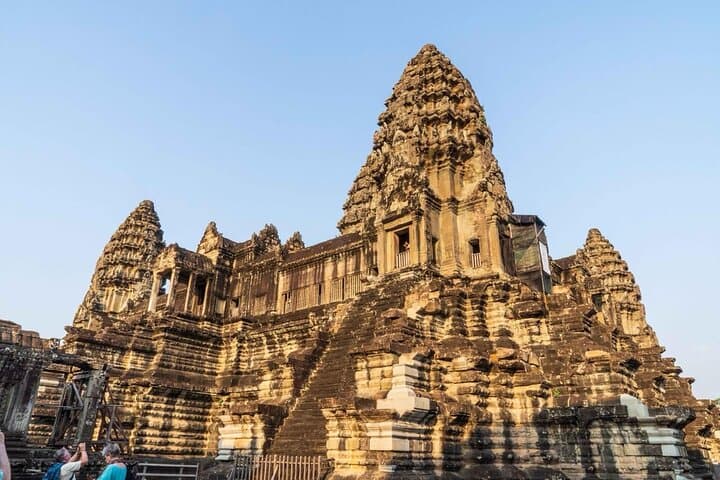
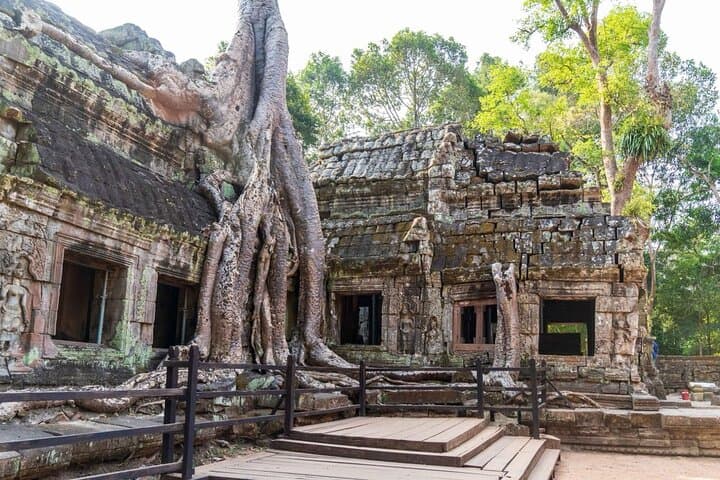
Before dawn the temple silhouette is a cutout against a slowly bleaching sky—spires puncture the horizon and the reflecting moat trembles with first light. On this full-day tour you watch Angkor Wat wake, then move through the day’s cooler hours to explore the stone-carved stories of Bayon, the tree-entwined corridors of Ta Prohm and the pink sandstone detail of Banteay Srei.
Before dawn the temple silhouette is a cutout against a slowly bleaching sky—spires puncture the horizon and the reflecting moat trembles with first light. On this full-day tour you watch Angkor Wat wake, then move through the day’s cooler hours to explore the stone-carved stories of Bayon, the tree-entwined corridors of Ta Prohm and the pink sandstone detail of Banteay Srei.
The complex sits on Cambrian sandstone laid down by ancient seas and sculpted into temple blocks during the 9th–15th century Khmer Empire; each wall panel is both an artistic record and a political statement of kings and gods. The route typically covers several kilometers of mostly flat paths with intermittent steep temple steps—expect uneven stone, short stair flights and compacted dirt between sites.
Culturally, the area still hums with local life: village markets, rice paddies and monks in saffron robes passing silent courtyards. Guides translate bas-reliefs and point out subtle carving details that reveal daily life, warfare and cosmology.
Practicalities: pickup is pre-dawn to reach the best sunrise vantage; wear sun-protective clothing that also covers shoulders and knees, bring 2–3 liters of water, and use grippy shoes. Temperatures rise quickly after sunrise—pace your walking, plan restroom breaks at museum cafés or major temples, and carry small local currency for the Angkor Pass (purchased separately) and tips. The tour is accessible to most fitness levels but requires steady footing on ancient steps. With a knowledgeable guide and a relaxed pace, you’ll leave with a clear sense of why Angkor remains one of Southeast Asia’s most compelling outdoor cultural experiences.