THE ADVENTURE COLLECTIVE® · Independent discovery and booking for outdoor travel

Catch Angkor Wat’s first light and spend two days moving from the stone faces of Bayon to the pink carvings of Banteay Srei. This private, two‑day circuit covers sunrise, temple classics, and lesser‑visited corners of the Angkor Park.
Catch Angkor Wat’s first light and spend two days moving from the stone faces of Bayon to the pink carvings of Banteay Srei. This private, two‑day circuit covers sunrise, temple classics, and lesser‑visited corners of the Angkor Park.
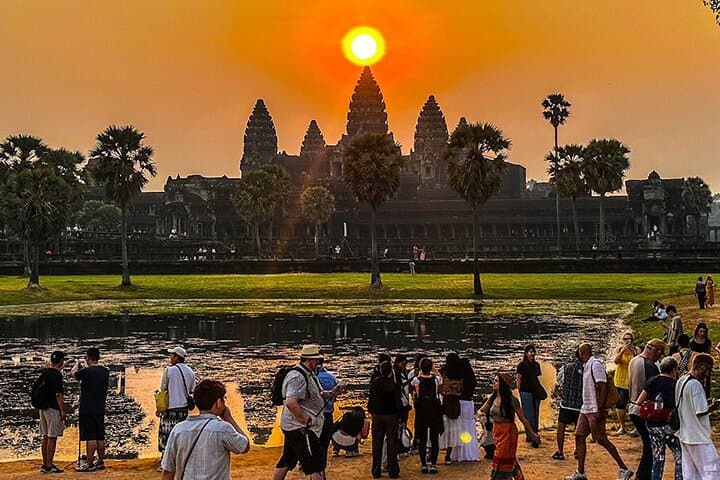
You stand before the moat as the sky lightens — Angkor Wat’s central towers silhouette against a wash of gold. Cool dawn air carries incense and the distant calls of tuk‑tuk drivers; stone carvings emerge from shadow as photographers and pilgrims collect at the west causeway.
Verified experiences and guided adventures in the surrounding area.
Operated by Angkor Happy Tour · Siem Reap, Siem Reap Province
You stand before the moat as the sky lightens — Angkor Wat’s central towers silhouette against a wash of gold. Cool dawn air carries incense and the distant calls of tuk‑tuk drivers; stone carvings emerge from shadow as photographers and pilgrims collect at the west causeway.
Over two days this private tour threads the high points of the Angkor Archaeological Park: the sunrise spectacle at Angkor Wat, the introspective faces of Bayon, Ta Prohm’s roots reclaiming stone, and the finely carved pink sandstone of Banteay Srei. The temples are products of the Khmer Empire (9th–15th centuries), built on Khmer hydraulic engineering: reservoirs and barays that shaped both ritual and irrigation across the plains.
Geology is visible in the stone palettes — laterite cores and sandstone façades — and culture in devout bas‑reliefs depicting Hindu and Buddhist narratives. You’ll pass Neak Pean’s circular pool, Pre Rup’s temple mountain best seen near sunset, and quieter niches at Ta Som.
Practically: expect a very early pickup for sunrise (often before 5:00AM), full days of walking on flat and uneven stone (plan 3–6 miles/5–10 km per day), and Cambodia’s heat and humidity. A valid Angkor Pass is required to enter the park; keep it on you at all times. Dress modestly (shoulders and knees covered) out of respect and to avoid entry issues. Bring water, sun protection, insect repellent and comfortable closed shoes for uneven steps and slick stone after rain. Guides handle logistics and timing, letting you focus on the sights and local stories that animate these ancient places.
easy.
2 days.
Suitable for travelers with basic fitness—expect 3–6 miles (5–10 km) of walking per day on uneven surfaces and stairs.
Yes — all visitors must hold a valid Angkor Pass; your guide can advise where to buy it in Siem Reap before the tour.
Pickups commonly begin between 4:00–5:00AM so you arrive before dawn at Angkor Wat for the classic view.
The tour typically includes transport and a licensed English‑speaking guide; temple entry fees and many meals (except some breakfasts) are usually paid separately — confirm with the operator.
The itinerary is classified as physically easy but involves stone steps and uneven ground; the provider lists wheelchair accessibility for transport, but some temple areas may be difficult to navigate.
Angkor was the political and religious center of the Khmer Empire from the 9th to the 15th century; many temples shifted between Hindu and Buddhist use over time.
The Angkor Archaeological Park is managed to balance tourism with preservation—stay on marked paths, avoid touching carvings, and use local guides to support sustainable site management.
Angkor Happy Tour operates guided outdoor trips and adventures with an emphasis on safety, stewardship, and memorable experiences.

You stand before the moat as the sky lightens — Angkor Wat’s central towers silhouette against a wash of gold. Cool dawn air carries incense and the distant calls of tuk‑tuk drivers; stone carvings emerge from shadow as photographers and pilgrims collect at the west causeway.
You stand before the moat as the sky lightens — Angkor Wat’s central towers silhouette against a wash of gold. Cool dawn air carries incense and the distant calls of tuk‑tuk drivers; stone carvings emerge from shadow as photographers and pilgrims collect at the west causeway.
Over two days this private tour threads the high points of the Angkor Archaeological Park: the sunrise spectacle at Angkor Wat, the introspective faces of Bayon, Ta Prohm’s roots reclaiming stone, and the finely carved pink sandstone of Banteay Srei. The temples are products of the Khmer Empire (9th–15th centuries), built on Khmer hydraulic engineering: reservoirs and barays that shaped both ritual and irrigation across the plains.
Geology is visible in the stone palettes — laterite cores and sandstone façades — and culture in devout bas‑reliefs depicting Hindu and Buddhist narratives. You’ll pass Neak Pean’s circular pool, Pre Rup’s temple mountain best seen near sunset, and quieter niches at Ta Som.
Practically: expect a very early pickup for sunrise (often before 5:00AM), full days of walking on flat and uneven stone (plan 3–6 miles/5–10 km per day), and Cambodia’s heat and humidity. A valid Angkor Pass is required to enter the park; keep it on you at all times. Dress modestly (shoulders and knees covered) out of respect and to avoid entry issues. Bring water, sun protection, insect repellent and comfortable closed shoes for uneven steps and slick stone after rain. Guides handle logistics and timing, letting you focus on the sights and local stories that animate these ancient places.