THE ADVENTURE COLLECTIVE® · Independent discovery and booking for outdoor travel

Witness sunrise over Angkor Wat and spend a full day exploring Ta Prohm's root-wrapped ruins and the carved faces of Bayon. This guided tour blends archaeology, local insight, and practical logistics for a compact, informative Angkor experience.
Witness sunrise over Angkor Wat and spend a full day exploring Ta Prohm's root-wrapped ruins and the carved faces of Bayon. This guided tour blends archaeology, local insight, and practical logistics for a compact, informative Angkor experience.
Before dawn the moat holds a low, silver light and Angkor Wat’s spires silhouette into the sky. On this full-day circuit from Siem Reap, the temple complex opens like a folded map — pathways that lead from carved galleries into tree-choked ruins — and a local guide turns architectural detail into living history.
Verified experiences and guided adventures in the surrounding area.
Operated by Angkor Guide Bon · Siem Reap, Siem Reap Province
Before dawn the moat holds a low, silver light and Angkor Wat’s spires silhouette into the sky. On this full-day circuit from Siem Reap, the temple complex opens like a folded map — pathways that lead from carved galleries into tree-choked ruins — and a local guide turns architectural detail into living history.
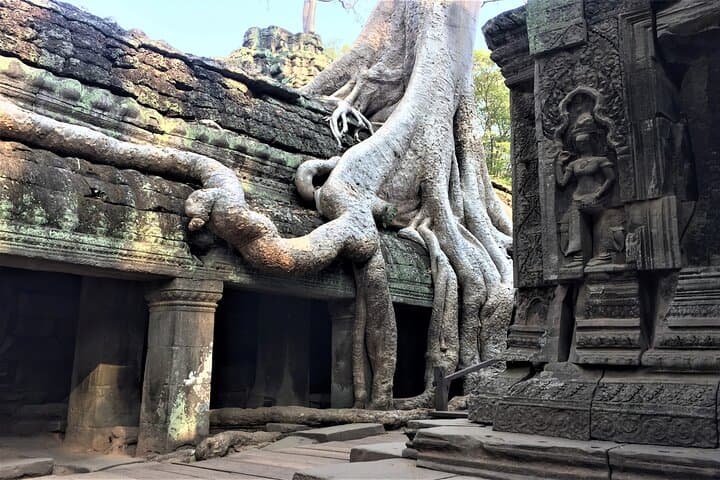
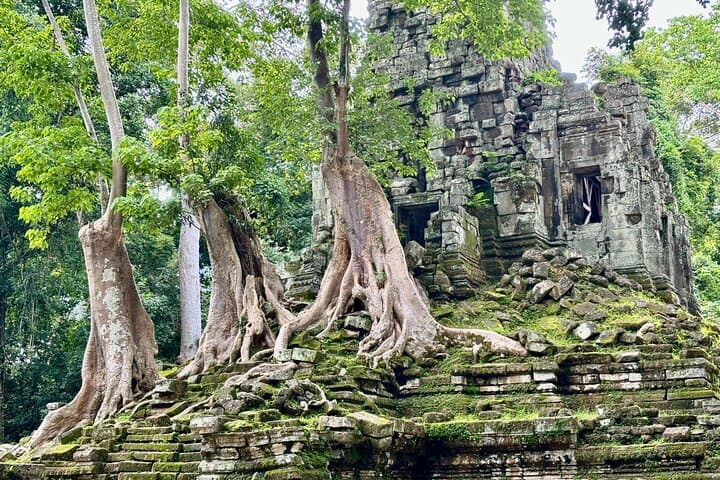
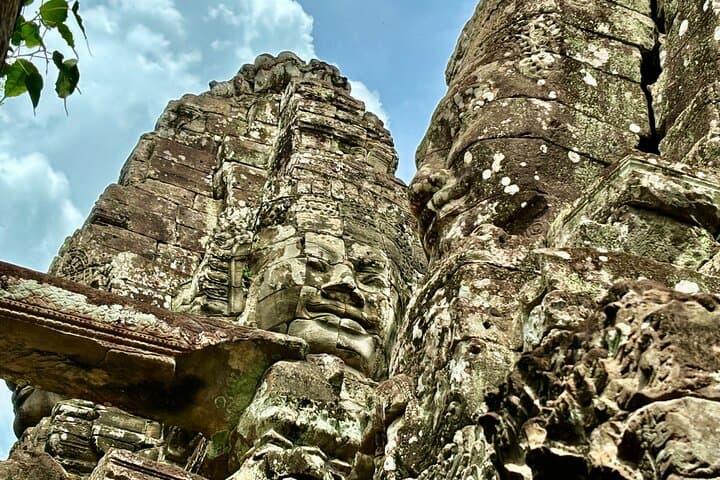
Angkor Wat began as a 12th-century Hindu state temple and evolved into a Buddhist center; its sandstone terraces and bas-reliefs record cosmology, kingship, and daily life. The surrounding plain sits on a laterite base; at Ta Prohm, strangler figs press roots through walls and the jungle seems to be pushing the site back. Angkor Thom offers a different tempo: wide causeways, giant carved faces at Bayon, and stepped pyramids at Baphuon that reward a brief climb with broad sightlines over the ancient city.
Culturally, tours reveal Khmer craftsmanship and the colonial-era excavation that brought these monuments into modern sight. Locals remain present — vendors, monks, and caretakers who sustain daily ritual amid tourism.
Practical guidance: expect lots of short walks, uneven stone and steep temple steps, and intermittent shade. Start before sunrise to beat heat and larger crowds; bring sun protection and water, and wear shoes with good traction. Photography windows change quickly with light, so move deliberately. Respect religious sites: cover shoulders and knees when required, and avoid loud behavior inside sanctuaries.
This itinerary suits travelers wanting a concentrated immersion in Angkor’s major sites with contextual storytelling and manageable walking, packaged as a convenient full-day loop with hotel pickup and drop-off.
easy.
8 hours.
Light to moderate fitness—able to stand and walk intermittently for several hours and climb uneven steps.
No; the park pass is usually purchased separately on arrival—verify current prices and bring cash or card for the ticket office.
Yes; the route involves short walks and guided stops, but those with mobility limits should note uneven terrain and some steep steps.
Transport is provided with pickup and drop-off; tuk-tuk transfer is common for small groups while air-conditioned vehicles may be available—confirm at booking.
Photography is allowed in most outdoor areas; exercise respect inside active shrines and follow guide instructions about restricted interiors.
The Angkor complex was the political and religious center of the Khmer Empire from the 9th to the 15th centuries, with monumental building phases under kings like Suryavarman II and Jayavarman VII.
Conservation focuses on stabilizing sandstone structures and managing visitor impact; stick to designated paths, avoid touching bas-reliefs, and support local guides and community-run initiatives.
Angkor Guide Bon operates guided outdoor trips and adventures with an emphasis on safety, stewardship, and memorable experiences.
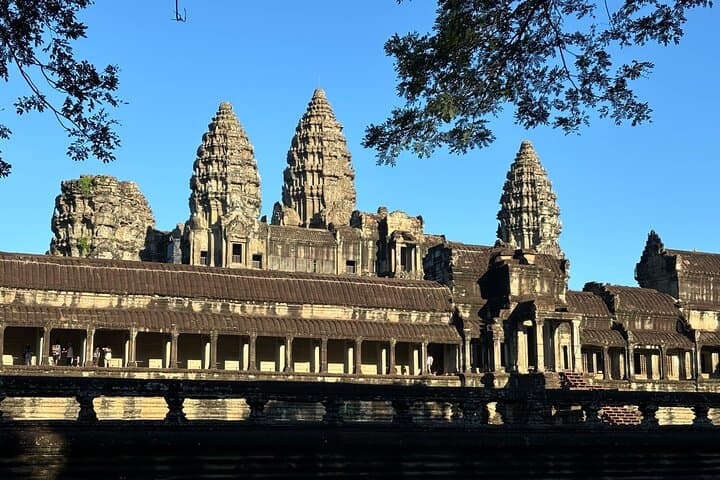
Before dawn the moat holds a low, silver light and Angkor Wat’s spires silhouette into the sky. On this full-day circuit from Siem Reap, the temple complex opens like a folded map — pathways that lead from carved galleries into tree-choked ruins — and a local guide turns architectural detail into living history.
Before dawn the moat holds a low, silver light and Angkor Wat’s spires silhouette into the sky. On this full-day circuit from Siem Reap, the temple complex opens like a folded map — pathways that lead from carved galleries into tree-choked ruins — and a local guide turns architectural detail into living history.
Angkor Wat began as a 12th-century Hindu state temple and evolved into a Buddhist center; its sandstone terraces and bas-reliefs record cosmology, kingship, and daily life. The surrounding plain sits on a laterite base; at Ta Prohm, strangler figs press roots through walls and the jungle seems to be pushing the site back. Angkor Thom offers a different tempo: wide causeways, giant carved faces at Bayon, and stepped pyramids at Baphuon that reward a brief climb with broad sightlines over the ancient city.
Culturally, tours reveal Khmer craftsmanship and the colonial-era excavation that brought these monuments into modern sight. Locals remain present — vendors, monks, and caretakers who sustain daily ritual amid tourism.
Practical guidance: expect lots of short walks, uneven stone and steep temple steps, and intermittent shade. Start before sunrise to beat heat and larger crowds; bring sun protection and water, and wear shoes with good traction. Photography windows change quickly with light, so move deliberately. Respect religious sites: cover shoulders and knees when required, and avoid loud behavior inside sanctuaries.
This itinerary suits travelers wanting a concentrated immersion in Angkor’s major sites with contextual storytelling and manageable walking, packaged as a convenient full-day loop with hotel pickup and drop-off.