THE ADVENTURE COLLECTIVE® · Independent discovery and booking for outdoor travel

Step off the city streets of Amritsar and into a working Punjabi village for a three‑ to four‑hour morning of field rides, local games, and a home‑style breakfast. This accessible excursion pairs cultural insight with hands‑on farm life.
Step off the city streets of Amritsar and into a working Punjabi village for a three‑ to four‑hour morning of field rides, local games, and a home‑style breakfast. This accessible excursion pairs cultural insight with hands‑on farm life.
The cracked mud lanes open like pages as the group steps out of the air‑conditioned van and into a village that moves at the rhythm of fields and livestock. Children scatter to play; a cow regards the visitors with slow curiosity; farmers pause to wave. The guide points out an old brick arch and the low huts where generations have lived, and the day begins as an exchange — not a show.
Verified experiences and guided adventures in the surrounding area.
Operated by Indus Voyages · Amritsar, Punjab
The cracked mud lanes open like pages as the group steps out of the air‑conditioned van and into a village that moves at the rhythm of fields and livestock. Children scatter to play; a cow regards the visitors with slow curiosity; farmers pause to wave. The guide points out an old brick arch and the low huts where generations have lived, and the day begins as an exchange — not a show.
This short excursion threads cultural history and agriculture. Punjab’s villages reflect decades of farming innovation and communal life: simple homes, open courtyards, and the seasonal patterns that dictate sowing and harvest. Geologically, the region sits on fertile alluvial plains fed by rivers branching from the Sutlej, which is why wheat and mustard fields dominate the view. Visitors will see traditional animal sheds, tractor‑trolley tracks, and a living pace that honors the land.
Expect practical, hands‑on moments: a walk along narrow brick paths, learning the local game 'gilli danda', and a bumpy tractor trolley ride through fields that change color with the seasons. An authentic Punjabi breakfast is included, offering home‑cooked rotis, lentils, pickles and milk, served with straightforward hospitality.
For planning: wear closed‑toe shoes for uneven paths, carry sun protection, and bring a compact camera with extra battery. Respect local customs — ask before photographing people — and keep noise low near homes and animals. The excursion is accessible to most fitness levels and lasts roughly three to four hours; it’s an immediate, practical window into rural life rather than a deep ethnographic study.
easy.
3–4 hours.
Suitable for most fitness levels; mostly walking on flat to slightly uneven village paths.
Yes—pickup and drop‑off in an air‑conditioned vehicle is typically included; confirm your pickup point when booking.
An authentic Punjabi breakfast is included, prepared with local ingredients—inform the operator of dietary restrictions in advance.
Yes—this tour is family‑friendly; strollers are accessible and children can participate in simple games under supervision.
Yes—visitors ride a tractor trolley to view fields; ride conditions are bumpy, so mobility or balance issues should be discussed before booking.
Punjabi village life reflects centuries of agrarian practices; the Green Revolution of the 1960s reshaped cropping patterns and irrigation across the plains near Amritsar.
Visitors should avoid littering, use provided sanitation facilities, and limit single‑use plastics; small‑group tourism helps reduce pressure on village resources.
Indus Voyages operates guided outdoor trips and adventures with an emphasis on safety, stewardship, and memorable experiences.


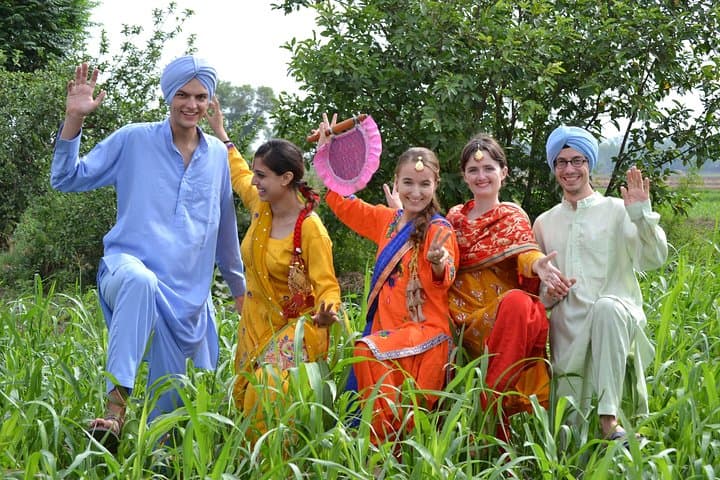
The cracked mud lanes open like pages as the group steps out of the air‑conditioned van and into a village that moves at the rhythm of fields and livestock. Children scatter to play; a cow regards the visitors with slow curiosity; farmers pause to wave. The guide points out an old brick arch and the low huts where generations have lived, and the day begins as an exchange — not a show.
The cracked mud lanes open like pages as the group steps out of the air‑conditioned van and into a village that moves at the rhythm of fields and livestock. Children scatter to play; a cow regards the visitors with slow curiosity; farmers pause to wave. The guide points out an old brick arch and the low huts where generations have lived, and the day begins as an exchange — not a show.
This short excursion threads cultural history and agriculture. Punjab’s villages reflect decades of farming innovation and communal life: simple homes, open courtyards, and the seasonal patterns that dictate sowing and harvest. Geologically, the region sits on fertile alluvial plains fed by rivers branching from the Sutlej, which is why wheat and mustard fields dominate the view. Visitors will see traditional animal sheds, tractor‑trolley tracks, and a living pace that honors the land.
Expect practical, hands‑on moments: a walk along narrow brick paths, learning the local game 'gilli danda', and a bumpy tractor trolley ride through fields that change color with the seasons. An authentic Punjabi breakfast is included, offering home‑cooked rotis, lentils, pickles and milk, served with straightforward hospitality.
For planning: wear closed‑toe shoes for uneven paths, carry sun protection, and bring a compact camera with extra battery. Respect local customs — ask before photographing people — and keep noise low near homes and animals. The excursion is accessible to most fitness levels and lasts roughly three to four hours; it’s an immediate, practical window into rural life rather than a deep ethnographic study.