THE ADVENTURE COLLECTIVE® · Independent discovery and booking for outdoor travel

Escape Cairo for a full-day exploration of Alexandria’s Greco-Roman landmarks. Visit Kom El Shoqafa, the Bibliotheca Alexandrina, Qaitbay Fort and the National Museum with an Egyptologist guide.
Escape Cairo for a full-day exploration of Alexandria’s Greco-Roman landmarks. Visit Kom El Shoqafa, the Bibliotheca Alexandrina, Qaitbay Fort and the National Museum with an Egyptologist guide.
A private vehicle peels away from Cairo at dawn and the Nile delta flattens into a salt-scented plain; by mid-morning the Mediterranean appears, cool and restless, curling against Alexandria’s seawalls as if daring you to step closer. The day unfolds as a circuit of stone and memory—rock-carved catacombs, a modern library with ancient ambitions, and a coastal citadel watching over shipping lanes.
Verified experiences and guided adventures in the surrounding area.
Operated by Egypt Unexpected Travel · Alexandria, Alexandria Governorate
A private vehicle peels away from Cairo at dawn and the Nile delta flattens into a salt-scented plain; by mid-morning the Mediterranean appears, cool and restless, curling against Alexandria’s seawalls as if daring you to step closer. The day unfolds as a circuit of stone and memory—rock-carved catacombs, a modern library with ancient ambitions, and a coastal citadel watching over shipping lanes.
Alexandria was founded in the fourth century BCE by Alexander the Great and grew into a Hellenistic hub where Greek, Roman and Egyptian cultures mixed. Geologically the city sits on lagoonal plains and reclaimed shoreline; many of its ancient monuments survive because they were carved into the limestone and bedrock, like the three-level Kom El Shoqafa catacombs. Local life is anchored to the sea—fishing boats, cafés along the corniche, and a mosque whose minarets mark centuries of devotional architecture.
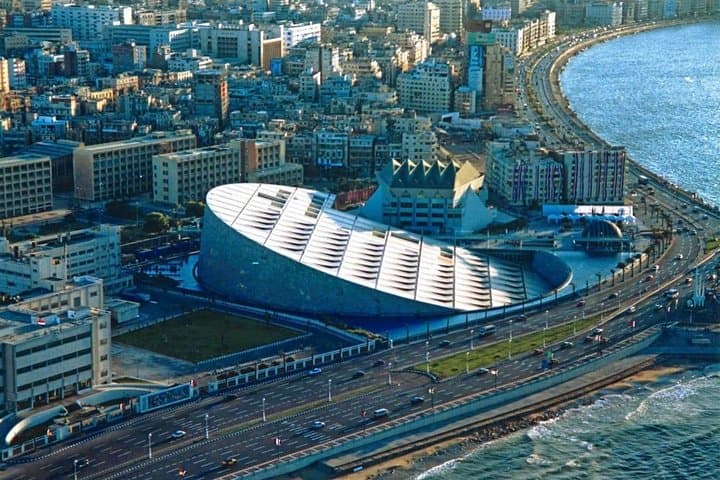
On a one-day tour visitors typically move between sites by air-conditioned vehicle, stopping at the National Museum to trace pharaonic and Greco-Roman artifacts, the Bibliotheca Alexandrina for its sweeping reading hall and exhibitions, Qaitbay Fort for Mediterranean views, and the Catacombs for subterranean archaeology. Guides (Egyptologists in many tours) stitch the sites into a historical narrative and flag conservation concerns.
Practical notes: expect around 10 hours with several short walks and stair sections in the catacombs and forts. Dress smart-casual and modest for mosque exteriors; comfortable closed shoes handle uneven stone and steps. Carry water, sunscreen and a light layer against coastal breezes. Peak times are mid-morning and late afternoon—start early from Cairo to avoid traffic and get cooler light for photos.
moderate.
10 hours.
Moderate fitness—able to walk short distances, climb stairs and stand during museum stops.
Most shared tours include guides and transfers but typically do not include museum or monument entrance fees—confirm with the operator before booking.
Yes—this tour lists hotel pickup and drop-off from Cairo; you’ll be asked for a pickup point when booking.
Families can attend, but children should be comfortable with long days, vehicle travel and walking through stairs and catacombs; check age guidance with the operator.
Photography is generally allowed at outdoor sites and many museums, but flash or tripods may be restricted; follow onsite signage and guide instructions.
Founded by Alexander the Great in the 4th century BCE, Alexandria was a major Hellenistic center whose ancient library and lighthouse shaped Mediterranean learning and navigation.
Coastal erosion and modern development challenge preservation; follow site rules, avoid touching fragile carvings, and use local guides to support sustainable visitation.
Egypt Unexpected Travel operates guided outdoor trips and adventures with an emphasis on safety, stewardship, and memorable experiences.


A private vehicle peels away from Cairo at dawn and the Nile delta flattens into a salt-scented plain; by mid-morning the Mediterranean appears, cool and restless, curling against Alexandria’s seawalls as if daring you to step closer. The day unfolds as a circuit of stone and memory—rock-carved catacombs, a modern library with ancient ambitions, and a coastal citadel watching over shipping lanes.
A private vehicle peels away from Cairo at dawn and the Nile delta flattens into a salt-scented plain; by mid-morning the Mediterranean appears, cool and restless, curling against Alexandria’s seawalls as if daring you to step closer. The day unfolds as a circuit of stone and memory—rock-carved catacombs, a modern library with ancient ambitions, and a coastal citadel watching over shipping lanes.
Alexandria was founded in the fourth century BCE by Alexander the Great and grew into a Hellenistic hub where Greek, Roman and Egyptian cultures mixed. Geologically the city sits on lagoonal plains and reclaimed shoreline; many of its ancient monuments survive because they were carved into the limestone and bedrock, like the three-level Kom El Shoqafa catacombs. Local life is anchored to the sea—fishing boats, cafés along the corniche, and a mosque whose minarets mark centuries of devotional architecture.
On a one-day tour visitors typically move between sites by air-conditioned vehicle, stopping at the National Museum to trace pharaonic and Greco-Roman artifacts, the Bibliotheca Alexandrina for its sweeping reading hall and exhibitions, Qaitbay Fort for Mediterranean views, and the Catacombs for subterranean archaeology. Guides (Egyptologists in many tours) stitch the sites into a historical narrative and flag conservation concerns.
Practical notes: expect around 10 hours with several short walks and stair sections in the catacombs and forts. Dress smart-casual and modest for mosque exteriors; comfortable closed shoes handle uneven stone and steps. Carry water, sunscreen and a light layer against coastal breezes. Peak times are mid-morning and late afternoon—start early from Cairo to avoid traffic and get cooler light for photos.