THE ADVENTURE COLLECTIVE® · Independent discovery and booking for outdoor travel

Walk among seven ocean-facing moai at Ahu Akivi, explore the red scoria quarry of Puna Pau, and watch Tahai’s restored ahu at golden hour. This compact half-day tour pairs geology and living Rapa Nui culture with straightforward logistics for travelers based in Hanga Roa.
Walk among seven ocean-facing moai at Ahu Akivi, explore the red scoria quarry of Puna Pau, and watch Tahai’s restored ahu at golden hour. This compact half-day tour pairs geology and living Rapa Nui culture with straightforward logistics for travelers based in Hanga Roa.
You step off the compact van and feel the wind that shapes Rapa Nui—salt-laden, insistent, pushing your jacket back like an impatient guide. Before you, seven moai stand aligned at Ahu Akivi, faces turned out to sea; their stone eyes carry the weight of generations and the quiet geometry of island power.
Verified experiences and guided adventures in the surrounding area.
You step off the compact van and feel the wind that shapes Rapa Nui—salt-laden, insistent, pushing your jacket back like an impatient guide. Before you, seven moai stand aligned at Ahu Akivi, faces turned out to sea; their stone eyes carry the weight of generations and the quiet geometry of island power.
This half-day circuit moves between ceremonial platforms and volcanic quarries: Ahu Akivi’s ocean-facing moai, Puna Pau’s red scoria where the pukao (topknots) were carved, and the Tahai complex where sunset light skims basalt and restored ahu. The geology is immediate—basalt flows, tuff cones, and the distinct red of scoria—evidence of the island’s volcanic birth and the material culture that grew from it.
Culturally, this route traces the arc of Rapa Nui society: monumental carving, transport across rugged terrain, and later European contact that reshaped life here. Local guides usually share Rapa Nui stories and explain how restoration work at Tahai and other sites attempts to balance tourism with cultural stewardship.
Expect uneven rock, short walks between sites, and wide coastal views. Photography is constant; light shifts fast in the open landscape. Practicalities: bring sun protection and water, wear sturdy shoes with grip, and plan for wind and a brief shower even on clear days. Respect cordons and follow your guide’s directions—these platforms are archaeological and part of a living cultural landscape.
A morning or late-afternoon timing makes the most of softer light and smaller crowds, letting the stone guardians hold their quiet scrutiny as you move through island history.
moderate.
3 hours.
Light to moderate fitness for short walks over uneven ground; able to stand and walk for stretches of 10–30 minutes at a time.
The tour is about three hours and typically includes Ahu Akivi, Puna Pau quarry, and the Tahai ceremonial complex.
Yes—paths are short but uneven; children and older travelers should be able to walk short distances and step over low rocks.
Facilities are limited; Hanga Roa has options before departure and at some larger archaeological sites, but bring essentials just in case.
Photography is allowed, but do not climb on ahu or moai and avoid crossing ropes or barriers—respect site rules and your guide’s directions.
Rapa Nui’s moai were carved by Polynesian settlers between roughly 900–1600 AD; Puna Pau provided the red scoria used for pukao (topknots) added later.
Rapa Nui faces erosion and impacts from heavy visitation—support local guides, stay on designated paths, and avoid touching archaeological features to help preserve sites.
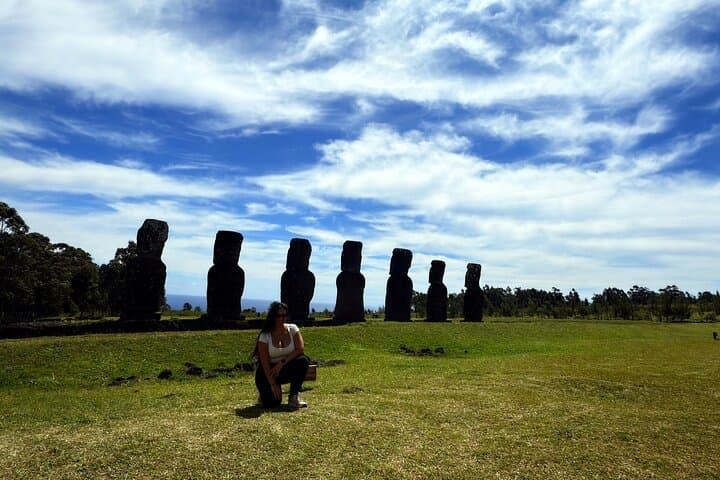
You step off the compact van and feel the wind that shapes Rapa Nui—salt-laden, insistent, pushing your jacket back like an impatient guide. Before you, seven moai stand aligned at Ahu Akivi, faces turned out to sea; their stone eyes carry the weight of generations and the quiet geometry of island power.
You step off the compact van and feel the wind that shapes Rapa Nui—salt-laden, insistent, pushing your jacket back like an impatient guide. Before you, seven moai stand aligned at Ahu Akivi, faces turned out to sea; their stone eyes carry the weight of generations and the quiet geometry of island power.
This half-day circuit moves between ceremonial platforms and volcanic quarries: Ahu Akivi’s ocean-facing moai, Puna Pau’s red scoria where the pukao (topknots) were carved, and the Tahai complex where sunset light skims basalt and restored ahu. The geology is immediate—basalt flows, tuff cones, and the distinct red of scoria—evidence of the island’s volcanic birth and the material culture that grew from it.
Culturally, this route traces the arc of Rapa Nui society: monumental carving, transport across rugged terrain, and later European contact that reshaped life here. Local guides usually share Rapa Nui stories and explain how restoration work at Tahai and other sites attempts to balance tourism with cultural stewardship.
Expect uneven rock, short walks between sites, and wide coastal views. Photography is constant; light shifts fast in the open landscape. Practicalities: bring sun protection and water, wear sturdy shoes with grip, and plan for wind and a brief shower even on clear days. Respect cordons and follow your guide’s directions—these platforms are archaeological and part of a living cultural landscape.
A morning or late-afternoon timing makes the most of softer light and smaller crowds, letting the stone guardians hold their quiet scrutiny as you move through island history.