THE ADVENTURE COLLECTIVE® · Independent discovery and booking for outdoor travel

Walk among seven ocean-gazing moai, explore the red scoria quarry at Puna Pau and catch dramatic light at Tahai on this focused half-day tour. Ideal for travelers who want dense cultural and geological context without a full-day commitment.
Walk among seven ocean-gazing moai, explore the red scoria quarry at Puna Pau and catch dramatic light at Tahai on this focused half-day tour. Ideal for travelers who want dense cultural and geological context without a full-day commitment.
On arrival to the scrubby high plain, seven stone figures turn their blank faces to the horizon like a guard detail watching the Pacific. Wind pushes across the volcanic rock; seabirds wheel above the slopes. The Ahu Akivi half-day tour moves with this rhythm—short walks, wide views and concentrated moments at archaeologically important sites.
Verified experiences and guided adventures in the surrounding area.
On arrival to the scrubby high plain, seven stone figures turn their blank faces to the horizon like a guard detail watching the Pacific. Wind pushes across the volcanic rock; seabirds wheel above the slopes. The Ahu Akivi half-day tour moves with this rhythm—short walks, wide views and concentrated moments at archaeologically important sites.
Visitors follow a path through basalt fields to Ahu Akivi, a rare inland ahu where the moai face seaward. Nearby, Puna Pau reveals the red scoria quarry where pukao (topknots) were carved from small, iron-rich plugs. At Tahai, restored platforms meet the sea and make a photogenic stop for late-afternoon light. The geology is simple and stark: basalt flows, tuff cones and pockets of scoria shaped by volcanoes that built the island.
Culturally, these sites reflect a society that moved massive statues inland and oriented them for ritual purpose; oral histories and midden finds tell of resource limits, voyaging, and reconfiguration of sacred landscapes. Guides weave this context into each stop, connecting rock, ritual and reef.
Practical note: the tour is mainly short, uneven walks with exposed sun and occasional gusts. Wear closed shoes with grip, sun protection and bring water. Mornings are cooler and clearer for photos; late afternoons bring warmer light at Tahai. Expect 2–3 photo stops and 20–30 minutes of easy hiking spread across the three sites. The experience is compact—part history lesson, part landscape walk—ideal for travelers who want concentrated cultural context without a full-day commitment.
easy.
3 hours.
Suitable for travelers in basic fitness who can walk short distances over uneven ground and climb low steps.
The tour includes short walks at each site totaling roughly 1–2 kilometers on mainly flat but uneven ground; expect 20–30 minutes of walking per stop.
Yes—photography is generally allowed at the public ahu but respect signage and stay off restored platforms unless indicated by guides.
Many tours offer English- and Spanish-speaking guides; check the booking description to confirm language options.
This half-day itinerary is compact but can be scheduled alongside other attractions on a separate day; logistic time to/from Hanga Roa should be considered.
Ahu Akivi and Tahai are among the island’s restored ceremonial platforms; Ahu Akivi is unique for its inland placement and the hypothesis that its seven moai align with navigational stars.
Easter Island’s fragile soils and cultural sites require staying on paths and following guide instructions; visitor pressure is managed through site protection and local conservation programs.
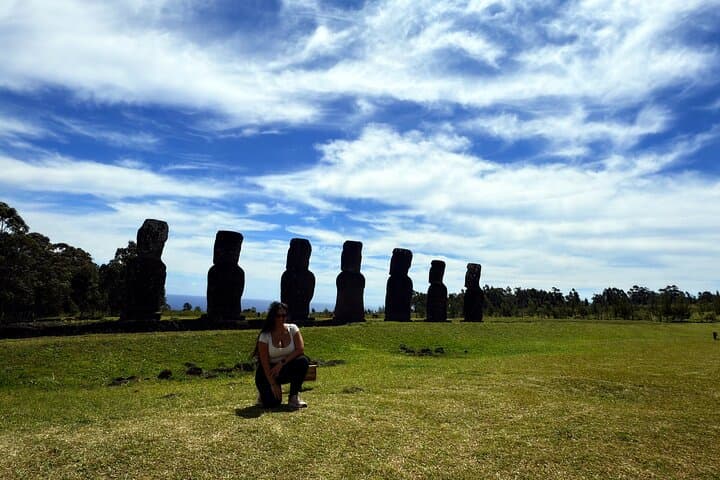
On arrival to the scrubby high plain, seven stone figures turn their blank faces to the horizon like a guard detail watching the Pacific. Wind pushes across the volcanic rock; seabirds wheel above the slopes. The Ahu Akivi half-day tour moves with this rhythm—short walks, wide views and concentrated moments at archaeologically important sites.
On arrival to the scrubby high plain, seven stone figures turn their blank faces to the horizon like a guard detail watching the Pacific. Wind pushes across the volcanic rock; seabirds wheel above the slopes. The Ahu Akivi half-day tour moves with this rhythm—short walks, wide views and concentrated moments at archaeologically important sites.
Visitors follow a path through basalt fields to Ahu Akivi, a rare inland ahu where the moai face seaward. Nearby, Puna Pau reveals the red scoria quarry where pukao (topknots) were carved from small, iron-rich plugs. At Tahai, restored platforms meet the sea and make a photogenic stop for late-afternoon light. The geology is simple and stark: basalt flows, tuff cones and pockets of scoria shaped by volcanoes that built the island.
Culturally, these sites reflect a society that moved massive statues inland and oriented them for ritual purpose; oral histories and midden finds tell of resource limits, voyaging, and reconfiguration of sacred landscapes. Guides weave this context into each stop, connecting rock, ritual and reef.
Practical note: the tour is mainly short, uneven walks with exposed sun and occasional gusts. Wear closed shoes with grip, sun protection and bring water. Mornings are cooler and clearer for photos; late afternoons bring warmer light at Tahai. Expect 2–3 photo stops and 20–30 minutes of easy hiking spread across the three sites. The experience is compact—part history lesson, part landscape walk—ideal for travelers who want concentrated cultural context without a full-day commitment.