THE ADVENTURE COLLECTIVE® · Independent discovery and booking for outdoor travel

Swap Marrakech’s medina for a day that pairs the river-carved Ourika Valley with the stony plains of Agafay. Walk, ride a camel and time your return for a desert sunset framed by the High Atlas.
Swap Marrakech’s medina for a day that pairs the river-carved Ourika Valley with the stony plains of Agafay. Walk, ride a camel and time your return for a desert sunset framed by the High Atlas.
You roll away from the bustle of Marrakech at 9 a.m., the city shrinking behind orange walls as the road threads into the Ourika Valley. Olive terraces and low stone villages slip by; the river ahead pushes a cool soundtrack under the lunch terrace where you pause.
Verified experiences and guided adventures in the surrounding area.
Operated by Authentic Destination · Marrakech, Marrakech-Safi
You roll away from the bustle of Marrakech at 9 a.m., the city shrinking behind orange walls as the road threads into the Ourika Valley. Olive terraces and low stone villages slip by; the river ahead pushes a cool soundtrack under the lunch terrace where you pause.
The day pairs two contrasting landscapes. Ourika Valley is carved by mountain streams flowing off the High Atlas—an agricultural corridor where Berber villages still tend terraces and seasonal markets. Geologically, the valley taps runoff from snowmelt higher in the Atlas, while the Agafay “stone desert” is a stony plain of compacted alluvium and boulder fields, not Saharan sand dunes. The nearby Atlas shoulders the skyline; on clear days its snowfields puncture the horizon.
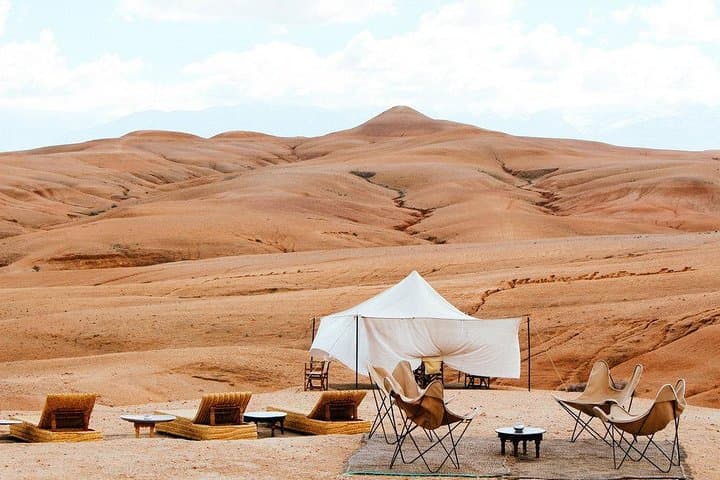
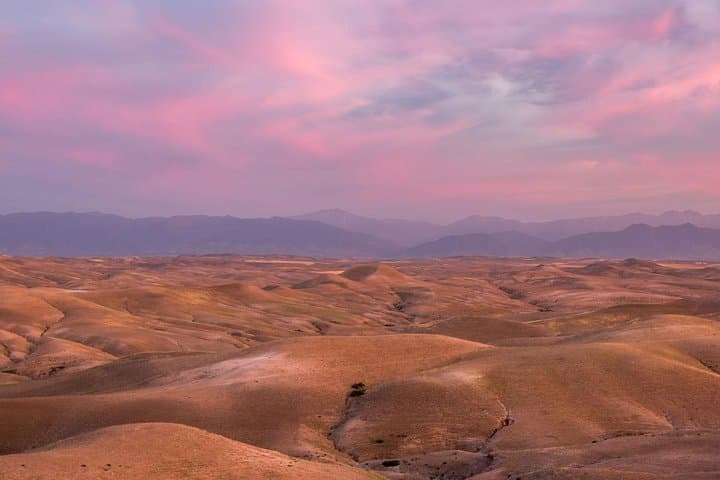
Culturally, expect warm, practical hospitality: riverside lunches, markets with woven goods and simple, home-style food. In Agafay you’ll choose a short guided walk across lunar rock and scrub or mount a camel for a slower, steady approach to wide, sun-scrubbed views. The landscape trades shade for long sightlines—ideal for sunset photography.
Practical guidance: the full excursion runs about 8–9 hours with roughly 45 minutes driving each way to Agafay; the itinerary typically includes a 1.5–2 hour riverside lunch and 2–3 hours in the desert. Wear sturdy shoes for rough, rocky terrain, bring sun protection and 1–2 liters of water, and carry a light layer for cooling evening wind after sunset. Respect private farmland in Ourika, ask before photographing people, and plan for dust—camera covers and quick-dry clothing help. Pickup and return to your riad are usually included, making this a straightforward day of two very different Moroccan landscapes.
easy.
8–9 hours.
Suitable for most fitness levels—short walks over uneven ground and optional camel rides require basic mobility
Expect about 30–60 minutes each way depending on traffic and exact pickup location; the itinerary typically includes both Ourika and Agafay, so travel is broken into segments.
Camel rides are offered as an option; animals are handled by local guides and moves are slow—wear long pants and hold on during mounting and dismounting.
Lunch is included and most operators can accommodate dietary requests if notified at booking—use the special requirements field to specify allergies or preferences.
Yes—this is rated easy with minimal physical strain, but consider mobility for uneven ground and bring sun protection and water for younger or older travelers.
Ourika has long been an agricultural corridor for mountain communities; Berber villages here retain clan-based ties and traditional terrace farming methods.
Stay on marked tracks, avoid disturbing vegetation and livestock, and carry out any waste; water resources in the valley are locally prized and sensitive to overuse.
Authentic Destination operates guided outdoor trips and adventures with an emphasis on safety, stewardship, and memorable experiences.
You roll away from the bustle of Marrakech at 9 a.m., the city shrinking behind orange walls as the road threads into the Ourika Valley. Olive terraces and low stone villages slip by; the river ahead pushes a cool soundtrack under the lunch terrace where you pause.
You roll away from the bustle of Marrakech at 9 a.m., the city shrinking behind orange walls as the road threads into the Ourika Valley. Olive terraces and low stone villages slip by; the river ahead pushes a cool soundtrack under the lunch terrace where you pause.
The day pairs two contrasting landscapes. Ourika Valley is carved by mountain streams flowing off the High Atlas—an agricultural corridor where Berber villages still tend terraces and seasonal markets. Geologically, the valley taps runoff from snowmelt higher in the Atlas, while the Agafay “stone desert” is a stony plain of compacted alluvium and boulder fields, not Saharan sand dunes. The nearby Atlas shoulders the skyline; on clear days its snowfields puncture the horizon.
Culturally, expect warm, practical hospitality: riverside lunches, markets with woven goods and simple, home-style food. In Agafay you’ll choose a short guided walk across lunar rock and scrub or mount a camel for a slower, steady approach to wide, sun-scrubbed views. The landscape trades shade for long sightlines—ideal for sunset photography.
Practical guidance: the full excursion runs about 8–9 hours with roughly 45 minutes driving each way to Agafay; the itinerary typically includes a 1.5–2 hour riverside lunch and 2–3 hours in the desert. Wear sturdy shoes for rough, rocky terrain, bring sun protection and 1–2 liters of water, and carry a light layer for cooling evening wind after sunset. Respect private farmland in Ourika, ask before photographing people, and plan for dust—camera covers and quick-dry clothing help. Pickup and return to your riad are usually included, making this a straightforward day of two very different Moroccan landscapes.