THE ADVENTURE COLLECTIVE® · Independent discovery and booking for outdoor travel

Head out of Marrakech for an evening among the rocky plains of the Agafay Desert — a short camel ride, sunset tea, a Moroccan dinner and a live fire show under the stars. Practical, atmospheric and easily combined with a half-day in the city.
Head out of Marrakech for an evening among the rocky plains of the Agafay Desert — a short camel ride, sunset tea, a Moroccan dinner and a live fire show under the stars. Practical, atmospheric and easily combined with a half-day in the city.
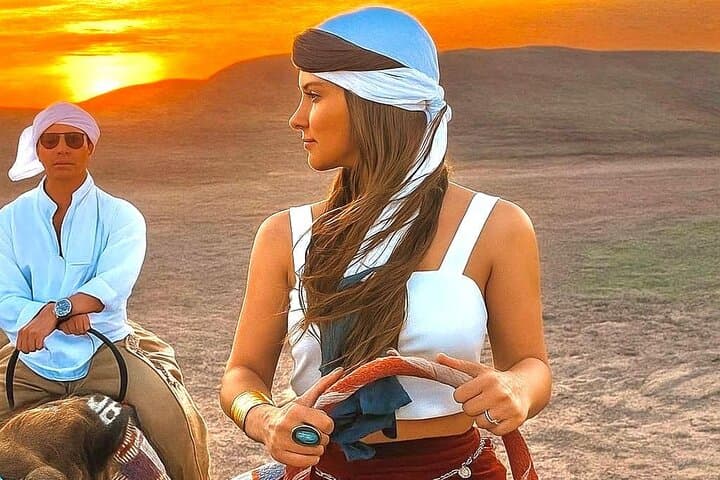
The sun drops low over a hard, stone plain and the Agafay’s pale slopes throw long, cool shadows. You arrive after a short, scenic drive from Marrakech — the city’s ochre roofs shrinking behind you — and step into a landscape of scrub, scattered boulders and flattened, moonlike ridgelines. A line of camels waits; the animals shift and breathe, patient as the light changes.
Verified experiences and guided adventures in the surrounding area.
Operated by Hamidy Travel · Marrakech, Marrakech-Safi
The sun drops low over a hard, stone plain and the Agafay’s pale slopes throw long, cool shadows. You arrive after a short, scenic drive from Marrakech — the city’s ochre roofs shrinking behind you — and step into a landscape of scrub, scattered boulders and flattened, moonlike ridgelines. A line of camels waits; the animals shift and breathe, patient as the light changes.
Geology here is not Saharan sand but a stony desert carved from ancient bedrock and seasonal wadis, part of the High Atlas foothills’ rain-shadow. Historically the area sat between caravan routes and agricultural villages; today local Berber culture shapes the evening with music, tea and simple hospitality. Along the way many tours stop at an argan cooperative run by local women — a practical window into regional livelihoods.
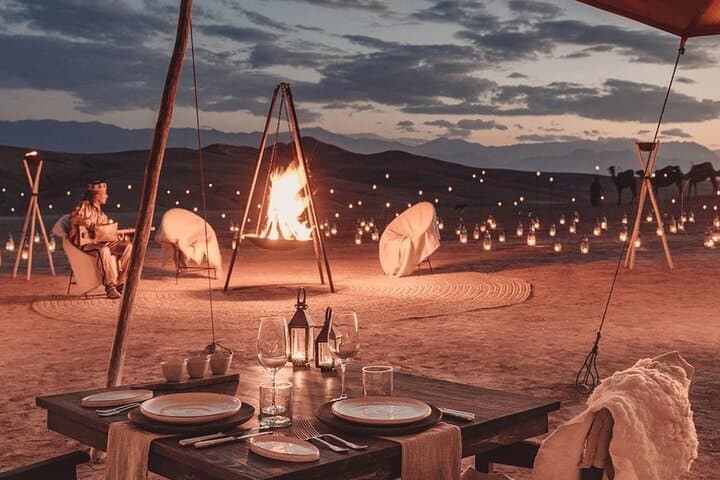
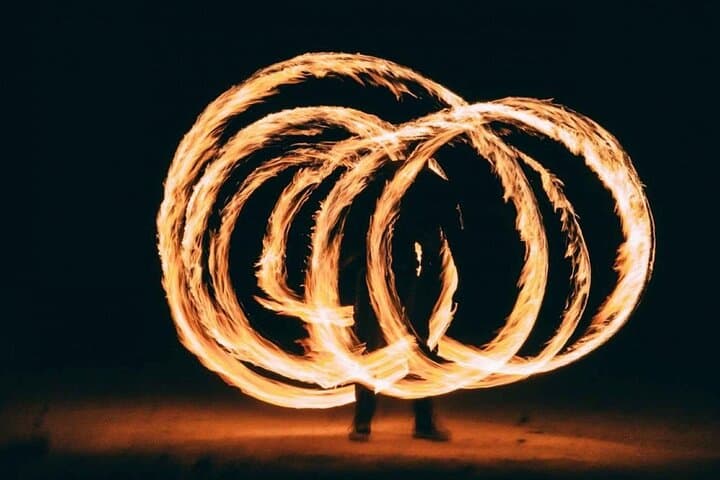
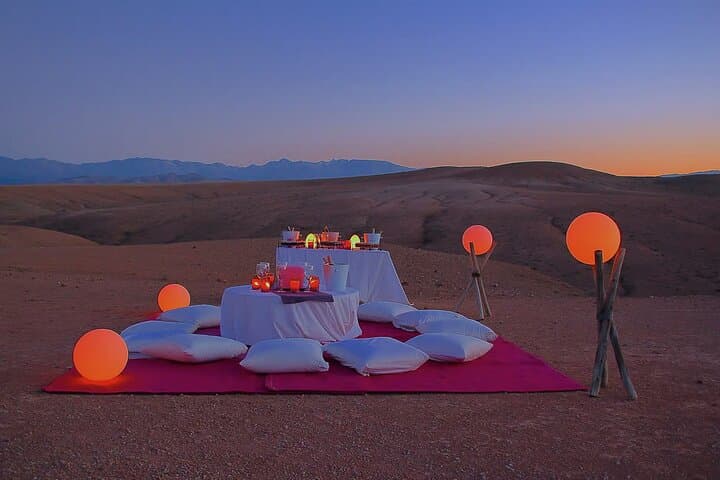
Expect a roughly 40–60 minute transfer from central Marrakech, a 20-minute guided camel ride across firm, gravelly terrain, a sunset tea moment, followed by a seated Moroccan dinner (tagine, soup, fruit) and a Berber music set capped by a fire show under open sky. The itinerary is low-impact but uneven underfoot: minimal elevation change, rocky ground and occasional dust.
Plan for wind and cooler temperatures after sundown; bring layered clothing, protected footwear and water. Photographs at golden hour are excellent but keep camera straps secure on camels. This is a short, sensory introduction to Morocco’s desert fringe — communal, easygoing and best enjoyed with curiosity and respect for local rhythms.
easy.
4–5 hours.
Low fitness required — able to mount a camel and walk on uneven, rocky ground for short distances.
The guided camel ride included is approximately 20 minutes across flat, rocky desert terrain.
Yes — hotel pickup and drop-off in Marrakech are included, typically by air-conditioned vehicle; transfer time is usually 40–60 minutes each way.
A traditional Moroccan dinner (starter, tagine main, dessert) and Moroccan tea are included; alcoholic drinks are not usually provided unless specified by the operator.
Children can participate but infants may need to sit on laps; the camel ride is not recommended for travelers with spinal injuries or severe mobility issues.
Agafay was a traditional grazing and transit zone on the margins of Marrakech rather than a sand sea; its stony plains reflect erosion of High Atlas foothill beds.
Keep to established paths and avoid feeding wildlife; many local operators emphasize minimal-impact evening events and support nearby cooperatives that benefit local communities.
Hamidy Travel operates guided outdoor trips and adventures with an emphasis on safety, stewardship, and memorable experiences.
The sun drops low over a hard, stone plain and the Agafay’s pale slopes throw long, cool shadows. You arrive after a short, scenic drive from Marrakech — the city’s ochre roofs shrinking behind you — and step into a landscape of scrub, scattered boulders and flattened, moonlike ridgelines. A line of camels waits; the animals shift and breathe, patient as the light changes.
The sun drops low over a hard, stone plain and the Agafay’s pale slopes throw long, cool shadows. You arrive after a short, scenic drive from Marrakech — the city’s ochre roofs shrinking behind you — and step into a landscape of scrub, scattered boulders and flattened, moonlike ridgelines. A line of camels waits; the animals shift and breathe, patient as the light changes.
Geology here is not Saharan sand but a stony desert carved from ancient bedrock and seasonal wadis, part of the High Atlas foothills’ rain-shadow. Historically the area sat between caravan routes and agricultural villages; today local Berber culture shapes the evening with music, tea and simple hospitality. Along the way many tours stop at an argan cooperative run by local women — a practical window into regional livelihoods.
Expect a roughly 40–60 minute transfer from central Marrakech, a 20-minute guided camel ride across firm, gravelly terrain, a sunset tea moment, followed by a seated Moroccan dinner (tagine, soup, fruit) and a Berber music set capped by a fire show under open sky. The itinerary is low-impact but uneven underfoot: minimal elevation change, rocky ground and occasional dust.
Plan for wind and cooler temperatures after sundown; bring layered clothing, protected footwear and water. Photographs at golden hour are excellent but keep camera straps secure on camels. This is a short, sensory introduction to Morocco’s desert fringe — communal, easygoing and best enjoyed with curiosity and respect for local rhythms.