THE ADVENTURE COLLECTIVE® · Independent discovery and booking for outdoor travel

Swap Marrakech’s medina walls for a short, scenic drive to the stony Agafay Desert and a 1.5‑hour camel ride with Atlas Mountain views. Expect mint tea, a local house visit, and a gentle, accessible desert introduction.
Swap Marrakech’s medina walls for a short, scenic drive to the stony Agafay Desert and a 1.5‑hour camel ride with Atlas Mountain views. Expect mint tea, a local house visit, and a gentle, accessible desert introduction.
A wind-swept plain of broken stone rolls away from the road as your van slides out of Marrakech and toward the Agafay. Camels line up like patient ships on a rocky sea; the Atlas Mountains puncture the horizon, their ridges daring you to look closer.
Verified experiences and guided adventures in the surrounding area.
Operated by Palacio da Bahia · Marrakech, Marrakech-Safi
A wind-swept plain of broken stone rolls away from the road as your van slides out of Marrakech and toward the Agafay. Camels line up like patient ships on a rocky sea; the Atlas Mountains puncture the horizon, their ridges daring you to look closer.
The Agafay is not true sand dune desert but a stony reg of ancient riverbeds and fractured bedrock shaped by wind and episodic rains. Berber and local rural communities have long used the plain for grazing and as a transit corridor between Marrakech and High Atlas settlements, and the camel remains a practical emblem of travel and trade here.
Culturally, the experience centers on hospitality: a mint tea ceremony, a short visit to a local house and a chance to learn simple desert rhythms. Geologically, you’ll notice coarse gravel, sculpted stone slabs and the occasional dry wadi channel—terrain that makes the camel a sensible mount rather than a novelty.
Practically, this is a 4‑hour experience from Marrakech (about 45 minutes each way) with roughly 90 minutes in the saddle. Dress for strong sun and temperature swings: breathable layers, closed shoes for mounting, and a hat. Carry water and a small daypack for your camera and sunscreen. The ride is gentle and suitable for most fitness levels, but it’s not recommended for pregnant travelers.
Expect modest facilities at the meeting spot, friendly local hosts, and straightforward logistics: private transfers, drop‑off in the city, and a compact window to taste desert space without committing to an overnight.
easy.
3–4 hours.
Light activity; able to mount and remain seated on a camel for about 90 minutes and walk short distances on uneven stone.
The camel segment is about 1.5 hours; the full tour including transfers runs roughly 3–4 hours.
Infant seats are available for the transfer, but consider age and comfort for the camel ride; parents should assess riding suitability for young children.
Yes—private transfers from Marrakech and drop-off at your hotel or city point are included unless you choose a meeting point option.
Operators advise that the camel ride is not recommended for pregnant travelers due to mounting and the motion of the animal.
The Agafay sits on ancient alluvial terraces once connected to wetter river systems; local Berber communities historically used the plain for seasonal grazing and trade routes.
Tour operators operate small‑scale visits; stick to marked paths, avoid leaving waste, and support local households by following respectful photography and tipping practices.
Palacio da Bahia operates guided outdoor trips and adventures with an emphasis on safety, stewardship, and memorable experiences.
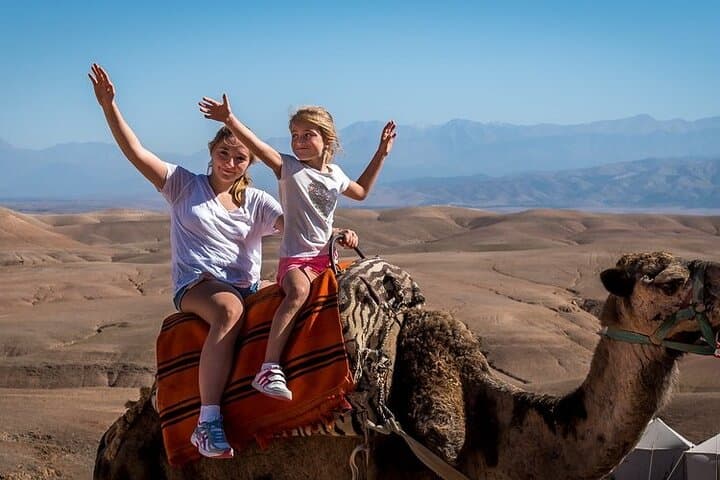
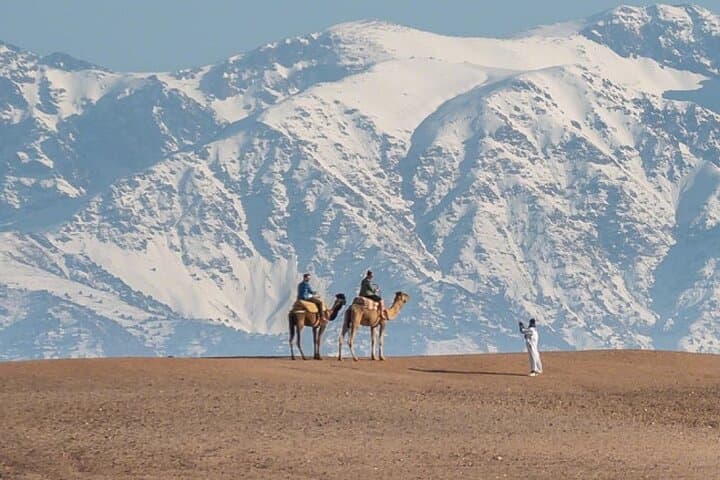
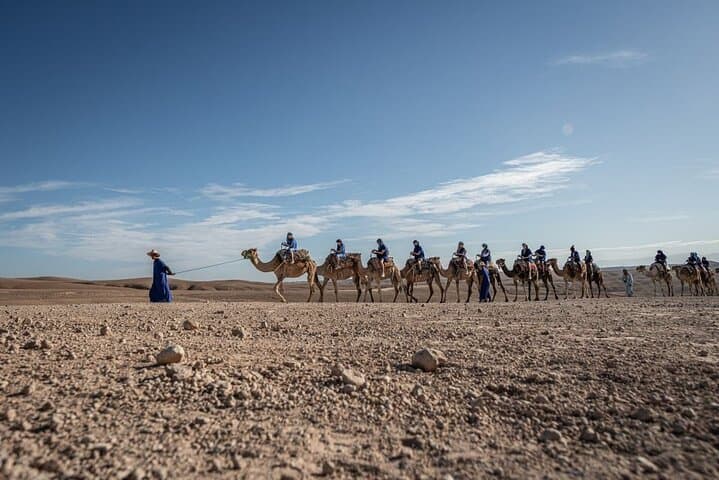
A wind-swept plain of broken stone rolls away from the road as your van slides out of Marrakech and toward the Agafay. Camels line up like patient ships on a rocky sea; the Atlas Mountains puncture the horizon, their ridges daring you to look closer.
A wind-swept plain of broken stone rolls away from the road as your van slides out of Marrakech and toward the Agafay. Camels line up like patient ships on a rocky sea; the Atlas Mountains puncture the horizon, their ridges daring you to look closer.
The Agafay is not true sand dune desert but a stony reg of ancient riverbeds and fractured bedrock shaped by wind and episodic rains. Berber and local rural communities have long used the plain for grazing and as a transit corridor between Marrakech and High Atlas settlements, and the camel remains a practical emblem of travel and trade here.
Culturally, the experience centers on hospitality: a mint tea ceremony, a short visit to a local house and a chance to learn simple desert rhythms. Geologically, you’ll notice coarse gravel, sculpted stone slabs and the occasional dry wadi channel—terrain that makes the camel a sensible mount rather than a novelty.
Practically, this is a 4‑hour experience from Marrakech (about 45 minutes each way) with roughly 90 minutes in the saddle. Dress for strong sun and temperature swings: breathable layers, closed shoes for mounting, and a hat. Carry water and a small daypack for your camera and sunscreen. The ride is gentle and suitable for most fitness levels, but it’s not recommended for pregnant travelers.
Expect modest facilities at the meeting spot, friendly local hosts, and straightforward logistics: private transfers, drop‑off in the city, and a compact window to taste desert space without committing to an overnight.