THE ADVENTURE COLLECTIVE® · Independent discovery and booking for outdoor travel

See Agadir’s bay, Casbah and sprawling Souk El Had in a focused three-hour tour that blends history, coastal geology and hands-on culture. Perfect for a first-time visit or a quick city orientation, with stops at an argan cooperative and the marina.
See Agadir’s bay, Casbah and sprawling Souk El Had in a focused three-hour tour that blends history, coastal geology and hands-on culture. Perfect for a first-time visit or a quick city orientation, with stops at an argan cooperative and the marina.
The afternoon light slants over Agadir’s corniche as the tour vehicle pulls up and the ocean keeps its steady, salty rhythm—an easy introduction to a city rebuilt after 1960’s earthquake. From the car you climb toward Agadir Oufella (the Casbah), where wind-swept ruins and a simple stone wall give a clear, panoramic read on the bay, marina and the spread of low-rise white buildings below.
Verified experiences and guided adventures in the surrounding area.
Operated by REDALI TOURS · Agadir, Souss-Massa
The afternoon light slants over Agadir’s corniche as the tour vehicle pulls up and the ocean keeps its steady, salty rhythm—an easy introduction to a city rebuilt after 1960’s earthquake. From the car you climb toward Agadir Oufella (the Casbah), where wind-swept ruins and a simple stone wall give a clear, panoramic read on the bay, marina and the spread of low-rise white buildings below.
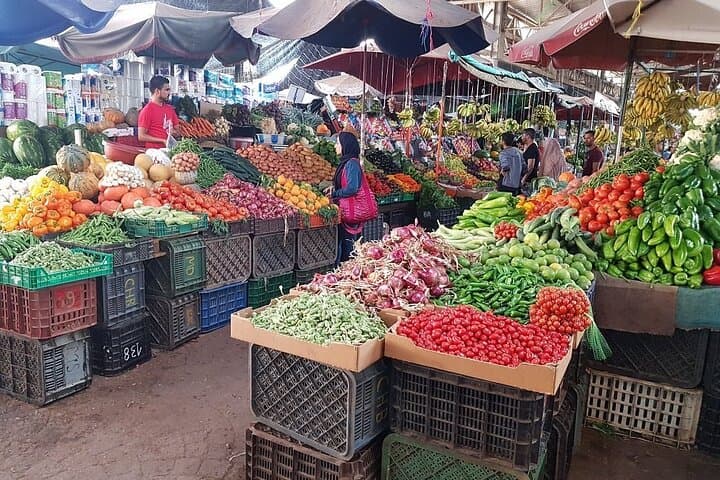
This compact tour stitches recent history and living culture: the Casbah’s 16th-century foundation, the city’s reinvention after the quake, and the modern marina born of a 2007 development push. Geologically, Agadir sits on a fertile coastal plain backed by the Anti-Atlas foothills; the sand and wind shape the shoreline and the city’s flat, accessible layout. Culture arrives in small, human-scale moments—the cooperative where local women press argan oil from roasted kernels, explaining each step from nut to jar, and Souk El Had, a 12-hectare market where stalls are organized by trade and bargaining is part performance.
Practical: the excursion is three hours, mostly by air-conditioned vehicle with short guided stops and about an hour of free time at the souk. Expect paved walking, uneven archaeological paths at the Casbah, and crowded market lanes. Photography is welcome but be respectful in religious sites and cooperative workshops. Carry cash for small purchases, sun protection for exposed viewpoints, and comfortable shoes for up to 30–45 minutes of walking in short segments. The route is accessible for most abilities and offers a concentrated, sensible primer on Agadir’s coastal life—good planning for a longer stay or a quick cultural orientation.
easy.
3 hours.
Suitable for most fitness levels; involves short walks and some uneven surfaces at viewpoints.
Yes—most bookings include pickup from central Agadir hotels; confirm your pickup point when you book.
The vehicle and many stops are wheelchair accessible, but the Casbah ruins have uneven ground and limited access—contact the operator to plan accommodations.
Yes—the cooperative sells locally produced argan oil and cosmetics; buying supports local women’s cooperatives, and small purchases are expected in cash or card depending on the vendor.
The itinerary includes about one hour of free time at Souk El Had to explore independently and shop.
Agadir was largely rebuilt after a devastating 1960 earthquake; the Casbah’s ruins and the city’s wide avenues reflect both its 16th-century origins and 20th-century reconstruction.
Local argan cooperatives practice traditional harvesting that supports the Argana biosphere; visitors are encouraged to buy directly from cooperatives to support sustainable local economies.
REDALI TOURS operates guided outdoor trips and adventures with an emphasis on safety, stewardship, and memorable experiences.



The afternoon light slants over Agadir’s corniche as the tour vehicle pulls up and the ocean keeps its steady, salty rhythm—an easy introduction to a city rebuilt after 1960’s earthquake. From the car you climb toward Agadir Oufella (the Casbah), where wind-swept ruins and a simple stone wall give a clear, panoramic read on the bay, marina and the spread of low-rise white buildings below.
The afternoon light slants over Agadir’s corniche as the tour vehicle pulls up and the ocean keeps its steady, salty rhythm—an easy introduction to a city rebuilt after 1960’s earthquake. From the car you climb toward Agadir Oufella (the Casbah), where wind-swept ruins and a simple stone wall give a clear, panoramic read on the bay, marina and the spread of low-rise white buildings below.
This compact tour stitches recent history and living culture: the Casbah’s 16th-century foundation, the city’s reinvention after the quake, and the modern marina born of a 2007 development push. Geologically, Agadir sits on a fertile coastal plain backed by the Anti-Atlas foothills; the sand and wind shape the shoreline and the city’s flat, accessible layout. Culture arrives in small, human-scale moments—the cooperative where local women press argan oil from roasted kernels, explaining each step from nut to jar, and Souk El Had, a 12-hectare market where stalls are organized by trade and bargaining is part performance.
Practical: the excursion is three hours, mostly by air-conditioned vehicle with short guided stops and about an hour of free time at the souk. Expect paved walking, uneven archaeological paths at the Casbah, and crowded market lanes. Photography is welcome but be respectful in religious sites and cooperative workshops. Carry cash for small purchases, sun protection for exposed viewpoints, and comfortable shoes for up to 30–45 minutes of walking in short segments. The route is accessible for most abilities and offers a concentrated, sensible primer on Agadir’s coastal life—good planning for a longer stay or a quick cultural orientation.