THE ADVENTURE COLLECTIVE® · Independent discovery and booking for outdoor travel

See Agadir’s seaside panorama from the Kasbah, then dive into Souk El Hed on a focused three-hour guided tour with hotel pickup and drop-off. Ideal for first-time visitors who want a compact introduction to the city’s history, markets and coastline.
See Agadir’s seaside panorama from the Kasbah, then dive into Souk El Hed on a focused three-hour guided tour with hotel pickup and drop-off. Ideal for first-time visitors who want a compact introduction to the city’s history, markets and coastline.
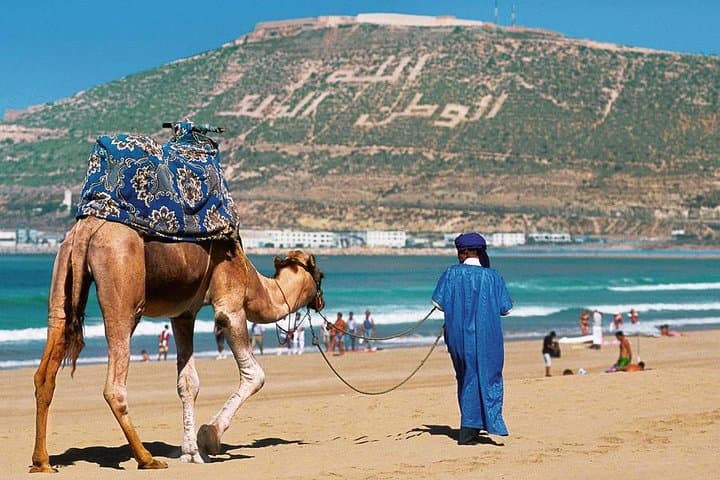
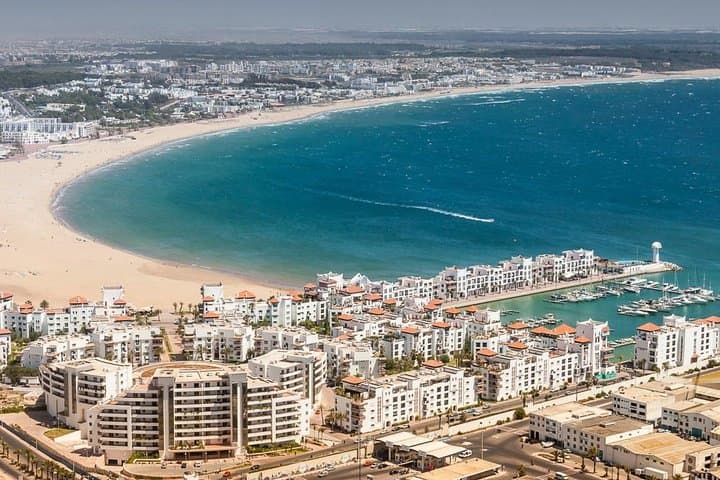
Wind from the Atlantic pushes up the stone slope to the Kasbah and the city opens below: a sweep of beach, the marina’s bobbing masts, and the low-rise blocks that rose after the 1960 quake. In three hours a local guide steers you through those frames — a ruined fortress viewpoint, a quick coastal drive and the crowded lanes of Souk El Hed where voices and spices press in close.
Verified experiences and guided adventures in the surrounding area.
Operated by Marvels Tours · Agadir, Souss-Massa
Wind from the Atlantic pushes up the stone slope to the Kasbah and the city opens below: a sweep of beach, the marina’s bobbing masts, and the low-rise blocks that rose after the 1960 quake. In three hours a local guide steers you through those frames — a ruined fortress viewpoint, a quick coastal drive and the crowded lanes of Souk El Hed where voices and spices press in close.
Agadir sits on the Souss plain where the Atlas foothills meet the ocean. The modern city was rebuilt after the 1960 earthquake; visible ruins at the Kasbah give a first-hand lesson in that history. Geologically, the coast is a mix of sandy spits and riverine estuaries — Oued Souss carves saline wetlands that attract birds. Culturally, the area blends Arab and Amazigh traditions; Souk El Hed remains the regional trading heart for produce, textiles and crafts.
Practical guidance: tours include hotel pickup and air-conditioned transport and last about three hours, making this a concentrated primer rather than a deep exploration. Mornings are cooler and better for clear Kasbah views; bring cash for small purchases and expect to haggle politely. Wear closed-toe shoes for cobbled alleys and a hat for strong sun; markets can be crowded and steps at viewpoints are uneven. Service animals are permitted on this tour, and guides will point out local produce, fishing history and craft techniques as you move between stops. For travelers short on time, this is a compact, informed way to read Agadir’s recent history and lively present.
easy.
3 hours.
Suitable for all fitness levels; minimal walking but some uneven ground and steps.
Yes — the tour includes air-conditioned transportation with pickup and drop-off from most Agadir hotels.
Yes — the itinerary is classified as easy with minimal walking; some stops have uneven ground and steps to the Kasbah.
The Kasbah is a ruin and accessible for views, but facilities are basic and there may be stairs and loose stone underfoot.
Most stalls prefer cash; larger shops may accept cards but bring Moroccan dirham for the best experience.
Agadir was largely rebuilt after a catastrophic 1960 earthquake; the Kasbah ruins above the city are a visible reminder of that event and of the city’s coastal trading past.
The Souss-Massa coastal wetlands are ecologically sensitive; visitors should avoid disturbing birds and minimize plastic and food waste in market areas.
Marvels Tours operates guided outdoor trips and adventures with an emphasis on safety, stewardship, and memorable experiences.
Wind from the Atlantic pushes up the stone slope to the Kasbah and the city opens below: a sweep of beach, the marina’s bobbing masts, and the low-rise blocks that rose after the 1960 quake. In three hours a local guide steers you through those frames — a ruined fortress viewpoint, a quick coastal drive and the crowded lanes of Souk El Hed where voices and spices press in close.
Wind from the Atlantic pushes up the stone slope to the Kasbah and the city opens below: a sweep of beach, the marina’s bobbing masts, and the low-rise blocks that rose after the 1960 quake. In three hours a local guide steers you through those frames — a ruined fortress viewpoint, a quick coastal drive and the crowded lanes of Souk El Hed where voices and spices press in close.
Agadir sits on the Souss plain where the Atlas foothills meet the ocean. The modern city was rebuilt after the 1960 earthquake; visible ruins at the Kasbah give a first-hand lesson in that history. Geologically, the coast is a mix of sandy spits and riverine estuaries — Oued Souss carves saline wetlands that attract birds. Culturally, the area blends Arab and Amazigh traditions; Souk El Hed remains the regional trading heart for produce, textiles and crafts.
Practical guidance: tours include hotel pickup and air-conditioned transport and last about three hours, making this a concentrated primer rather than a deep exploration. Mornings are cooler and better for clear Kasbah views; bring cash for small purchases and expect to haggle politely. Wear closed-toe shoes for cobbled alleys and a hat for strong sun; markets can be crowded and steps at viewpoints are uneven. Service animals are permitted on this tour, and guides will point out local produce, fishing history and craft techniques as you move between stops. For travelers short on time, this is a compact, informed way to read Agadir’s recent history and lively present.