THE ADVENTURE COLLECTIVE® · Independent discovery and booking for outdoor travel

A five-day sweep across western Turkey that pairs Pamukkale’s calcium-white terraces with the marble streets of Ephesus and the otherworldly landscapes of Cappadocia. Expect guided ruins walks, thermal pools, local crafts and short regional flights between iconic sites.
A five-day sweep across western Turkey that pairs Pamukkale’s calcium-white terraces with the marble streets of Ephesus and the otherworldly landscapes of Cappadocia. Expect guided ruins walks, thermal pools, local crafts and short regional flights between iconic sites.
A white slope catches the light like a whale's spine against the Aegean sky — the travertine terraces of Pamukkale are the first scene in a five-day route that reads like an atlas of Anatolia’s ancient wealth. You step from the shuttle onto lime-soaked stone, the warm mineral water whispering across shallow pools, and a guide points toward the crumbled theater of Hierapolis, where steps lead down into an amphitheater that once held thousands.
Verified experiences and guided adventures in the surrounding area.
Operated by Turkey Experiences · Pamukkale, Denizli
A white slope catches the light like a whale's spine against the Aegean sky — the travertine terraces of Pamukkale are the first scene in a five-day route that reads like an atlas of Anatolia’s ancient wealth. You step from the shuttle onto lime-soaked stone, the warm mineral water whispering across shallow pools, and a guide points toward the crumbled theater of Hierapolis, where steps lead down into an amphitheater that once held thousands.
The tour threads together geologic spectacle and urban archaeology. Pamukkale’s travertines formed over millennia as calcium-rich springs cooled; the same thermal system fed Hierapolis, a Roman spa-city whose agora, baths and necropolis speak to rituals of healing that began in the Bronze Age and peaked in Roman times. From there the route shifts west to Ephesus — a harbor city that rose to prominence in classical Greece and Rome, its marble streets and the Celsus Library still oriented toward the sea that has receded a kilometer since antiquity.
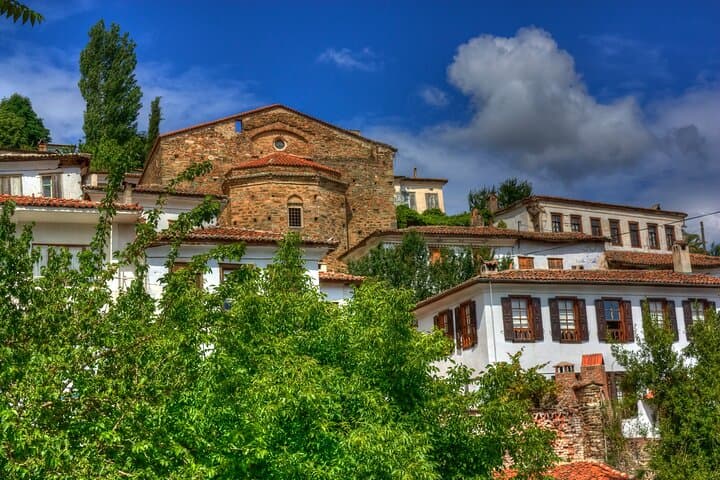
On day two the itinerary moves inland to Miletus, Priene and the village of Doganbey, where Ottoman inns and Greek-built houses bear the scars of 20th-century population exchanges. The program finishes with Cappadocia’s stone-carved churches, fairy chimneys and the optional, gravity-light lift of a hot-air balloon at sunrise — 700–1,000 meters above an extraterrestrial plain of eroded tuff.
Practicalities are straightforward but substantive: expect multiple short flights (Denizli/Denizli-Çardak, Izmir, Nevşehir) and daily drives of one to three hours between sites. Walking is the core activity — cobbled streets, archaeological terraces and uneven dirt trails mean good ankle support is non-negotiable. The tour is semi-private (max 10 guests), includes most breakfasts and lunches, and schedules time for craft demonstrations — from pottery in Avanos to carpet weaving in Cappadocia.
Plan for variable microclimates: Pamukkale’s terraces feel hot at midday; Ephesus offers shade but long exposed walks; Cappadocia is markedly cooler at dawn and in the valleys. Hydrate deliberately, carry layered clothing for morning balloons and afternoon walks, and protect your camera from steam and spray near thermal pools. Photographers should aim for sunrise over Cappadocia or late afternoon on Pamukkale’s terraces when low light brings texture and color.
This is a trip for travelers who want history in motion: baths still steaming, libraries frozen in marble, and villages where architecture narrates centuries. It’s not a rugged expedition, but it does ask for a steady pair of legs, curiosity for layered histories, and some patience for regional transfers — rewards that arrive as panoramic vistas, quiet ruins and the odd moment when ancient stone and active landscape suddenly align.
moderate.
5 days.
Moderate — able to walk 2–4 miles a day on uneven ground and manage short flights/transfers.
The tour includes guided visits and most site access; some optional attractions like the Antique (Cleopatra) Pool and certain museum entries may require extra fees.
Plan for 2–4 miles of walking on uneven surfaces daily, with stairs in amphitheaters and some dirt trails in Cappadocia — moderate fitness is recommended.
Regional flights referenced in the itinerary are included where specified; verify your chosen package option, as some variations (Flexible/Standard) change inclusions.
The hot-air balloon is optional depending on package choice and weather; paragliding at Pamukkale is offered as an extra-cost add-on.
Infants can join but must sit on laps; the itinerary is semi-private and includes some long transfer periods — consider your child’s tolerance for travel and walking.
Tours are semi-private with a maximum of 10 guests; guides operate in the language specified at booking — check availability for your preferred language.
Hierapolis was a Roman spa founded on hot springs and expanded under Roman rule; Ephesus was a major Ionian port and later a Roman metropolis with the Celsus Library as its monumental face.
Pamukkale is a UNESCO site with strict rules to protect the fragile travertines—stay on designated paths and avoid applying lotions before entering thermal pools to reduce contamination.
Turkey Experiences operates guided outdoor trips and adventures with an emphasis on safety, stewardship, and memorable experiences.



A white slope catches the light like a whale's spine against the Aegean sky — the travertine terraces of Pamukkale are the first scene in a five-day route that reads like an atlas of Anatolia’s ancient wealth. You step from the shuttle onto lime-soaked stone, the warm mineral water whispering across shallow pools, and a guide points toward the crumbled theater of Hierapolis, where steps lead down into an amphitheater that once held thousands.
A white slope catches the light like a whale's spine against the Aegean sky — the travertine terraces of Pamukkale are the first scene in a five-day route that reads like an atlas of Anatolia’s ancient wealth. You step from the shuttle onto lime-soaked stone, the warm mineral water whispering across shallow pools, and a guide points toward the crumbled theater of Hierapolis, where steps lead down into an amphitheater that once held thousands.
The tour threads together geologic spectacle and urban archaeology. Pamukkale’s travertines formed over millennia as calcium-rich springs cooled; the same thermal system fed Hierapolis, a Roman spa-city whose agora, baths and necropolis speak to rituals of healing that began in the Bronze Age and peaked in Roman times. From there the route shifts west to Ephesus — a harbor city that rose to prominence in classical Greece and Rome, its marble streets and the Celsus Library still oriented toward the sea that has receded a kilometer since antiquity.
On day two the itinerary moves inland to Miletus, Priene and the village of Doganbey, where Ottoman inns and Greek-built houses bear the scars of 20th-century population exchanges. The program finishes with Cappadocia’s stone-carved churches, fairy chimneys and the optional, gravity-light lift of a hot-air balloon at sunrise — 700–1,000 meters above an extraterrestrial plain of eroded tuff.
Practicalities are straightforward but substantive: expect multiple short flights (Denizli/Denizli-Çardak, Izmir, Nevşehir) and daily drives of one to three hours between sites. Walking is the core activity — cobbled streets, archaeological terraces and uneven dirt trails mean good ankle support is non-negotiable. The tour is semi-private (max 10 guests), includes most breakfasts and lunches, and schedules time for craft demonstrations — from pottery in Avanos to carpet weaving in Cappadocia.
Plan for variable microclimates: Pamukkale’s terraces feel hot at midday; Ephesus offers shade but long exposed walks; Cappadocia is markedly cooler at dawn and in the valleys. Hydrate deliberately, carry layered clothing for morning balloons and afternoon walks, and protect your camera from steam and spray near thermal pools. Photographers should aim for sunrise over Cappadocia or late afternoon on Pamukkale’s terraces when low light brings texture and color.
This is a trip for travelers who want history in motion: baths still steaming, libraries frozen in marble, and villages where architecture narrates centuries. It’s not a rugged expedition, but it does ask for a steady pair of legs, curiosity for layered histories, and some patience for regional transfers — rewards that arrive as panoramic vistas, quiet ruins and the odd moment when ancient stone and active landscape suddenly align.