THE ADVENTURE COLLECTIVE® · Independent discovery and booking for outdoor travel

Link Pamukkale’s otherworldly white travertines with the marble avenues of Ephesus on a focused two‑day semi‑private tour. Expect guided archaeology, thermal pools, and compact logistics designed for travelers wanting both nature and history.
Link Pamukkale’s otherworldly white travertines with the marble avenues of Ephesus on a focused two‑day semi‑private tour. Expect guided archaeology, thermal pools, and compact logistics designed for travelers wanting both nature and history.
Morning light on the Aegean washes Kusadasi’s bay in a cool silver; by midday you’re inland, the road climbing toward Pamukkale’s bleached terraces that look almost engineered by winter. The travertine steps stare back, warm water daring you to walk their shallow pools barefoot while steam threads the air.
Verified experiences and guided adventures in the surrounding area.
Operated by Turkey Experiences · Kusadasi, Aydın
Morning light on the Aegean washes Kusadasi’s bay in a cool silver; by midday you’re inland, the road climbing toward Pamukkale’s bleached terraces that look almost engineered by winter. The travertine steps stare back, warm water daring you to walk their shallow pools barefoot while steam threads the air.
This compact two‑day loop pairs Pamukkale’s calcium‑rich hot springs and the graveled avenues of Hierapolis with Ephesus’s marble theaters and the Celsus Library. Geology here is obvious: mineral‑laden thermal water deposits calcite over millennia, creating the white travertines that UNESCO protects. Ephesus, once a major Roman port, still announces itself in grand facades, while nearby sites — the House of the Virgin and the Byzantine basilica of St. John — underline the region’s layered religious history.
Culturally the Aegean blends Greek and Ottoman influences: seaside fishing towns, handcraft cooperatives, and small tavernas serving lente beans and charcoal‑grilled fish. Local guides licensed by Turkey’s Ministry of Culture add context, and limited group sizes (max 10) keep the pace personal.
Practical edge: expect several hours of walking on uneven stone, some barefoot sections at Pamukkale, and tight domestic flight luggage limits if your itinerary includes internal flights. Bring sun protection, a lightweight daypack, and comfortable walking shoes you can remove easily. Optional extras — Cleopatra’s Antique Pool or tandem paragliding — are memorable but cost extra. Time your visit for early morning light at Ephesus and late afternoon at Pamukkale to avoid the hottest hours and crowds.
moderate.
2 days (approx. 48 hours).
Moderate fitness: able to walk 2–4 hours across uneven terrain and climb stairs; comfortable standing for guided talks.
The tour operator provides entrance tickets for museums and ruins as described, but optional activities such as Cleopatra’s Antique Pool swim and paragliding require extra payment.
You may wade in designated travertine channels barefoot; access to the Antique (Cleopatra’s) Pool is an extra‑fee swim in a separate, clearer thermal pool.
Yes—solo travelers are accommodated without a solo supplement and will be assigned single rooms when available, though single room upgrades may cost extra.
Yes—the operator offers an option to fly from Izmir to Cappadocia and provide transfers there; selecting that option adjusts included return flight arrangements.
Ephesus rose as a major Roman port and civic center; Hierapolis grew around thermal springs and developed as a healing center in antiquity.
Pamukkale’s travertines are fragile and legally protected — walking is restricted to set paths and barefoot sections to limit damage; visitors should avoid soaps and lotions in thermal waters.
Turkey Experiences operates guided outdoor trips and adventures with an emphasis on safety, stewardship, and memorable experiences.


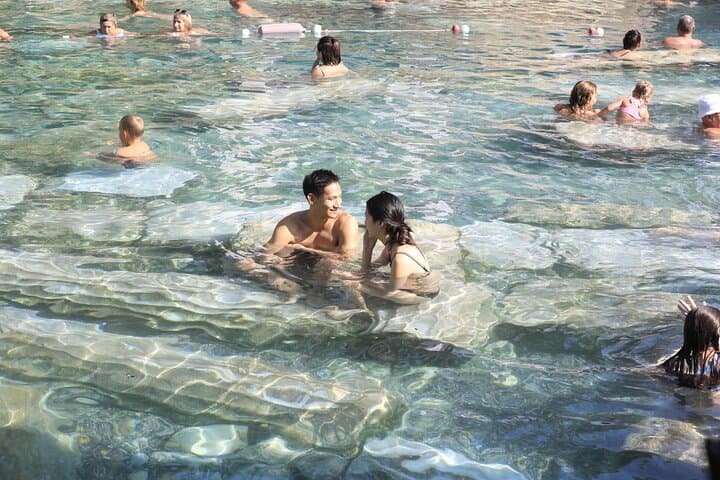
Morning light on the Aegean washes Kusadasi’s bay in a cool silver; by midday you’re inland, the road climbing toward Pamukkale’s bleached terraces that look almost engineered by winter. The travertine steps stare back, warm water daring you to walk their shallow pools barefoot while steam threads the air.
Morning light on the Aegean washes Kusadasi’s bay in a cool silver; by midday you’re inland, the road climbing toward Pamukkale’s bleached terraces that look almost engineered by winter. The travertine steps stare back, warm water daring you to walk their shallow pools barefoot while steam threads the air.
This compact two‑day loop pairs Pamukkale’s calcium‑rich hot springs and the graveled avenues of Hierapolis with Ephesus’s marble theaters and the Celsus Library. Geology here is obvious: mineral‑laden thermal water deposits calcite over millennia, creating the white travertines that UNESCO protects. Ephesus, once a major Roman port, still announces itself in grand facades, while nearby sites — the House of the Virgin and the Byzantine basilica of St. John — underline the region’s layered religious history.
Culturally the Aegean blends Greek and Ottoman influences: seaside fishing towns, handcraft cooperatives, and small tavernas serving lente beans and charcoal‑grilled fish. Local guides licensed by Turkey’s Ministry of Culture add context, and limited group sizes (max 10) keep the pace personal.
Practical edge: expect several hours of walking on uneven stone, some barefoot sections at Pamukkale, and tight domestic flight luggage limits if your itinerary includes internal flights. Bring sun protection, a lightweight daypack, and comfortable walking shoes you can remove easily. Optional extras — Cleopatra’s Antique Pool or tandem paragliding — are memorable but cost extra. Time your visit for early morning light at Ephesus and late afternoon at Pamukkale to avoid the hottest hours and crowds.