THE ADVENTURE COLLECTIVE® · Independent discovery and booking for outdoor travel

Fly from Aswan to Abu Simbel for a focused morning at the rock-cut temples of Ramses II and Nefertari. This private round-trip flight tour delivers big sights with minimal transit—ideal for time-pressed travelers who want a high-impact cultural day.
Fly from Aswan to Abu Simbel for a focused morning at the rock-cut temples of Ramses II and Nefertari. This private round-trip flight tour delivers big sights with minimal transit—ideal for time-pressed travelers who want a high-impact cultural day.
You step out of the small aircraft into a sun-baked sweep of sand and stone; Lake Nasser glints like a stubborn oasis and the four colossal faces of Ramses II loom from the cliff, watching the desert and the sky. The arrival itself is cinematic—short transfer, a few steps, and the rock-cut facades dominate the horizon with the blunt confidence of monuments that have weathered centuries.
Verified experiences and guided adventures in the surrounding area.
Operated by This is Egypt Tours · Abu Simbel, Aswan Governorate
You step out of the small aircraft into a sun-baked sweep of sand and stone; Lake Nasser glints like a stubborn oasis and the four colossal faces of Ramses II loom from the cliff, watching the desert and the sky. The arrival itself is cinematic—short transfer, a few steps, and the rock-cut facades dominate the horizon with the blunt confidence of monuments that have weathered centuries.
The two main temples—Ramses II’s Great Temple and the smaller temple to Queen Nefertari—date to the 13th century BCE and were rediscovered in 1813. In the 1960s both were dismantled and relocated, block by block, to higher ground during a UNESCO-led campaign to save them from the rising waters of the Aswan High Dam. The sandstone cliffs around Abu Simbel record both geological and human time: stratified desert rock that has been carved and moved to preserve a cultural landmark.
Practically, this is a compact, low-impact day: an early-morning pick-up in Aswan, a short domestic flight, 2–3 hours on site and an afternoon return. Expect exposed sun, limited shade, and a fair number of steps inside the temples. The site is accessible by wheelchair in primary areas, but terrain around viewpoints is uneven.
Bring sun protection, your passport (required for the flight), and a camera with a long lens if you want close-ups of hieroglyphic reliefs. Aim for the morning light to capture sculpture depth; late morning brings harsher shadows but fewer crowds. This tour is an efficient way to see one of ancient Egypt’s most dramatic monuments without an overnight desert slog.
easy.
6 hours.
Minimal fitness required; must be able to walk short distances and climb stairs inside temple interiors.
Yes—domestic flights in Egypt require a passport or national ID; bring the same document used when booking.
Flights are short—generally around 45–60 minutes each way—plus ground transfer times for hotel pick-up and drop-off.
Primary viewing areas and transfers are noted as wheelchair accessible, but some viewpoints and temple interiors have steps or uneven ground.
Most itineraries allow approximately 2–3 hours on site, enough to see the exteriors and enter the main temple chambers.
Abu Simbel’s twin temples were carved under Ramses II in the 13th century BCE and were relocated in the 1960s to escape the newly formed Lake Nasser under a UNESCO-led salvage operation.
The relocation preserved the monuments but ongoing conservation addresses salt crystallization and wind abrasion; visitors are asked to follow established paths and avoid touching reliefs.
This is Egypt Tours operates guided outdoor trips and adventures with an emphasis on safety, stewardship, and memorable experiences.
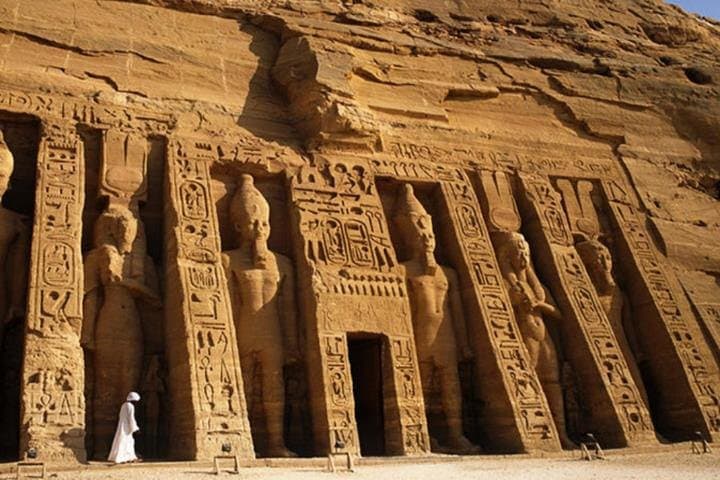


You step out of the small aircraft into a sun-baked sweep of sand and stone; Lake Nasser glints like a stubborn oasis and the four colossal faces of Ramses II loom from the cliff, watching the desert and the sky. The arrival itself is cinematic—short transfer, a few steps, and the rock-cut facades dominate the horizon with the blunt confidence of monuments that have weathered centuries.
You step out of the small aircraft into a sun-baked sweep of sand and stone; Lake Nasser glints like a stubborn oasis and the four colossal faces of Ramses II loom from the cliff, watching the desert and the sky. The arrival itself is cinematic—short transfer, a few steps, and the rock-cut facades dominate the horizon with the blunt confidence of monuments that have weathered centuries.
The two main temples—Ramses II’s Great Temple and the smaller temple to Queen Nefertari—date to the 13th century BCE and were rediscovered in 1813. In the 1960s both were dismantled and relocated, block by block, to higher ground during a UNESCO-led campaign to save them from the rising waters of the Aswan High Dam. The sandstone cliffs around Abu Simbel record both geological and human time: stratified desert rock that has been carved and moved to preserve a cultural landmark.
Practically, this is a compact, low-impact day: an early-morning pick-up in Aswan, a short domestic flight, 2–3 hours on site and an afternoon return. Expect exposed sun, limited shade, and a fair number of steps inside the temples. The site is accessible by wheelchair in primary areas, but terrain around viewpoints is uneven.
Bring sun protection, your passport (required for the flight), and a camera with a long lens if you want close-ups of hieroglyphic reliefs. Aim for the morning light to capture sculpture depth; late morning brings harsher shadows but fewer crowds. This tour is an efficient way to see one of ancient Egypt’s most dramatic monuments without an overnight desert slog.