THE ADVENTURE COLLECTIVE® · Independent discovery and booking for outdoor travel

A compact, two‑day cultural road trip from Aswan that pairs modern engineering and ancient grandeur. Visit the High Dam, study an unfinished obelisk in the quarry, wander Philae’s island temples, then travel south to the colossal twin temples of Abu Simbel.
A compact, two‑day cultural road trip from Aswan that pairs modern engineering and ancient grandeur. Visit the High Dam, study an unfinished obelisk in the quarry, wander Philae’s island temples, then travel south to the colossal twin temples of Abu Simbel.
You step off the air‑conditioned minivan into a dry heat that seems to steady itself around the stone—Nile water glints nearby and the desert pushes its ochre slopes toward the horizon.
Verified experiences and guided adventures in the surrounding area.
Operated by Book My Egypt Tours · Aswan, Aswan Governorate
You step off the air‑conditioned minivan into a dry heat that seems to steady itself around the stone—Nile water glints nearby and the desert pushes its ochre slopes toward the horizon.
Day one unfolds in Aswan: the concrete scale of the High Dam, the raw, half‑carved Unfinished Obelisk and the small, island sanctuary of Philae. The dam’s broad crest offers a surprising panorama of Lake Nasser and the river’s controlled sweep; the obelisk shows quarrying scars that reveal ancient techniques; Philae’s columns and hieroglyphs keep the island’s rituals audible to a modern ear.
On day two you drive south toward Abu Simbel, a four‑hour corridor through sandstone and scrub where the colossal façades of Ramses II and Nefertari suddenly command the desert. These temples were rescued from rising waters in a 1960s UNESCO operation—an engineering story as much as an archaeological one. Geology here is simple and stark: Nubian sandstone, granite outcrops and the flat floodplain carved by millennia of Nile flow.
Expect guided walking at each site, short approaches from boats at Philae, and flat paved surfaces around Abu Simbel’s entrance. Cultural context—pharaonic state religion, royal commemoration and 20th‑century preservation—threads every stop.
Practical guidance: carry original passport for tickets, move slowly in midday heat, wear sun protection and comfortable walking shoes, and bring a refillable bottle—the region is arid and shade is limited. Morning visits give the best light and cooler temperatures; guides typically handle logistics and entrance paperwork but have cash ready for small local purchases.
easy.
2 days.
Suitable for most travelers who can walk short distances and handle a few stairs; no sustained exertion.
The road transfer is roughly 3 to 4 hours each way by air‑conditioned vehicle depending on traffic and stops.
Some tour options include basic entrance fees—confirm at booking and have cash ready if upgrades are desired.
Sites have uneven surfaces and steps; Philae requires a short boat transfer. Travelers with limited mobility should notify the operator in advance to assess accessibility.
Early morning visits offer cooler temperatures and cleaner light for photography; late afternoon can also be pleasant but hotter in summer.
The High Dam transformed the Nile’s flood regime and created Lake Nasser; UNESCO coordinated the 1960s relocation of Abu Simbel to save it from the reservoir.
Visitor limits and controlled walkways protect fragile reliefs; stick to marked paths, avoid touching carved surfaces, and support local conservation fees when offered.
Book My Egypt Tours operates guided outdoor trips and adventures with an emphasis on safety, stewardship, and memorable experiences.
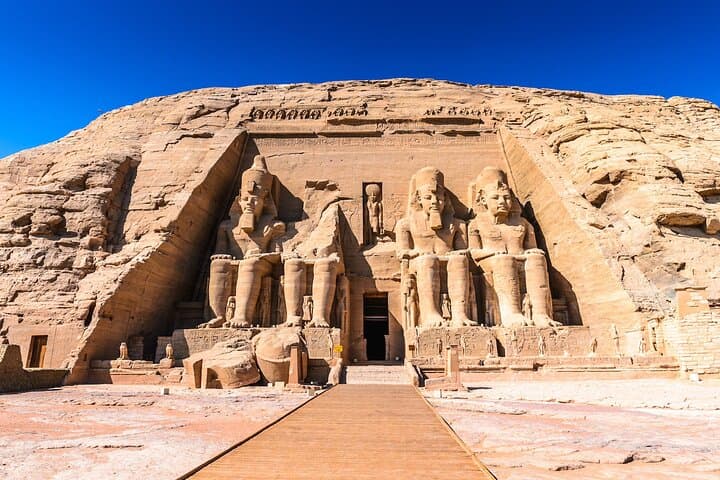


You step off the air‑conditioned minivan into a dry heat that seems to steady itself around the stone—Nile water glints nearby and the desert pushes its ochre slopes toward the horizon.
You step off the air‑conditioned minivan into a dry heat that seems to steady itself around the stone—Nile water glints nearby and the desert pushes its ochre slopes toward the horizon.
Day one unfolds in Aswan: the concrete scale of the High Dam, the raw, half‑carved Unfinished Obelisk and the small, island sanctuary of Philae. The dam’s broad crest offers a surprising panorama of Lake Nasser and the river’s controlled sweep; the obelisk shows quarrying scars that reveal ancient techniques; Philae’s columns and hieroglyphs keep the island’s rituals audible to a modern ear.
On day two you drive south toward Abu Simbel, a four‑hour corridor through sandstone and scrub where the colossal façades of Ramses II and Nefertari suddenly command the desert. These temples were rescued from rising waters in a 1960s UNESCO operation—an engineering story as much as an archaeological one. Geology here is simple and stark: Nubian sandstone, granite outcrops and the flat floodplain carved by millennia of Nile flow.
Expect guided walking at each site, short approaches from boats at Philae, and flat paved surfaces around Abu Simbel’s entrance. Cultural context—pharaonic state religion, royal commemoration and 20th‑century preservation—threads every stop.
Practical guidance: carry original passport for tickets, move slowly in midday heat, wear sun protection and comfortable walking shoes, and bring a refillable bottle—the region is arid and shade is limited. Morning visits give the best light and cooler temperatures; guides typically handle logistics and entrance paperwork but have cash ready for small local purchases.