THE ADVENTURE COLLECTIVE® · Independent discovery and booking for outdoor travel

Walk from Marrakech across the Atlas to the sweeping dunes of Erg Chegaga on an 8-day guided trek that balances cultural encounters with long desert days—camels carry your bags, guides set the camps, you keep the rhythm of the sand.
Walk from Marrakech across the Atlas to the sweeping dunes of Erg Chegaga on an 8-day guided trek that balances cultural encounters with long desert days—camels carry your bags, guides set the camps, you keep the rhythm of the sand.
A long dust-colored horizon opens as you leave Marrakech and climb over the Atlas: the city’s bustle slips into a line of palm groves and ochre villages, then into the silent stretch of the Sahara. On day two you arrive in Zagora and, from there, walk southwest beyond the last foothills of Djebel Bani toward Mhasser canyon—rock faces that flash mineral stripes in the sun—and finally the broad, wind-sculpted dunes of Erg Chegaga.
Verified experiences and guided adventures in the surrounding area.
Operated by Bivouac Erg Chegaga Nomademoi · Marrakech, Marrakesh-Safi
A long dust-colored horizon opens as you leave Marrakech and climb over the Atlas: the city’s bustle slips into a line of palm groves and ochre villages, then into the silent stretch of the Sahara. On day two you arrive in Zagora and, from there, walk southwest beyond the last foothills of Djebel Bani toward Mhasser canyon—rock faces that flash mineral stripes in the sun—and finally the broad, wind-sculpted dunes of Erg Chegaga.
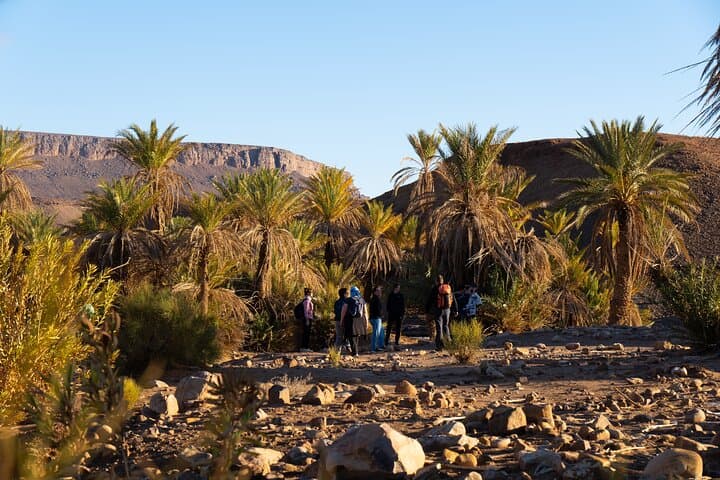
This route threads Berber villages, dry riverbeds, and scattered oases. Geologically the landscape is recent: wind-blown sand fields overlay older red and grey sedimentary plains carved by ephemeral rivers. Culturally the trek is shaped by nomadic and semi-nomadic traditions; local guides share stories and music around the campfire and camels transport your duffel between bivouacs.
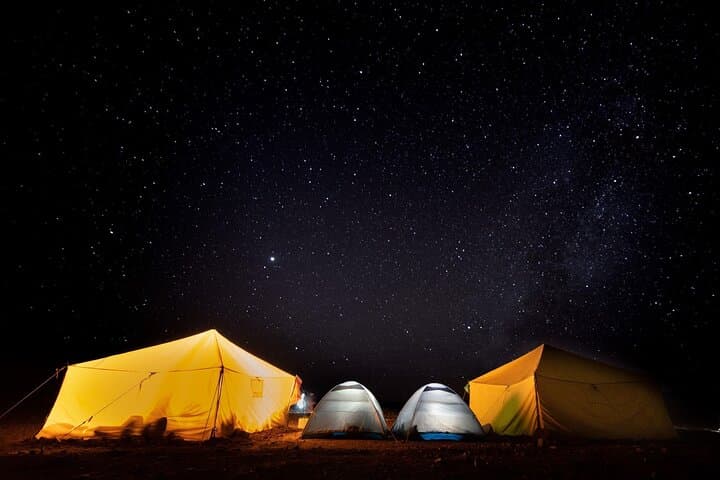
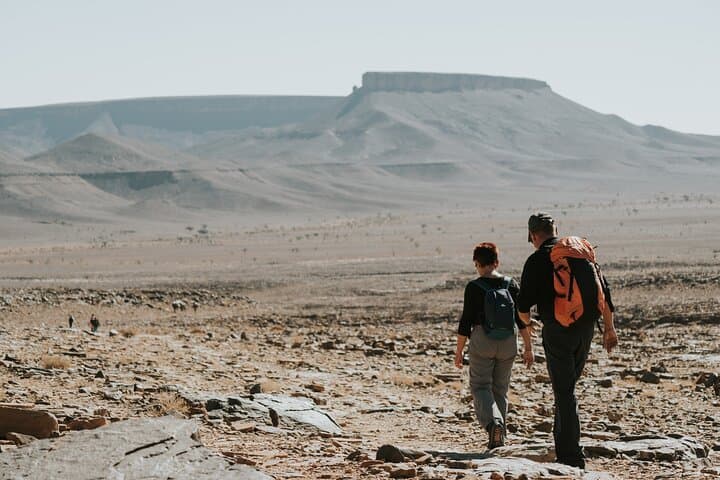
Expect 5–6 hours walking most days over a mix of stony reg, packed sand tracks and loose dune slopes, with daily distances around 15–20 km. Nights alternate between simple nomadic tents and a comfortable fixed bivouac in Chegaga under clear desert stars. Meals lean on fresh local produce and tagines; water is provided but carry a refill bottle.
Practical tips: pace yourself on dune ascents, wear high-SPF sun protection, and schedule tougher sections for morning starts when sand is firmer. This itinerary suits walkers with moderate fitness who want guided, multi-day desert travel with cultural immersion and minimal technical demands.
moderate.
8 days (approx. 6 hours walking daily).
Suitable for people with regular aerobic activity; expect sustained walking on sand and uneven terrain.
Expect 5–6 hours of moderate walking per day, covering roughly 15–20 km over mixed sand and rocky plains; good fitness helps but no technical climbing is required.
Personal luggage is carried by camels between bivouacs; you only need a daypack for water, layers, and snacks.
Nights alternate between nomadic-style tent camps and a fixed comfortable bivouac in Erg Chegaga with mattress-provided tents for the final night.
Yes—this itinerary is designed for occasional walkers with moderate fitness, though participants should be able to handle several consecutive days of walking in heat.
The route crosses traditional trans-Saharan corridors used by Berber and nomadic groups; local settlements maintain centuries-old customs and storytelling traditions.
Travel impacts are minimized by moving camps and using local guides; stick to established routes, pack out waste, and avoid damaging fragile dune vegetation.
Bivouac Erg Chegaga Nomademoi operates guided outdoor trips and adventures with an emphasis on safety, stewardship, and memorable experiences.
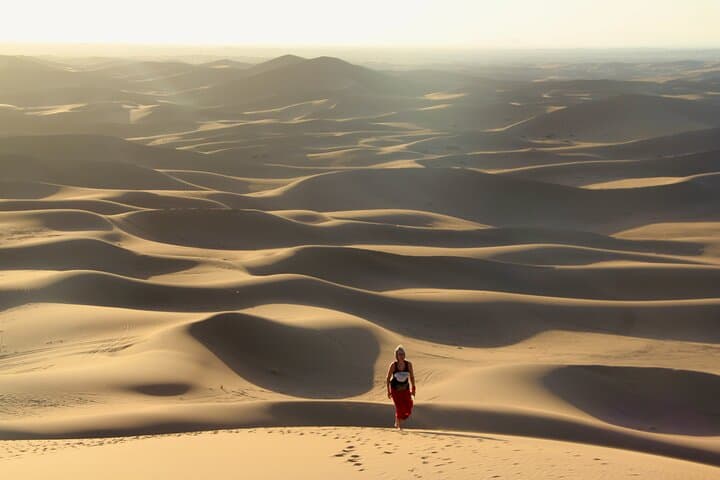
A long dust-colored horizon opens as you leave Marrakech and climb over the Atlas: the city’s bustle slips into a line of palm groves and ochre villages, then into the silent stretch of the Sahara. On day two you arrive in Zagora and, from there, walk southwest beyond the last foothills of Djebel Bani toward Mhasser canyon—rock faces that flash mineral stripes in the sun—and finally the broad, wind-sculpted dunes of Erg Chegaga.
A long dust-colored horizon opens as you leave Marrakech and climb over the Atlas: the city’s bustle slips into a line of palm groves and ochre villages, then into the silent stretch of the Sahara. On day two you arrive in Zagora and, from there, walk southwest beyond the last foothills of Djebel Bani toward Mhasser canyon—rock faces that flash mineral stripes in the sun—and finally the broad, wind-sculpted dunes of Erg Chegaga.
This route threads Berber villages, dry riverbeds, and scattered oases. Geologically the landscape is recent: wind-blown sand fields overlay older red and grey sedimentary plains carved by ephemeral rivers. Culturally the trek is shaped by nomadic and semi-nomadic traditions; local guides share stories and music around the campfire and camels transport your duffel between bivouacs.
Expect 5–6 hours walking most days over a mix of stony reg, packed sand tracks and loose dune slopes, with daily distances around 15–20 km. Nights alternate between simple nomadic tents and a comfortable fixed bivouac in Chegaga under clear desert stars. Meals lean on fresh local produce and tagines; water is provided but carry a refill bottle.
Practical tips: pace yourself on dune ascents, wear high-SPF sun protection, and schedule tougher sections for morning starts when sand is firmer. This itinerary suits walkers with moderate fitness who want guided, multi-day desert travel with cultural immersion and minimal technical demands.