THE ADVENTURE COLLECTIVE® · Independent discovery and booking for outdoor travel

A compact seven-day loop from Tbilisi that pairs ancient cave towns and UNESCO sites with High Caucasus views. Ideal for travelers who want cultural depth and accessible mountain scenery without technical hiking.
A compact seven-day loop from Tbilisi that pairs ancient cave towns and UNESCO sites with High Caucasus views. Ideal for travelers who want cultural depth and accessible mountain scenery without technical hiking.
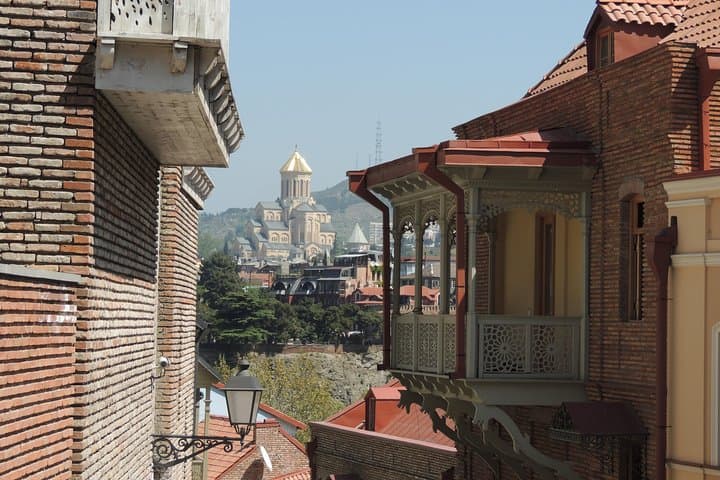
Morning light slices across Tbilisi’s orange roofs as a minivan pulls away from the old city and heads north toward the high Caucasus. Over seven days the route alternates between honeycombed caves and alpine passes: Uplistsikhe’s rock-cut chambers, the hilltop Jvari monastery watching the Mtkvari and Aragvi rivers meet, and the breakaway cliffs at Vardzia where medieval cells stare down at the river.
Verified experiences and guided adventures in the surrounding area.
Operated by Georgian Holidays · Tbilisi, Tbilisi
Morning light slices across Tbilisi’s orange roofs as a minivan pulls away from the old city and heads north toward the high Caucasus. Over seven days the route alternates between honeycombed caves and alpine passes: Uplistsikhe’s rock-cut chambers, the hilltop Jvari monastery watching the Mtkvari and Aragvi rivers meet, and the breakaway cliffs at Vardzia where medieval cells stare down at the river.
Georgia’s story is visible in stone here. Mtskheta was the medieval capital and the cradle of Georgian Christianity; Svetitskhoveli (11th c.) still holds a central place in national identity. The volcanic soils and folded limestone of Samtskhe-Javakheti feed high steppe lakes, while the High Caucasus presents glaciated summits—Mount Kazbegi towers near 5,033 m and the Cross Pass reaches about 2,395 m.
Travel is practical: most nights are in 3-star hotels (with a possible 4-star option at Vardzia), an English-speaking guide-driver escorts the group, and a local jeep is used for steeper approaches in Kazbegi. Expect short walks and viewpoints rather than technical climbs—yet altitude and rocky paths demand good footwear and steady footing.
Plan for variable weather: layers, rain shell, and sun protection are essential. Carry local cash for small purchases and tips; bottled water is usually provided. The tour balances cultural immersion with accessible mountain scenery—an efficient way to see Georgia’s heritage, natural parks such as Borjomi-Kharagauli (about 5,300 sq km), and the living landscape that shaped this crossroads of empires.
moderate.
7 days.
Suitable for travelers with average fitness who can manage several short hikes and long days in a vehicle; not for technical climbers.
Some admissions (e.g., Uplistsikhe, Vardzia) are indicated as included in the itinerary, but confirm specific site fees at booking or with your guide.
The tour is described as physically easy and suitable for all fitness levels, though it involves long drives and some stairs—consider mobility limits and comfort with vehicle travel.
Hotel pickup and drop-off in Tbilisi are provided; an air-conditioned car is used most days and a local jeep is used for Kazbegi approaches.
Breakfasts (6) and some dinners are included; notify the operator of dietary restrictions at booking so meals can be arranged.
Mtskheta was Georgia’s early capital and became a center of Christianization in the 4th century, reflected in monumental churches like Svetitskhoveli and Jvari.
Borjomi-Kharagauli is a protected national park—stick to marked trails, avoid disturbing wildlife, and limit plastic waste around fragile cave sites.
Georgian Holidays operates guided outdoor trips and adventures with an emphasis on safety, stewardship, and memorable experiences.
Morning light slices across Tbilisi’s orange roofs as a minivan pulls away from the old city and heads north toward the high Caucasus. Over seven days the route alternates between honeycombed caves and alpine passes: Uplistsikhe’s rock-cut chambers, the hilltop Jvari monastery watching the Mtkvari and Aragvi rivers meet, and the breakaway cliffs at Vardzia where medieval cells stare down at the river.
Morning light slices across Tbilisi’s orange roofs as a minivan pulls away from the old city and heads north toward the high Caucasus. Over seven days the route alternates between honeycombed caves and alpine passes: Uplistsikhe’s rock-cut chambers, the hilltop Jvari monastery watching the Mtkvari and Aragvi rivers meet, and the breakaway cliffs at Vardzia where medieval cells stare down at the river.
Georgia’s story is visible in stone here. Mtskheta was the medieval capital and the cradle of Georgian Christianity; Svetitskhoveli (11th c.) still holds a central place in national identity. The volcanic soils and folded limestone of Samtskhe-Javakheti feed high steppe lakes, while the High Caucasus presents glaciated summits—Mount Kazbegi towers near 5,033 m and the Cross Pass reaches about 2,395 m.
Travel is practical: most nights are in 3-star hotels (with a possible 4-star option at Vardzia), an English-speaking guide-driver escorts the group, and a local jeep is used for steeper approaches in Kazbegi. Expect short walks and viewpoints rather than technical climbs—yet altitude and rocky paths demand good footwear and steady footing.
Plan for variable weather: layers, rain shell, and sun protection are essential. Carry local cash for small purchases and tips; bottled water is usually provided. The tour balances cultural immersion with accessible mountain scenery—an efficient way to see Georgia’s heritage, natural parks such as Borjomi-Kharagauli (about 5,300 sq km), and the living landscape that shaped this crossroads of empires.