THE ADVENTURE COLLECTIVE® · Independent discovery and booking for outdoor travel

Cross red ridges and juniper forests on a six-day trek through Jebel Saghro. This guided route blends village stays, camping in gorges and full-day walks between Dadès Valley and Tabarkhacht.
Cross red ridges and juniper forests on a six-day trek through Jebel Saghro. This guided route blends village stays, camping in gorges and full-day walks between Dadès Valley and Tabarkhacht.
Sunlight hits the serrated ridgelines of Jebel Saghro and the desert cliffs glow like rusted iron. You start the trip on a long, purposeful drive from Marrakech—over mountain passes and past kasbahs—until villages thin and the high plateaus of Saghro open. Juniper-clad slopes, dry oueds and narrow gorges become your daily corridor; nights swap riad comfort for tented sky, and mule paths stitch together isolated Berber settlements.
Verified experiences and guided adventures in the surrounding area.
Operated by Smart Morocco Tours Excursions · Dades Valley, Drâa-Tafilalet
Sunlight hits the serrated ridgelines of Jebel Saghro and the desert cliffs glow like rusted iron. You start the trip on a long, purposeful drive from Marrakech—over mountain passes and past kasbahs—until villages thin and the high plateaus of Saghro open. Juniper-clad slopes, dry oueds and narrow gorges become your daily corridor; nights swap riad comfort for tented sky, and mule paths stitch together isolated Berber settlements.
Geologically Saghro is a compact massif of volcanic intrusions and heavily eroded sandstone, a landscape carved by wind and rare flash floods. Culturally, the route threads through Amazigh (Berber) communities where kasbahs and terraced fields mark long-settled lifeways tied to seasonal water. Historic caravan routes and seasonal shepherding explain the dotted villages and the reliance on mules and local guides.
Practically, expect six days of steady walking—most days 5–7 hours—over rocky tracks, dry riverbeds and short steep pitches (occasional 150–300m gains). The itinerary alternates village guesthouses with established camps; meals and a guide are included, and luggage support or mule drivers manage heavy loads. Temperatures swing: hot by day, cold at night. Bring sturdy boots for scree and oued crossings, a warm layer for desert nights, sun protection and at least 2–3 liters of water capacity. Navigation is straightforward with a local guide, but pony tracks and loose rock demand stable footing and attention.
The trek rewards with close-up geology, quiet gorges ringed by pink laurels, and authentic contact with mountain communities—an accessible, multi-day desert-mountain experience for prepared hikers.
moderate.
6 days (5–7 hours walking per day).
Suitable for hikers with regular endurance; you should be comfortable walking 10–15 km with elevation changes over consecutive days.
Moderate fitness is required—expect consecutive days of 5–7 hours walking over uneven terrain; regular walkers and hikers will find it manageable.
Typical inclusions are guided trekking, meals as listed (breakfasts, lunches, dinners), some accommodations and camping equipment, and pickup/dropoff in Marrakech.
Light daypacks are recommended; larger bags can often be transported by mule or vehicle—confirm with the operator ahead of departure.
Jebel Saghro elevations are modest compared with the High Atlas—altitude sickness is uncommon, but nights can be cold and weather variable.
Saghro sits along historic transhumance and caravan routes connecting oases and mountain pastures; its villages preserve Amazigh architecture and agricultural terraces.
The massif is ecologically fragile—stay on established tracks, pack out waste and minimize fire risk to protect scarce desert vegetation.
Smart Morocco Tours Excursions operates guided outdoor trips and adventures with an emphasis on safety, stewardship, and memorable experiences.

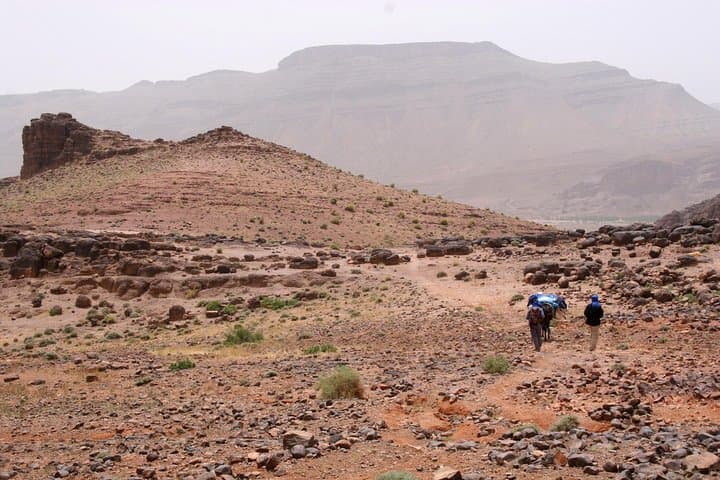


Sunlight hits the serrated ridgelines of Jebel Saghro and the desert cliffs glow like rusted iron. You start the trip on a long, purposeful drive from Marrakech—over mountain passes and past kasbahs—until villages thin and the high plateaus of Saghro open. Juniper-clad slopes, dry oueds and narrow gorges become your daily corridor; nights swap riad comfort for tented sky, and mule paths stitch together isolated Berber settlements.
Sunlight hits the serrated ridgelines of Jebel Saghro and the desert cliffs glow like rusted iron. You start the trip on a long, purposeful drive from Marrakech—over mountain passes and past kasbahs—until villages thin and the high plateaus of Saghro open. Juniper-clad slopes, dry oueds and narrow gorges become your daily corridor; nights swap riad comfort for tented sky, and mule paths stitch together isolated Berber settlements.
Geologically Saghro is a compact massif of volcanic intrusions and heavily eroded sandstone, a landscape carved by wind and rare flash floods. Culturally, the route threads through Amazigh (Berber) communities where kasbahs and terraced fields mark long-settled lifeways tied to seasonal water. Historic caravan routes and seasonal shepherding explain the dotted villages and the reliance on mules and local guides.
Practically, expect six days of steady walking—most days 5–7 hours—over rocky tracks, dry riverbeds and short steep pitches (occasional 150–300m gains). The itinerary alternates village guesthouses with established camps; meals and a guide are included, and luggage support or mule drivers manage heavy loads. Temperatures swing: hot by day, cold at night. Bring sturdy boots for scree and oued crossings, a warm layer for desert nights, sun protection and at least 2–3 liters of water capacity. Navigation is straightforward with a local guide, but pony tracks and loose rock demand stable footing and attention.
The trek rewards with close-up geology, quiet gorges ringed by pink laurels, and authentic contact with mountain communities—an accessible, multi-day desert-mountain experience for prepared hikers.