THE ADVENTURE COLLECTIVE® · Independent discovery and booking for outdoor travel

Combine a sunrise summit on North Africa’s highest peak with a camel-led crossing of Erg Chebbi. This five-day route pairs demanding mountain trails with shifting desert dunes and authentic Berber hospitality.
Combine a sunrise summit on North Africa’s highest peak with a camel-led crossing of Erg Chebbi. This five-day route pairs demanding mountain trails with shifting desert dunes and authentic Berber hospitality.
Morning light spills across Marrakech as minibuses line up for the long drive toward the High Atlas — a low, excited hum of engines and voices before the mountains take over.
Verified experiences and guided adventures in the surrounding area.
Operated by Art de Cuivre Travel · Marrakech, Marrakech-Safi
Morning light spills across Marrakech as minibuses line up for the long drive toward the High Atlas — a low, excited hum of engines and voices before the mountains take over.
By late morning the road climbs through Tizi-n-Tichka, where winds have carved the pass into a sequence of switchbacks and the air smells of thyme and dust. In Imlil the village feels deliberate and unhurried; here the trek begins, narrow mule tracks threading through rock and stone toward the Toubkal refuge. Mount Toubkal (4,167 m) rewards early-risers with a sunrise that stretches across the Maghreb — a broad, non-technical summit where steepness, not exposure, is the primary test.
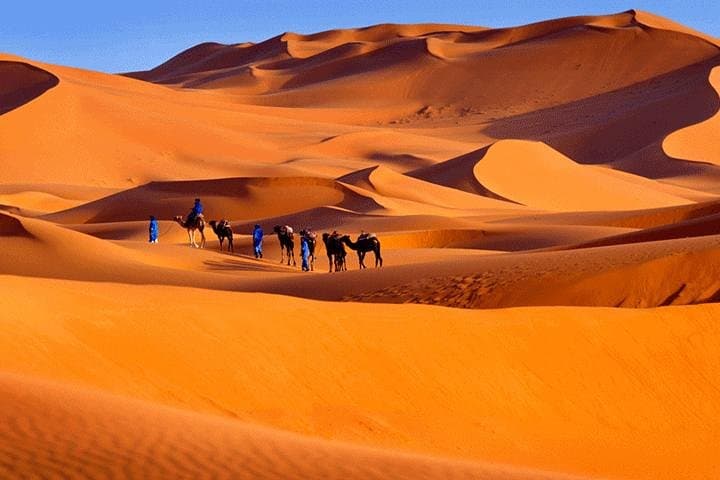
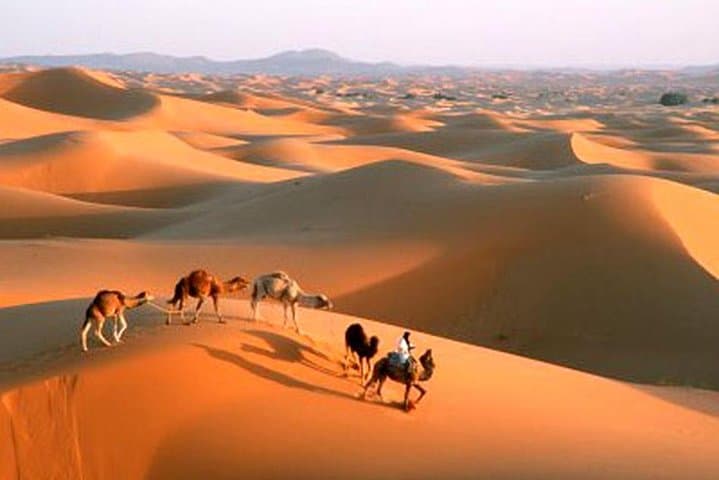
Descending back to Marrakech, the route turns south through valleys of kasbahs and the sculpted gorges of Dades and Todra. The landscape rearranges itself again at Merzouga: Erg Chebbi’s dunes rise like living anatomy, wind-sculpted and shifting. A one-and-a-half-hour camel trek carries travelers to a nomad camp, where dinner and a sky full of stars feel vast and immediate.
This itinerary stitches together geology, Berber culture and cinematic landscapes — kasbahs that once protected families and film studios that now stage history. Practical notes: expect steep, rocky trails on Toubkal, big diurnal temperature swings in the desert, and long drives across mountain passes. Hydrate proactively, layer for cold nights at altitude and in the dunes, and plan summit attempts for early mornings when rock is stable and weather is calm.
The trip balances physical challenge with cultural immersion: mule logistics and local guides smooth the route so the landscape — relentless, generous and changing — can take the lead.
challenging.
5 days.
Good cardiovascular fitness and experience with sustained uphill hiking; able to carry a daypack and manage long drives between stops.
The ascent is non-technical but steep; expect 5–8 hours round-trip depending on pace, with significant elevation gain to 4,167 m.
No — mules are provided to carry overnight bags to the refuge; bring a comfortable daypack for summit essentials.
Desert days are hot and dry with large night-time cooling; the High Atlas can be cold, windy and snowy in winter—dress in layers and check forecasts.
Prior high-altitude experience isn’t mandatory, but familiarity with long hikes and attention to acclimatization will help; communicate any health concerns to guides.
The route crosses traditional Amazigh (Berber) lands where kasbahs served as family strongholds and caravan shelters; Ait Ben Haddou is a UNESCO-listed example used in many films.
Water is scarce across the region—use water sparingly and avoid off-track driving in dune systems; support local guides to keep tourism benefits in the community.
Art de Cuivre Travel operates guided outdoor trips and adventures with an emphasis on safety, stewardship, and memorable experiences.
Morning light spills across Marrakech as minibuses line up for the long drive toward the High Atlas — a low, excited hum of engines and voices before the mountains take over.
Morning light spills across Marrakech as minibuses line up for the long drive toward the High Atlas — a low, excited hum of engines and voices before the mountains take over.
By late morning the road climbs through Tizi-n-Tichka, where winds have carved the pass into a sequence of switchbacks and the air smells of thyme and dust. In Imlil the village feels deliberate and unhurried; here the trek begins, narrow mule tracks threading through rock and stone toward the Toubkal refuge. Mount Toubkal (4,167 m) rewards early-risers with a sunrise that stretches across the Maghreb — a broad, non-technical summit where steepness, not exposure, is the primary test.
Descending back to Marrakech, the route turns south through valleys of kasbahs and the sculpted gorges of Dades and Todra. The landscape rearranges itself again at Merzouga: Erg Chebbi’s dunes rise like living anatomy, wind-sculpted and shifting. A one-and-a-half-hour camel trek carries travelers to a nomad camp, where dinner and a sky full of stars feel vast and immediate.
This itinerary stitches together geology, Berber culture and cinematic landscapes — kasbahs that once protected families and film studios that now stage history. Practical notes: expect steep, rocky trails on Toubkal, big diurnal temperature swings in the desert, and long drives across mountain passes. Hydrate proactively, layer for cold nights at altitude and in the dunes, and plan summit attempts for early mornings when rock is stable and weather is calm.
The trip balances physical challenge with cultural immersion: mule logistics and local guides smooth the route so the landscape — relentless, generous and changing — can take the lead.