THE ADVENTURE COLLECTIVE® · Independent discovery and booking for outdoor travel

A five-day Sirimon–Chogoria traverse up Mount Kenya combines high moorland, glacial valleys and a non-technical summit at Point Lenana. Expect long days, dramatic views and distinct altitude challenges.
A five-day Sirimon–Chogoria traverse up Mount Kenya combines high moorland, glacial valleys and a non-technical summit at Point Lenana. Expect long days, dramatic views and distinct altitude challenges.
Dawn on the Sirimon Track feels sharp and deliberate: cold wind pushing across open moorland, heather whispering under boot soles, and the peaks of Batian and Nelion rising like a wall against the sky. The route threads the dry northwest flank, climbs through montane forest, and gives way to expansive ridges and the dramatic Gorges Valley — landscapes that demand steady breathing and careful footing.
Verified experiences and guided adventures in the surrounding area.
Operated by Africa Tours · Nanyuki, Laikipia County
Dawn on the Sirimon Track feels sharp and deliberate: cold wind pushing across open moorland, heather whispering under boot soles, and the peaks of Batian and Nelion rising like a wall against the sky. The route threads the dry northwest flank, climbs through montane forest, and gives way to expansive ridges and the dramatic Gorges Valley — landscapes that demand steady breathing and careful footing.
Geologically Mount Kenya is an eroded stratovolcano with glacial cirques carved into basalt and trachyte; its high-altitude tarns and knife-edged ridges record ice and fire. The mountain has long been sacred to the Kikuyu and Embu peoples, and many modern place names reflect early survey work by explorers such as Halford Mackinder.
Expect a purposeful itinerary: Day 1 climbs ~9 km with ~860 m gain to Judmier/Old Moses Camp; Day 2 pushes ~14 km and ~900 m to Shipton Camp (4,200 m); Day 3 is an acclimatization circuit to Hauseberg/Lenana area; Day 4 is the pre-dawn ascent to Point Lenana (approx. 4,985 m) followed by a long descent and Day 5 finishes via Chogoria. Trails vary from packed forest tracks to steep scree and rocky quarries; no technical roped climbing is required for Point Lenana but exposure and altitude are real factors.
Practical guidance: start early on summit day, move slowly to reduce altitude effects, carry layered insulation for sub-zero summit winds, and use trekking poles on long descents. Guides and porters are standard; permits and park fees apply through Mount Kenya National Park. Hydrate, monitor symptoms of altitude sickness, and leave no trace — the mountain supplies water to surrounding lowlands and its protection matters to local communities.
challenging.
5 days.
Good cardiovascular fitness with experience hiking 6–7 hour days and carrying a daypack; previous high-altitude trekking helpful.
No technical ropes or ice equipment are needed for Point Lenana on the Sirimon–Chogoria route; however, you should be comfortable with steep scree, uneven rock and high-altitude conditions.
The drier months (roughly January–March and July–October) are preferred for clearer weather and firmer trails; the mountain can be wet and slippery during long rains.
Yes — Mount Kenya National Park requires entry permits and camping fees; these are typically arranged by the operator or guide as part of the package.
Altitude is a significant factor above 3,000 m; follow acclimatization days, stay hydrated, ascend slowly, and inform your guide immediately if symptoms worsen.
Mount Kenya is central to Kikuyu culture and was later mapped by European surveyors; many route names reflect early explorers and survey work such as Mackinder.
The mountain is protected as Mount Kenya National Park and a UNESCO site; stick to established trails, pack out waste and support local guides to minimize impact.
Africa Tours operates guided outdoor trips and adventures with an emphasis on safety, stewardship, and memorable experiences.
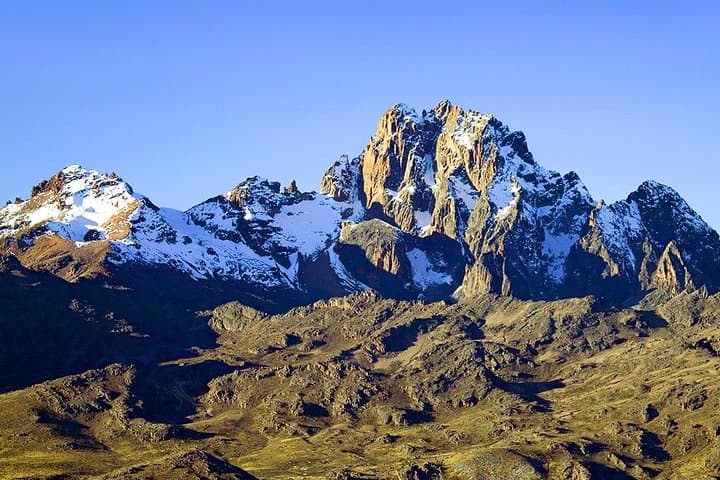
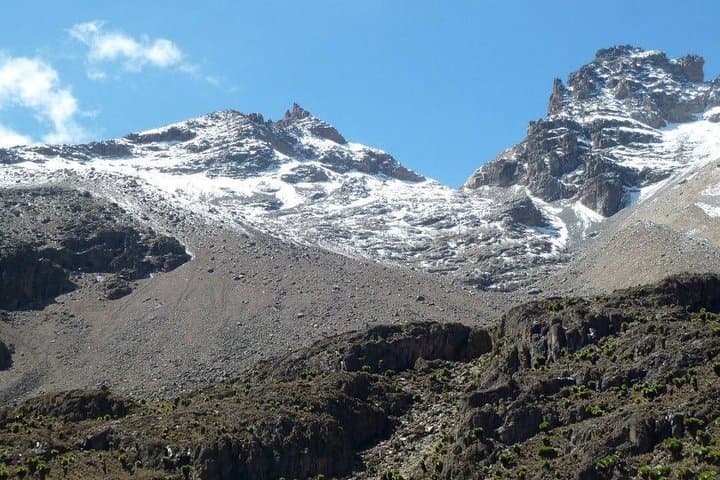
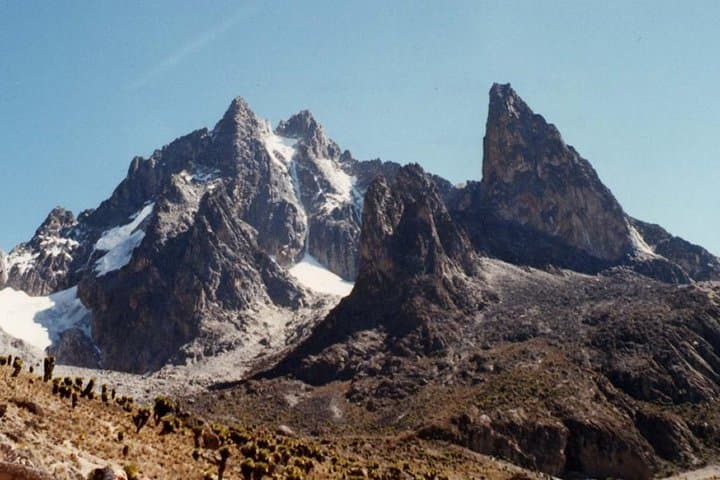

Dawn on the Sirimon Track feels sharp and deliberate: cold wind pushing across open moorland, heather whispering under boot soles, and the peaks of Batian and Nelion rising like a wall against the sky. The route threads the dry northwest flank, climbs through montane forest, and gives way to expansive ridges and the dramatic Gorges Valley — landscapes that demand steady breathing and careful footing.
Dawn on the Sirimon Track feels sharp and deliberate: cold wind pushing across open moorland, heather whispering under boot soles, and the peaks of Batian and Nelion rising like a wall against the sky. The route threads the dry northwest flank, climbs through montane forest, and gives way to expansive ridges and the dramatic Gorges Valley — landscapes that demand steady breathing and careful footing.
Geologically Mount Kenya is an eroded stratovolcano with glacial cirques carved into basalt and trachyte; its high-altitude tarns and knife-edged ridges record ice and fire. The mountain has long been sacred to the Kikuyu and Embu peoples, and many modern place names reflect early survey work by explorers such as Halford Mackinder.
Expect a purposeful itinerary: Day 1 climbs ~9 km with ~860 m gain to Judmier/Old Moses Camp; Day 2 pushes ~14 km and ~900 m to Shipton Camp (4,200 m); Day 3 is an acclimatization circuit to Hauseberg/Lenana area; Day 4 is the pre-dawn ascent to Point Lenana (approx. 4,985 m) followed by a long descent and Day 5 finishes via Chogoria. Trails vary from packed forest tracks to steep scree and rocky quarries; no technical roped climbing is required for Point Lenana but exposure and altitude are real factors.
Practical guidance: start early on summit day, move slowly to reduce altitude effects, carry layered insulation for sub-zero summit winds, and use trekking poles on long descents. Guides and porters are standard; permits and park fees apply through Mount Kenya National Park. Hydrate, monitor symptoms of altitude sickness, and leave no trace — the mountain supplies water to surrounding lowlands and its protection matters to local communities.