THE ADVENTURE COLLECTIVE® · Independent discovery and booking for outdoor travel

Travel overnight by reclinable bus from Buenos Aires to Puerto Iguazú for a five-day exploration of both the Argentine and Brazilian sides of Iguazú Falls. Walk elevated circuits, ride the eco-train to the Devil’s Throat and experience rainforest wildlife with local guides.
Travel overnight by reclinable bus from Buenos Aires to Puerto Iguazú for a five-day exploration of both the Argentine and Brazilian sides of Iguazú Falls. Walk elevated circuits, ride the eco-train to the Devil’s Throat and experience rainforest wildlife with local guides.
The air changes long before you see the cascade: on the overnight bus the city lights blur, and by morning the horizon opens to a band of green and the distant roar that grows into a physical presence. Arriving in Puerto Iguazú, the damp heat and the scent of earth and foliage announce a landscape where water insists on movement — rivers daring you forward, spray pushing sunlight into prisms.
Verified experiences and guided adventures in the surrounding area.
Operated by Say Hueque Travel · Puerto Iguazú, Misiones
The air changes long before you see the cascade: on the overnight bus the city lights blur, and by morning the horizon opens to a band of green and the distant roar that grows into a physical presence. Arriving in Puerto Iguazú, the damp heat and the scent of earth and foliage announce a landscape where water insists on movement — rivers daring you forward, spray pushing sunlight into prisms.
Iguazú Falls straddles Argentina and Brazil, part of a 275-drop system carved from basalt about 200,000 years ago. The region sits on Misiones’ red soils and was historically home to Guaraní communities whose knowledge still informs local guides. Today the parks are UNESCO-listed and managed to balance heavy visitation with conservation: elevated walkways protect root systems while the eco-train reduces vehicle traffic.
Your itinerary pairs long-distance travel with intimate nature time — a full day on the Argentine side to walk upper and lower circuits and the Devil’s Throat, and a panoramic half-day on the Brazilian side. Expect wet platforms, sudden mists, and jungle trails where coatis and toucans are common company.
Practical edge: bring a lightweight waterproof layer, quick-dry clothing, secure footwear with grip, and ID for border crossings. Plan for early starts to avoid peak crowds and midday storms, and budget for park entrance fees and optional boat rides. Hydrate on the trail, keep electronics in dry pouches, and follow guide directions — the falls reward patience and preparation.
moderate.
4–5 days.
Suitable for travellers who can walk 2–5 miles over uneven, wet surfaces and manage stairs and short hikes; long bus rides require tolerance for limited mobility.
Yes — visiting the Brazilian side requires a passport and may require a visa depending on your nationality; check entry rules before travel.
No — National Park entrance fees for both Argentina and Brazil are typically paid separately on-site or to your guide as noted in your booking.
The overnight bus runs about 18–20 hours (roughly 1,400 km); seats recline and there are onboard toilets, but prepare snacks and motion comforts.
Boat rides are usually optional upgrades and cost extra; they get you close to the falls and are wet and thrilling, so plan accordingly.
The falls lie on land historically inhabited by Guaraní peoples; the parks protect both natural and cultural heritage and were designated UNESCO World Heritage in 1984.
Authorities use elevated walkways and an eco-train to limit soil compaction and vehicle emissions; visitors are asked not to feed wildlife and to stay on marked trails.
Say Hueque Travel operates guided outdoor trips and adventures with an emphasis on safety, stewardship, and memorable experiences.


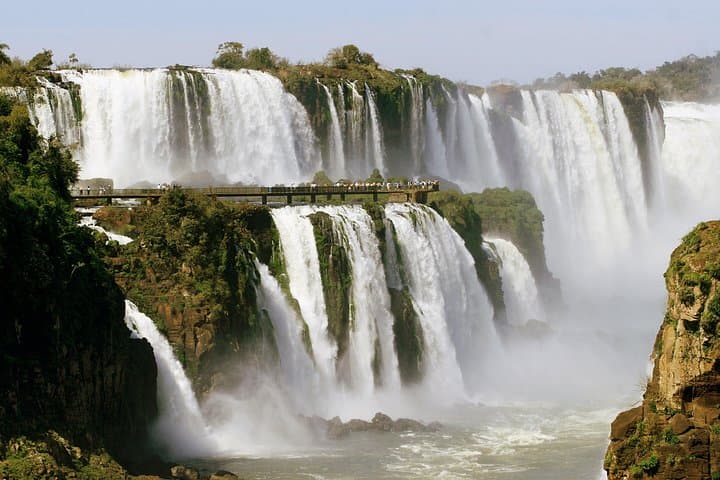
The air changes long before you see the cascade: on the overnight bus the city lights blur, and by morning the horizon opens to a band of green and the distant roar that grows into a physical presence. Arriving in Puerto Iguazú, the damp heat and the scent of earth and foliage announce a landscape where water insists on movement — rivers daring you forward, spray pushing sunlight into prisms.
The air changes long before you see the cascade: on the overnight bus the city lights blur, and by morning the horizon opens to a band of green and the distant roar that grows into a physical presence. Arriving in Puerto Iguazú, the damp heat and the scent of earth and foliage announce a landscape where water insists on movement — rivers daring you forward, spray pushing sunlight into prisms.
Iguazú Falls straddles Argentina and Brazil, part of a 275-drop system carved from basalt about 200,000 years ago. The region sits on Misiones’ red soils and was historically home to Guaraní communities whose knowledge still informs local guides. Today the parks are UNESCO-listed and managed to balance heavy visitation with conservation: elevated walkways protect root systems while the eco-train reduces vehicle traffic.
Your itinerary pairs long-distance travel with intimate nature time — a full day on the Argentine side to walk upper and lower circuits and the Devil’s Throat, and a panoramic half-day on the Brazilian side. Expect wet platforms, sudden mists, and jungle trails where coatis and toucans are common company.
Practical edge: bring a lightweight waterproof layer, quick-dry clothing, secure footwear with grip, and ID for border crossings. Plan for early starts to avoid peak crowds and midday storms, and budget for park entrance fees and optional boat rides. Hydrate on the trail, keep electronics in dry pouches, and follow guide directions — the falls reward patience and preparation.