THE ADVENTURE COLLECTIVE® · Independent discovery and booking for outdoor travel

Spend four concentrated hours exploring Wadi Rum’s rock arches, narrow siqs and rippling dunes—with an optional 30-minute camel ride that adds Bedouin perspective. This short loop packs geology, history and hands-on desert culture into a compact, camera-ready outing.
Spend four concentrated hours exploring Wadi Rum’s rock arches, narrow siqs and rippling dunes—with an optional 30-minute camel ride that adds Bedouin perspective. This short loop packs geology, history and hands-on desert culture into a compact, camera-ready outing.
The Land Cruiser slows and then stops against a sweep of wind-sanded rock; light spills across the gullies and the desert exhales. You step out into a flat that looks empty until the sand moves—a ridge of granules sliding like a living thing underfoot—and suddenly you remember the landscape here is constantly in motion. Over the next four hours this short loop threads sandstone towers, a narrow siq, a soft-sand climb and a perched natural arch; on request you add a 30-minute camel ride and see the world the Bedouins once read on hoof.
Verified experiences and guided adventures in the surrounding area.
Operated by Ali · Wadi Rum Village, Ma'an Governorate
The Land Cruiser slows and then stops against a sweep of wind-sanded rock; light spills across the gullies and the desert exhales. You step out into a flat that looks empty until the sand moves—a ridge of granules sliding like a living thing underfoot—and suddenly you remember the landscape here is constantly in motion. Over the next four hours this short loop threads sandstone towers, a narrow siq, a soft-sand climb and a perched natural arch; on request you add a 30-minute camel ride and see the world the Bedouins once read on hoof.
Wadi Rum wears its history visibly. Nabatean petroglyphs etch animals and riders into Khazali’s face; Lawrence’s Spring still drips where T.E. Lawrence is said to have paused during the Great Arab Revolt. Filmmakers used the same moonscape to stand in for alien planets—so when you stand on a dune and scan the skyline of freestanding rock walls, you understand why directors chose this palette.
Geologically the place is a lesson in time and wind. Layers of sandstone and granite have been hollowed by sand-laden gusts into bridges and arches; Um Fruth and the Small Arch are the result of persistent abrasion that carved voids big enough to climb. Siq Al Mahma’s shaded corridor demonstrates how episodic water flow cut between vertical walls, leaving a cool pocket of air in midday heat.
Culturally the trip leans local: your guide brews Bedouin tea over a small fire and tells stories that link place names with tribal memory. The camel ride—slow, rhythmic and surprisingly steady—gives perspective on how people once moved through this terrain, carrying goods and knowledge across distances that now take minutes by vehicle.
Practical side: plan for 3–4.5 hours total, but expect short walks rather than long-distance trekking—roughly 1–2 km of walking with occasional 10–40 meter rock scrambles. Terrain alternates between soft dunes (where the sand shifts beneath your step) and compact rock shelves that can be uneven and steep. Bring at least 2 liters of water, sunglasses and SPF; a pair of sturdy, closed-toe shoes with good grip will make the small climbs and sandy slopes far easier.
Timing matters. Morning tours offer cool air and crisp light for photos; sunset runs concentrate the desert’s color change and cooler evening temperatures. If you’re chasing quiet, ask to avoid larger shared departures—this operator limits shared groups to seven. Accessibility: most of the stops are short and manageable, but not suitable for travelers with serious spinal or cardiovascular issues. Finally, leave no trace—Wadi Rum is protected and its fragile surfaces and archaeological inscriptions deserve distance and respect.
In four hours you won’t map the whole valley, but you will feel its scale: the dunes that shift their shape like a living thing, the rocks that keep human marks for millennia, and a sky wide enough to make time feel different.
easy.
4–4.5 hours.
Suitable for most people with average fitness; requires short climbs and walking on sand.
The camel ride is optional—add it when booking; the tour price covers the vehicle, guide and short hikes.
Wadi Rum rest house is roughly a 50–60 minute drive from Aqaba, depending on traffic and pickup arrangements.
Yes—families join frequently; children should be supervised on climbs and during the camel ride.
Pickup is available from many hotels in Aqaba and nearby towns—confirm your hotel at booking for pickup details.
There are basic facilities at the Wadi Rum rest house; the tour includes tea and bottled water but not a full meal unless arranged in advance.
Light, breathable layers for daytime, closed-toe shoes, sun protection and a light jacket if you plan a sunset tour.
Wadi Rum’s rock art and Nabatean inscriptions show trade and religious practices dating back over 2,000 years; Lawrence’s Spring ties the valley to the early 20th-century Great Arab Revolt.
Wadi Rum is a protected area—stick to marked tracks, avoid touching rock art and support local guides who practice minimal-impact tourism.
Ali operates guided outdoor trips and adventures with an emphasis on safety, stewardship, and memorable experiences.
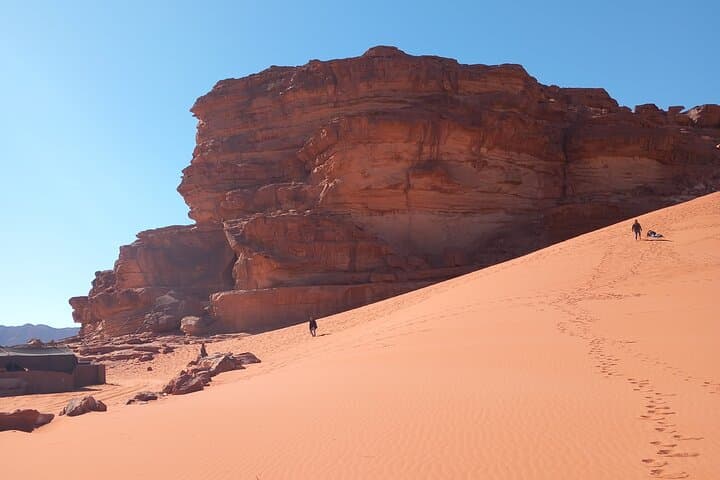
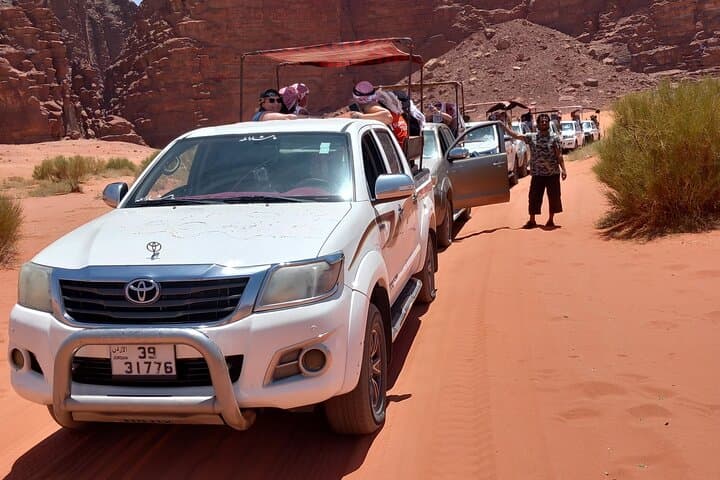
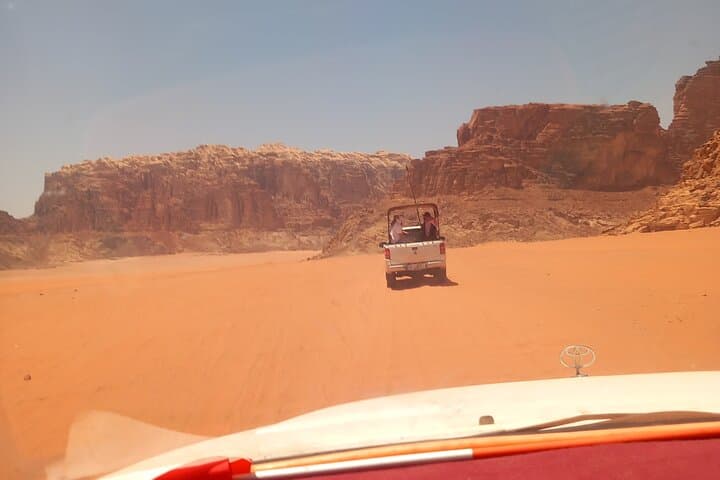
The Land Cruiser slows and then stops against a sweep of wind-sanded rock; light spills across the gullies and the desert exhales. You step out into a flat that looks empty until the sand moves—a ridge of granules sliding like a living thing underfoot—and suddenly you remember the landscape here is constantly in motion. Over the next four hours this short loop threads sandstone towers, a narrow siq, a soft-sand climb and a perched natural arch; on request you add a 30-minute camel ride and see the world the Bedouins once read on hoof.
The Land Cruiser slows and then stops against a sweep of wind-sanded rock; light spills across the gullies and the desert exhales. You step out into a flat that looks empty until the sand moves—a ridge of granules sliding like a living thing underfoot—and suddenly you remember the landscape here is constantly in motion. Over the next four hours this short loop threads sandstone towers, a narrow siq, a soft-sand climb and a perched natural arch; on request you add a 30-minute camel ride and see the world the Bedouins once read on hoof.
Wadi Rum wears its history visibly. Nabatean petroglyphs etch animals and riders into Khazali’s face; Lawrence’s Spring still drips where T.E. Lawrence is said to have paused during the Great Arab Revolt. Filmmakers used the same moonscape to stand in for alien planets—so when you stand on a dune and scan the skyline of freestanding rock walls, you understand why directors chose this palette.
Geologically the place is a lesson in time and wind. Layers of sandstone and granite have been hollowed by sand-laden gusts into bridges and arches; Um Fruth and the Small Arch are the result of persistent abrasion that carved voids big enough to climb. Siq Al Mahma’s shaded corridor demonstrates how episodic water flow cut between vertical walls, leaving a cool pocket of air in midday heat.
Culturally the trip leans local: your guide brews Bedouin tea over a small fire and tells stories that link place names with tribal memory. The camel ride—slow, rhythmic and surprisingly steady—gives perspective on how people once moved through this terrain, carrying goods and knowledge across distances that now take minutes by vehicle.
Practical side: plan for 3–4.5 hours total, but expect short walks rather than long-distance trekking—roughly 1–2 km of walking with occasional 10–40 meter rock scrambles. Terrain alternates between soft dunes (where the sand shifts beneath your step) and compact rock shelves that can be uneven and steep. Bring at least 2 liters of water, sunglasses and SPF; a pair of sturdy, closed-toe shoes with good grip will make the small climbs and sandy slopes far easier.
Timing matters. Morning tours offer cool air and crisp light for photos; sunset runs concentrate the desert’s color change and cooler evening temperatures. If you’re chasing quiet, ask to avoid larger shared departures—this operator limits shared groups to seven. Accessibility: most of the stops are short and manageable, but not suitable for travelers with serious spinal or cardiovascular issues. Finally, leave no trace—Wadi Rum is protected and its fragile surfaces and archaeological inscriptions deserve distance and respect.
In four hours you won’t map the whole valley, but you will feel its scale: the dunes that shift their shape like a living thing, the rocks that keep human marks for millennia, and a sky wide enough to make time feel different.