THE ADVENTURE COLLECTIVE® · Independent discovery and booking for outdoor travel

Cross the High Atlas, explore Aït Benhaddou and Dades Gorges, then ride camels into Erg Chebbi for a night under the stars — a compact, culturally rich Sahara introduction from Marrakech to Fes.
Cross the High Atlas, explore Aït Benhaddou and Dades Gorges, then ride camels into Erg Chebbi for a night under the stars — a compact, culturally rich Sahara introduction from Marrakech to Fes.
The sun drops behind a serrated line of dunes and the wind writes new ridges across Erg Chebbi — you arrive by late afternoon after a ribbon of mountain passes, kasbah towns and rocky gorges. The first day is a road trip through the High Atlas: Tizi n’Tichka cresting at 2,260 m, ochre villages clinging to slopes, and the cinematic facades of Aït Benhaddou letting you step into Morocco’s caravan history.
Verified experiences and guided adventures in the surrounding area.
Operated by Top Sahara Trips · Merzouga, Drâa-Tafilalet
The sun drops behind a serrated line of dunes and the wind writes new ridges across Erg Chebbi — you arrive by late afternoon after a ribbon of mountain passes, kasbah towns and rocky gorges. The first day is a road trip through the High Atlas: Tizi n’Tichka cresting at 2,260 m, ochre villages clinging to slopes, and the cinematic facades of Aït Benhaddou letting you step into Morocco’s caravan history.
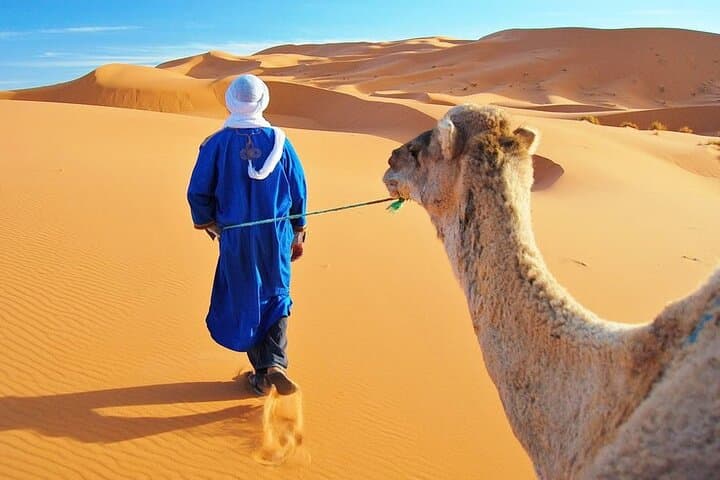
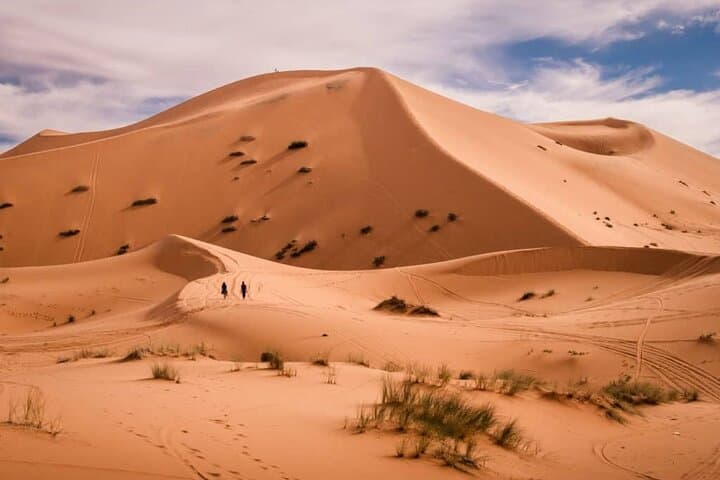
By the Dades and Todra gorges the rock narrows and the valley’s palm oases cradle clustered adobe villages; the geology here is folded Jurassic sandstone and limestone carved into steep canyons. Beyond, the plains flatten toward Merzouga where Erg Chebbi’s dunes — giant sand waves formed by Saharan winds — command the horizon. Local Berber and Gnawa cultures punctuate the route: rose markets at Kalaat M’gouna, the Gnaoua musicians of Khamlia, and caravan-era kasbahs that guarded ancient trade routes.
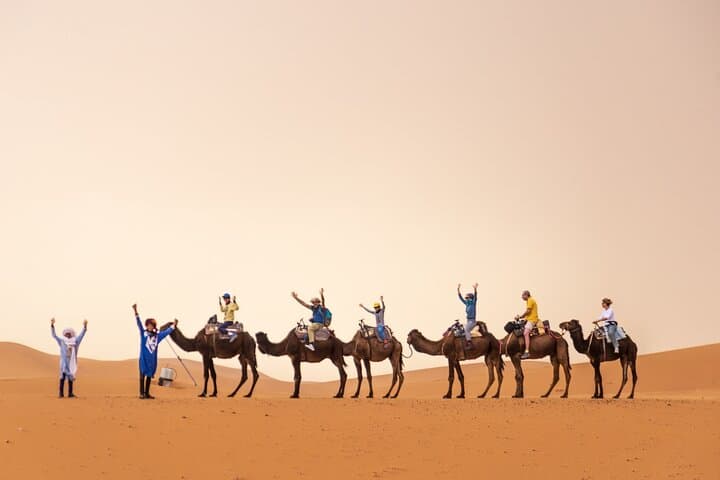
Practical guidance: travel involves long sections by air-conditioned vehicle, short hikes in gorges, a 4x4 excursion and a camel transfer into a nomad bivouac for one night. Nights in the desert are cold; days can be hot and sun-exposed. Bring layered clothing, sun protection, and sturdy shoes for uneven terrain. Hydrate regularly and allow time for the long drives between stops — the scenery is the reward.
This itinerary balances accessible cultural stops with desert immersion: watch the sunrise off the dunes, learn about local irrigation at Merzouga oasis, and expect simple but comfortable riad and bivouac accommodations.
moderate.
4 days.
Suitable for travelers in average fitness — involves long vehicle transfers, short canyon walks, and a camel ride; mobility required for uneven surfaces and stairs.
This listing indicates a private tour option — transportation and guide are dedicated to your group, though confirm booking details with the operator.
Camel transfers are short and low-intensity; bivouac nights are simple but comfortable. Basic mobility helps for mounting camels and uneven tent surfaces.
Typical inclusions are transport with A/C, driver-guide, two dinners and breakfasts, overnight riad and desert camp accommodation, and camel transfer to the bivouac; verify specifics at booking.
Not recommended for travelers with serious spinal problems or limited mobility due to camel transfers and uneven terrain; contact the operator if in doubt.
The route follows former trans-Saharan caravan corridors; Aït Benhaddou is a fortified ksar that reflects centuries of trade and adobe architecture.
Erg Chebbi’s dunes are ecologically sensitive — minimize off-track driving, pack out waste, and use local guides who practice low-impact camping.
Top Sahara Trips operates guided outdoor trips and adventures with an emphasis on safety, stewardship, and memorable experiences.

The sun drops behind a serrated line of dunes and the wind writes new ridges across Erg Chebbi — you arrive by late afternoon after a ribbon of mountain passes, kasbah towns and rocky gorges. The first day is a road trip through the High Atlas: Tizi n’Tichka cresting at 2,260 m, ochre villages clinging to slopes, and the cinematic facades of Aït Benhaddou letting you step into Morocco’s caravan history.
The sun drops behind a serrated line of dunes and the wind writes new ridges across Erg Chebbi — you arrive by late afternoon after a ribbon of mountain passes, kasbah towns and rocky gorges. The first day is a road trip through the High Atlas: Tizi n’Tichka cresting at 2,260 m, ochre villages clinging to slopes, and the cinematic facades of Aït Benhaddou letting you step into Morocco’s caravan history.
By the Dades and Todra gorges the rock narrows and the valley’s palm oases cradle clustered adobe villages; the geology here is folded Jurassic sandstone and limestone carved into steep canyons. Beyond, the plains flatten toward Merzouga where Erg Chebbi’s dunes — giant sand waves formed by Saharan winds — command the horizon. Local Berber and Gnawa cultures punctuate the route: rose markets at Kalaat M’gouna, the Gnaoua musicians of Khamlia, and caravan-era kasbahs that guarded ancient trade routes.
Practical guidance: travel involves long sections by air-conditioned vehicle, short hikes in gorges, a 4x4 excursion and a camel transfer into a nomad bivouac for one night. Nights in the desert are cold; days can be hot and sun-exposed. Bring layered clothing, sun protection, and sturdy shoes for uneven terrain. Hydrate regularly and allow time for the long drives between stops — the scenery is the reward.
This itinerary balances accessible cultural stops with desert immersion: watch the sunrise off the dunes, learn about local irrigation at Merzouga oasis, and expect simple but comfortable riad and bivouac accommodations.