THE ADVENTURE COLLECTIVE® · Independent discovery and booking for outdoor travel

Drive the High Atlas to reach Erg Chebbi in four days of kasbahs, river gorges and a night under desert stars. Expect long scenic drives, a camel trek to camp, and a pre-dawn dune climb for sunrise.
Drive the High Atlas to reach Erg Chebbi in four days of kasbahs, river gorges and a night under desert stars. Expect long scenic drives, a camel trek to camp, and a pre-dawn dune climb for sunrise.
Dawn breaks over the High Atlas as your convoy threads a narrow pass and the road falls away to ochre valleys. On a 4-day route from Marrakesh to Erg Chebbi you move from snow-swept summits to the warm, rippling thighs of the Sahara—stopping at cliff-carved gorges, fortified kasbahs and a sea of dunes that reshapes every hour.
Verified experiences and guided adventures in the surrounding area.
Operated by Said Benabbou · Merzouga, Drâa-Tafilalet
Dawn breaks over the High Atlas as your convoy threads a narrow pass and the road falls away to ochre valleys. On a 4-day route from Marrakesh to Erg Chebbi you move from snow-swept summits to the warm, rippling thighs of the Sahara—stopping at cliff-carved gorges, fortified kasbahs and a sea of dunes that reshapes every hour.
History rides alongside the route: Ait Benhaddou, a UNESCO ksar, stands as a 17th‑century trade and film location; the Taourirt and Telouet kasbahs recall the power of the Glaoui clan. Geology tells its own story—Tizi n’Tichka pass slices ancient folded strata, Dades and Todra gorges reveal river-cut limestone walls, and Erg Chebbi is wind-built sand, grain by grain.
Culture here is Berber and desert-practical: hospitable riads, rose-growing valleys near Kalaat M’Gouna, and campfire music in the dunes. Expect slow driving days punctuated by photo stops, a 1–2 hour camel trek to an equipped camp, a predawn dune climb for sunrise, and simple, hearty meals.
Practical guidance: pack sun protection and layered clothing (desert days are hot, nights can be cold), bring a reusable water bottle and a small daypack. Footwear should be sturdy for rocky gorges and sand-friendly for dunes. Allow for long transfers—daily drives range 200–350 km—and plan sleep in riads or a desert camp. Confirm pickup in Marrakesh and ask about private-vehicle amenities if you have mobility needs. With the right preparation this tour is an efficient, sensory way to cross Morocco’s dramatic landscapes.
moderate.
4 days.
Suitable for travelers in average fitness; involves 1–2 hour camel rides and short dune climbs—able to walk on uneven terrain.
The typical camel trek to Erg Chebbi camp takes about 1–2 hours with a sunset stop; some guests opt for a short ride instead.
Yes—nights are arranged in riads (Marrakesh, Dades, Ouarzazate) and an equipped Berber camp in Merzouga as listed in the itinerary.
The tour is described as physically easy overall, but camel rides and dune walking may be challenging for very young children or people with limited mobility—ask about alternatives.
Daily drives range from roughly 190–366 km depending on the stage; expect multi-hour scenic transfers between stops.
Ait Benhaddou and Telouet reflect centuries of trans-Saharan trade and the power of local caid families; many kasbahs date from the 16th–19th centuries.
Respect dune ecosystems by avoiding off-route driving and minimizing campfires; local operators often support water-conservation and waste-management practices.
Said Benabbou operates guided outdoor trips and adventures with an emphasis on safety, stewardship, and memorable experiences.
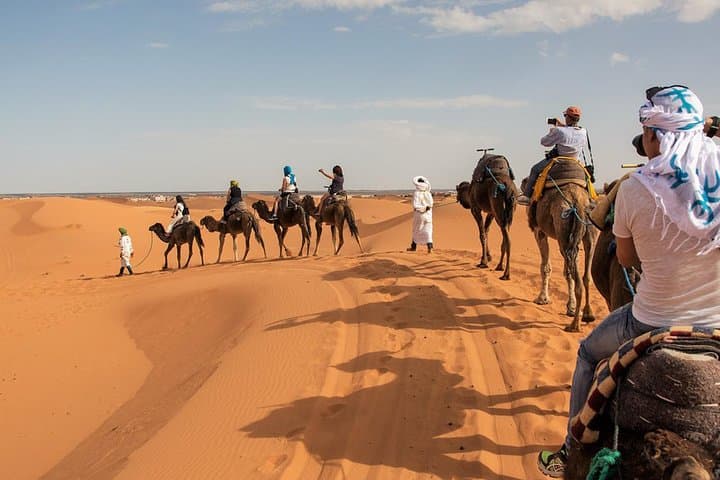


Dawn breaks over the High Atlas as your convoy threads a narrow pass and the road falls away to ochre valleys. On a 4-day route from Marrakesh to Erg Chebbi you move from snow-swept summits to the warm, rippling thighs of the Sahara—stopping at cliff-carved gorges, fortified kasbahs and a sea of dunes that reshapes every hour.
Dawn breaks over the High Atlas as your convoy threads a narrow pass and the road falls away to ochre valleys. On a 4-day route from Marrakesh to Erg Chebbi you move from snow-swept summits to the warm, rippling thighs of the Sahara—stopping at cliff-carved gorges, fortified kasbahs and a sea of dunes that reshapes every hour.
History rides alongside the route: Ait Benhaddou, a UNESCO ksar, stands as a 17th‑century trade and film location; the Taourirt and Telouet kasbahs recall the power of the Glaoui clan. Geology tells its own story—Tizi n’Tichka pass slices ancient folded strata, Dades and Todra gorges reveal river-cut limestone walls, and Erg Chebbi is wind-built sand, grain by grain.
Culture here is Berber and desert-practical: hospitable riads, rose-growing valleys near Kalaat M’Gouna, and campfire music in the dunes. Expect slow driving days punctuated by photo stops, a 1–2 hour camel trek to an equipped camp, a predawn dune climb for sunrise, and simple, hearty meals.
Practical guidance: pack sun protection and layered clothing (desert days are hot, nights can be cold), bring a reusable water bottle and a small daypack. Footwear should be sturdy for rocky gorges and sand-friendly for dunes. Allow for long transfers—daily drives range 200–350 km—and plan sleep in riads or a desert camp. Confirm pickup in Marrakesh and ask about private-vehicle amenities if you have mobility needs. With the right preparation this tour is an efficient, sensory way to cross Morocco’s dramatic landscapes.