THE ADVENTURE COLLECTIVE® · Independent discovery and booking for outdoor travel

Cross the High Atlas, explore Aït Benhaddou, and spend two nights beneath the Sahara sky on this four-day Marrakech to Merzouga tour. Expect camel treks, dune walks, Berber villages, and star-filled camps.
Cross the High Atlas, explore Aït Benhaddou, and spend two nights beneath the Sahara sky on this four-day Marrakech to Merzouga tour. Expect camel treks, dune walks, Berber villages, and star-filled camps.
A morning in Marrakech feels loud and immediate; within hours the city’s ochre walls give way to the High Atlas, whose hairpin Tizi n’Tichka pass trims the skyline into serrated ridges. By late afternoon the landscape softens into ochre valleys, palm oases and finally the vast, wind-sculpted ripples of Erg Chebbi at Merzouga. The dunes push and pull at your pace — a living landscape that nudges you to walk farther or simply stop and listen.
Verified experiences and guided adventures in the surrounding area.
Operated by Imperial Trail Tours · Marrakech, Marrakech-Safi
A morning in Marrakech feels loud and immediate; within hours the city’s ochre walls give way to the High Atlas, whose hairpin Tizi n’Tichka pass trims the skyline into serrated ridges. By late afternoon the landscape softens into ochre valleys, palm oases and finally the vast, wind-sculpted ripples of Erg Chebbi at Merzouga. The dunes push and pull at your pace — a living landscape that nudges you to walk farther or simply stop and listen.
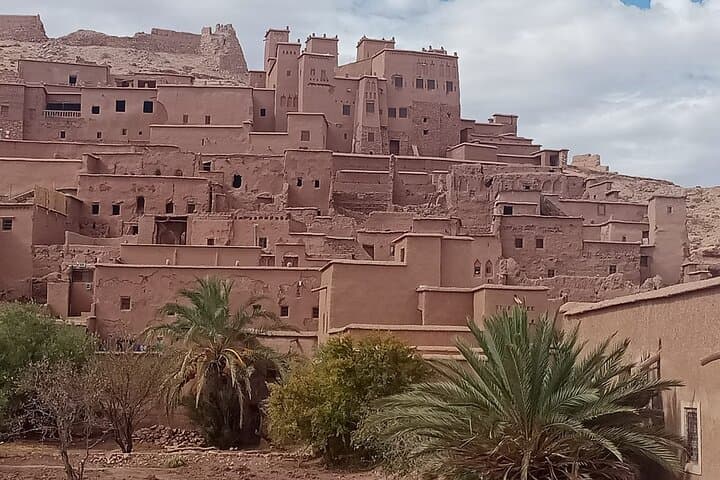
This four-day loop routes through Aït Benhaddou, a UNESCO kasbah built of mud-brick, and the Toudra Gorges — limestone walls carved by millennia of water — before arriving at the Sahara’s edge. Along the way, Berber villages and the Tafilalet oasis reveal a blend of Amazigh culture, caravan history and desert agriculture that depends on fragile groundwater.
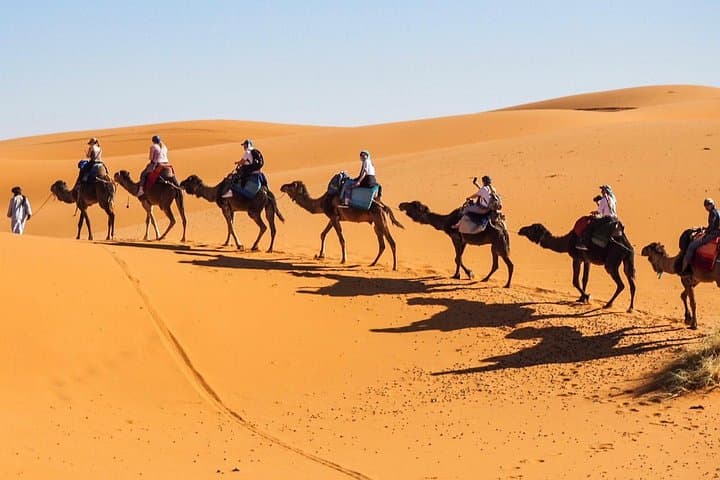
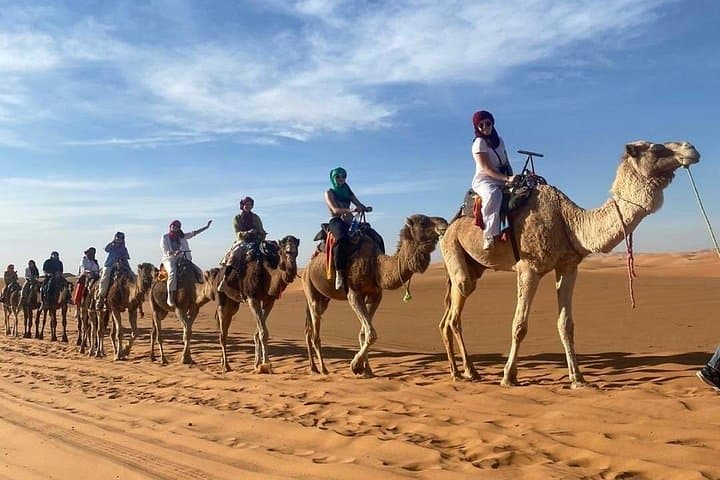
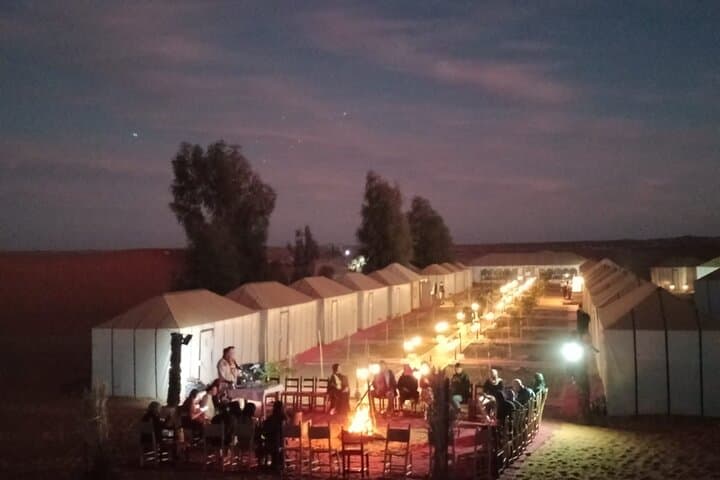
Practical notes: expect two nights under the desert sky in traditional nomad-style camps, camel rides at sunset and sunrise, and opportunities for sandboarding and short hikes on dune crests. Accommodations alternate between modest hotels and shared tents; luggage is left in the hotel while you carry a small overnight bag to camp.
Bring layers for wide diurnal swings, sun protection, and sturdy shoes for walking soft sand. Plan your photography around golden hours — sunsets and sunrises on the dunes are the most dramatic. The trip is low-impact physically but remote, so keep water and emergency meds handy and respect local customs when visiting villages and private family homesteads.
easy.
4 days.
Suitable for travelers in basic fitness; requires mounting camels, short dune walks and standing on uneven sand.
Camel rides are moderate and guided; dune walking involves short climbs on soft sand — basic mobility and balance are sufficient.
No — camps provide sleeping mats and blankets, though a lightweight sleeping liner is comfortable and hygienic if you prefer.
Tap water isn’t recommended; drink bottled water provided by the operator or use a treated refill from your personal filter bottle.
Operators typically accommodate common dietary needs if informed in advance on booking forms; communicate allergies or restrictions early.
The route follows ancient caravan corridors linking Saharan oases to North African trade networks; Aït Benhaddou served as an important fortified stop on these routes.
Water is scarce: conserve water, avoid single-use plastics when possible, and respect local grazing areas to reduce erosion and cultural impact.
Imperial Trail Tours operates guided outdoor trips and adventures with an emphasis on safety, stewardship, and memorable experiences.
A morning in Marrakech feels loud and immediate; within hours the city’s ochre walls give way to the High Atlas, whose hairpin Tizi n’Tichka pass trims the skyline into serrated ridges. By late afternoon the landscape softens into ochre valleys, palm oases and finally the vast, wind-sculpted ripples of Erg Chebbi at Merzouga. The dunes push and pull at your pace — a living landscape that nudges you to walk farther or simply stop and listen.
A morning in Marrakech feels loud and immediate; within hours the city’s ochre walls give way to the High Atlas, whose hairpin Tizi n’Tichka pass trims the skyline into serrated ridges. By late afternoon the landscape softens into ochre valleys, palm oases and finally the vast, wind-sculpted ripples of Erg Chebbi at Merzouga. The dunes push and pull at your pace — a living landscape that nudges you to walk farther or simply stop and listen.
This four-day loop routes through Aït Benhaddou, a UNESCO kasbah built of mud-brick, and the Toudra Gorges — limestone walls carved by millennia of water — before arriving at the Sahara’s edge. Along the way, Berber villages and the Tafilalet oasis reveal a blend of Amazigh culture, caravan history and desert agriculture that depends on fragile groundwater.
Practical notes: expect two nights under the desert sky in traditional nomad-style camps, camel rides at sunset and sunrise, and opportunities for sandboarding and short hikes on dune crests. Accommodations alternate between modest hotels and shared tents; luggage is left in the hotel while you carry a small overnight bag to camp.
Bring layers for wide diurnal swings, sun protection, and sturdy shoes for walking soft sand. Plan your photography around golden hours — sunsets and sunrises on the dunes are the most dramatic. The trip is low-impact physically but remote, so keep water and emergency meds handy and respect local customs when visiting villages and private family homesteads.