THE ADVENTURE COLLECTIVE® · Independent discovery and booking for outdoor travel

Three days from Marrakech carry you over the High Atlas, through fortified kasbahs and narrow canyons, and into the wind-sculpted dunes of Erg Chebbi. Expect long drives, dramatic geology, an authentic camel ride and a night under desert stars.
Three days from Marrakech carry you over the High Atlas, through fortified kasbahs and narrow canyons, and into the wind-sculpted dunes of Erg Chebbi. Expect long drives, dramatic geology, an authentic camel ride and a night under desert stars.
A long ribbon of tarmac climbs out of Marrakech, the High Atlas folding like an old map as your minivan pushes toward Tizi n’Tichka. Morning light sharpens the stone; the pass breathes cold air and the road winds you past stony villages where goats pick at scrub. By midday the UNESCO kasbah of Aït Ben Haddou rises from red earth — a stacked city of mud-brick that has guarded caravan routes for centuries and stood in the frame of international films.
Verified experiences and guided adventures in the surrounding area.
Operated by Fabulous Morocco Tours · Merzouga, Drâa-Tafilalet
A long ribbon of tarmac climbs out of Marrakech, the High Atlas folding like an old map as your minivan pushes toward Tizi n’Tichka. Morning light sharpens the stone; the pass breathes cold air and the road winds you past stony villages where goats pick at scrub. By midday the UNESCO kasbah of Aït Ben Haddou rises from red earth — a stacked city of mud-brick that has guarded caravan routes for centuries and stood in the frame of international films.
Beyond the kasbah the landscape loosens into the Road of a Thousand Kasbahs, palms and rose gardens giving way to the sculpted Dades and Todra gorges. Todra’s vertical limestone walls, cleaved by a narrow river, demand a slow, measured walk; the canyon’s coolness dares you to linger. Then the desert: Erg Chebbi’s dunes roll like an amber sea, sand shaped by north winds into ridges that can reach 100–150 meters. A sunset camel trek places you on a crest where the sky seems to push color into the sand; nights in a Berber camp reveal constellations with an immediacy the city hides.
Practical guidance: plan for long driving days (expect up to 6–9 hours on return routes), pack layers for hot days and cold nights (Tizi n’Tichka ~2,260 m), and bring at least 2–3 liters of water per person on excursions. Footwear should handle rocky gorges and soft dunes; sun protection and a small daypack make transitions between villages, kasbahs, and camp straightforward. Travel with local guides to support fragile desert ecosystems and Berber communities.
moderate.
3 days.
Suitable for travelers in average fitness able to handle multiple hours of sitting during drives, short walks in gorges, and mounting a camel; not recommended for serious mobility issues.
Yes; rides are short (sunset/sunrise) and guided—staff assist mounting and dismounting, but inform the operator if you have back issues.
Expect several long stretches: day segments commonly total 4–9 hours with stops for sights, food, and photo breaks.
You’ll stay one night in a hotel (Dades) and one night in a desert camp; options range from basic nomad tents to luxury private tents depending on booking.
Yes—private tours typically include hotel/riad pickup and drop-off within Marrakech; confirm exact pickup location and timing when booking.
This route follows historic caravan corridors linking Marrakech and Saharan oases; the ksars and kasbahs reflect centuries of trade, irrigation and local defense.
Stick to marked tracks, avoid collecting fossils or plants, and choose operators who minimize campfires and support local water-conservation practices.
Fabulous Morocco Tours operates guided outdoor trips and adventures with an emphasis on safety, stewardship, and memorable experiences.


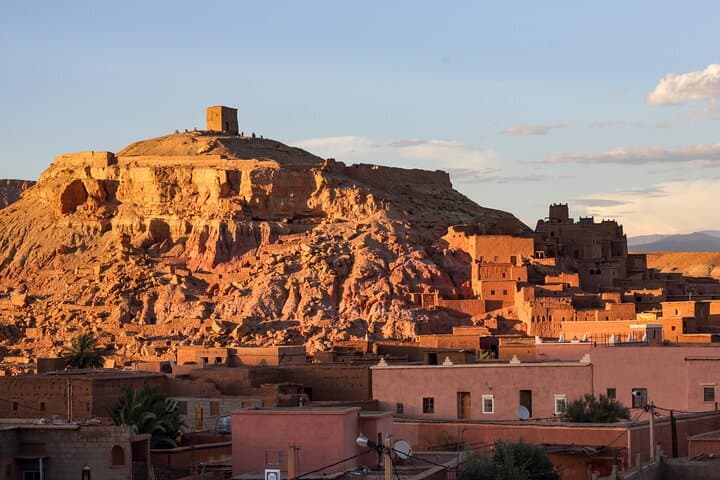

A long ribbon of tarmac climbs out of Marrakech, the High Atlas folding like an old map as your minivan pushes toward Tizi n’Tichka. Morning light sharpens the stone; the pass breathes cold air and the road winds you past stony villages where goats pick at scrub. By midday the UNESCO kasbah of Aït Ben Haddou rises from red earth — a stacked city of mud-brick that has guarded caravan routes for centuries and stood in the frame of international films.
A long ribbon of tarmac climbs out of Marrakech, the High Atlas folding like an old map as your minivan pushes toward Tizi n’Tichka. Morning light sharpens the stone; the pass breathes cold air and the road winds you past stony villages where goats pick at scrub. By midday the UNESCO kasbah of Aït Ben Haddou rises from red earth — a stacked city of mud-brick that has guarded caravan routes for centuries and stood in the frame of international films.
Beyond the kasbah the landscape loosens into the Road of a Thousand Kasbahs, palms and rose gardens giving way to the sculpted Dades and Todra gorges. Todra’s vertical limestone walls, cleaved by a narrow river, demand a slow, measured walk; the canyon’s coolness dares you to linger. Then the desert: Erg Chebbi’s dunes roll like an amber sea, sand shaped by north winds into ridges that can reach 100–150 meters. A sunset camel trek places you on a crest where the sky seems to push color into the sand; nights in a Berber camp reveal constellations with an immediacy the city hides.
Practical guidance: plan for long driving days (expect up to 6–9 hours on return routes), pack layers for hot days and cold nights (Tizi n’Tichka ~2,260 m), and bring at least 2–3 liters of water per person on excursions. Footwear should handle rocky gorges and soft dunes; sun protection and a small daypack make transitions between villages, kasbahs, and camp straightforward. Travel with local guides to support fragile desert ecosystems and Berber communities.