THE ADVENTURE COLLECTIVE® · Independent discovery and booking for outdoor travel

Escape Hanoi for three days of lowland tropical forest and tidal mangroves. Trek through Cuc Phuong’s limestone groves, visit a primate rescue center, then boat across Xuan Thuy’s vital mudflats to watch migratory shorebirds.
Escape Hanoi for three days of lowland tropical forest and tidal mangroves. Trek through Cuc Phuong’s limestone groves, visit a primate rescue center, then boat across Xuan Thuy’s vital mudflats to watch migratory shorebirds.
You leave Hanoi before dawn, the city shrinking behind rice paddies that blur into a ribbon of green. By late morning the road dips into limestone ridges and the air thickens with the smell of wet earth — this is Cuc Phuong National Park, where ancient trees lean over narrow trails and the forest seems to watch you back. A day later you trade canopy for tidal flats at Xuan Thuy, where boats skim mangrove channels and shorebirds slice the horizon.
Verified experiences and guided adventures in the surrounding area.
You leave Hanoi before dawn, the city shrinking behind rice paddies that blur into a ribbon of green. By late morning the road dips into limestone ridges and the air thickens with the smell of wet earth — this is Cuc Phuong National Park, where ancient trees lean over narrow trails and the forest seems to watch you back. A day later you trade canopy for tidal flats at Xuan Thuy, where boats skim mangrove channels and shorebirds slice the horizon.
Cuc Phuong, established as Vietnam’s first national park in 1962, protects lowland tropical forest and karst geology carved into caves and sinkholes. Xuan Thuy, a coastal wetland and important Ramsar site, is shaped each day by the Red River’s tides: mudflats exposed at low tide, feeding grounds for migratory birds. Local fishing communities and small village markets offer a glimpse into delta life; both parks combine natural history with living culture.
Expect 3 days of mixed activity: guided forest treks of 4–10 km across uneven, often muddy trails (elevation typically under 600 m), a short boat transfer through mangroves, and easy walks on tidal flats. Nights are spent in basic eco-lodges or homestays; bring a lightweight rain jacket and solid boots. Avoid the monsoon (June–August) for easier trails and clearer birdwatching; dawn and dusk are best for wildlife.
Practical tips: hydrate frequently, pack insect repellent and quick-dry layers, and carry cash for modest park fees and village purchases. Respect signage, stay on trails, and keep noise low—these parks reward patience with rare bird sightings and unexpectedly close encounters with the forest’s quieter residents.
moderate.
3 days (approx. 72 hours).
Moderate fitness: comfortable walking 4–10 km per day on uneven terrain and carrying a daypack.
Park entrance fees apply and are typically included in guided tours; independent visitors pay on arrival—check current prices locally.
Cuc Phuong is about 2–3 hours by road from Hanoi; Xuan Thuy is roughly 1.5–2 hours depending on traffic and route.
Accommodation is basic to mid-range: eco-lodges or simple homestays focused on comfort and local hospitality rather than luxury.
Yes for older children comfortable with multi-hour transfers and outdoor conditions; keep younger kids’ days shorter and watch tides closely at Xuan Thuy.
Cuc Phuong was Vietnam’s first national park, created to protect lowland forest and karst ecosystems; Xuan Thuy is an internationally recognized wetland important for migratory birds.
Both parks face pressure from development and tourism; follow trails, avoid feeding wildlife, and choose local operators that contribute to conservation and community programs.
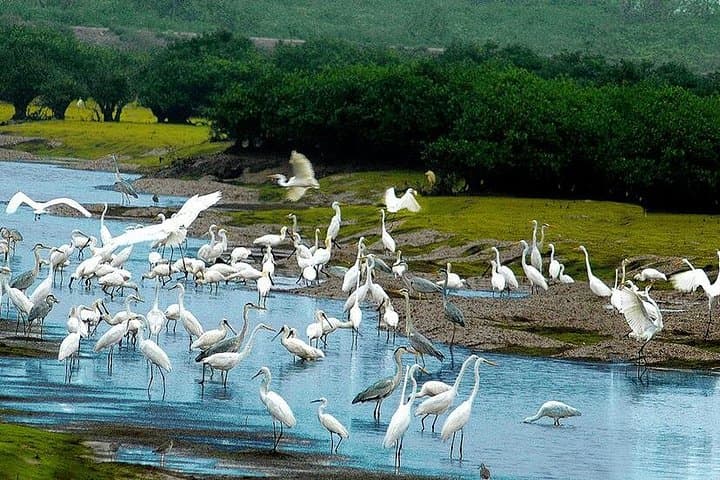
You leave Hanoi before dawn, the city shrinking behind rice paddies that blur into a ribbon of green. By late morning the road dips into limestone ridges and the air thickens with the smell of wet earth — this is Cuc Phuong National Park, where ancient trees lean over narrow trails and the forest seems to watch you back. A day later you trade canopy for tidal flats at Xuan Thuy, where boats skim mangrove channels and shorebirds slice the horizon.
You leave Hanoi before dawn, the city shrinking behind rice paddies that blur into a ribbon of green. By late morning the road dips into limestone ridges and the air thickens with the smell of wet earth — this is Cuc Phuong National Park, where ancient trees lean over narrow trails and the forest seems to watch you back. A day later you trade canopy for tidal flats at Xuan Thuy, where boats skim mangrove channels and shorebirds slice the horizon.
Cuc Phuong, established as Vietnam’s first national park in 1962, protects lowland tropical forest and karst geology carved into caves and sinkholes. Xuan Thuy, a coastal wetland and important Ramsar site, is shaped each day by the Red River’s tides: mudflats exposed at low tide, feeding grounds for migratory birds. Local fishing communities and small village markets offer a glimpse into delta life; both parks combine natural history with living culture.
Expect 3 days of mixed activity: guided forest treks of 4–10 km across uneven, often muddy trails (elevation typically under 600 m), a short boat transfer through mangroves, and easy walks on tidal flats. Nights are spent in basic eco-lodges or homestays; bring a lightweight rain jacket and solid boots. Avoid the monsoon (June–August) for easier trails and clearer birdwatching; dawn and dusk are best for wildlife.
Practical tips: hydrate frequently, pack insect repellent and quick-dry layers, and carry cash for modest park fees and village purchases. Respect signage, stay on trails, and keep noise low—these parks reward patience with rare bird sightings and unexpectedly close encounters with the forest’s quieter residents.