THE ADVENTURE COLLECTIVE® · Independent discovery and booking for outdoor travel

Witness the massed thunder of the Great Wildebeest Migration on a compact, group-joining 3-day safari to Masai Mara. Early mornings, long game drives and optional balloon flights put you at key crossing points where predators and prey meet.
Witness the massed thunder of the Great Wildebeest Migration on a compact, group-joining 3-day safari to Masai Mara. Early mornings, long game drives and optional balloon flights put you at key crossing points where predators and prey meet.
Dawn breaks low over open grass, and the Mara River catches the first light as a rolling wall of wildebeest edges toward the water. Dust coils up like smoke; horns and anxious bleats puncture the quiet. That is the pulse this three-day, group-joining safari aims to deliver—close, kinetic encounters with the Great Wildebeest Migration in Masai Mara.
Verified experiences and guided adventures in the surrounding area.
Operated by Gracepatt Ecotours Kenya · Narok, Narok County
Dawn breaks low over open grass, and the Mara River catches the first light as a rolling wall of wildebeest edges toward the water. Dust coils up like smoke; horns and anxious bleats puncture the quiet. That is the pulse this three-day, group-joining safari aims to deliver—close, kinetic encounters with the Great Wildebeest Migration in Masai Mara.
Geology here is simple but dramatic: the Mara forms the western edge of the East African Rift, a landscape of broad savanna, riverine forest and escarpment. The reserve (roughly 1,500 km²) supports classic Serengeti–Mara ecology—predator-rich plains, river crossings on the Mara River and seasonal grass pulses that drive the migration. The Maasai people have stewarded these lands for generations; their presence and culture remain visible at reserve edges and local villages.
Expect long game drives from a central tented camp (itinerary notes Rhino Tourist Camp or similar), early starts and full days of searching for crossings, lions, leopards and cheetahs. Optional hot-air balloon flights lift you above the herds for a different vantage. Practical details: plan for roughly 5–6 hours transfer time from Nairobi, elevations near 1,500 m, dusty unpaved tracks and variable temperatures—cold mornings, hot afternoons.
Pack binoculars, layered clothing, sun protection and insect repellent; charge camera batteries and keep playback time for wildlife viewing brief and respectful. Because this is a shared group tour, be ready for flexible pick-up times and a schedule driven by animal movements. The payoff is elemental: massed hooves, river drama and predator choreography that make the Mara one of Africa’s most compelling wildlife stages.
easy.
3 days.
Suitable for most travelers; involves extended vehicle time and short, easy walks
The high season for river crossings in Masai Mara typically runs June through October, when large herds move into the reserve from the Serengeti.
Expect about 5–6 hours by road depending on traffic and road conditions; morning departures around 7–8am are standard for this itinerary.
Yes—park entrance fees are listed as included in the tour inclusions for this product.
The operator lists the activity as physically easy and suitable for most fitness levels, but long vehicle rides and uneven camp areas may be challenging for very young children or travelers with significant mobility limitations.
Masai Mara forms the Kenyan arm of the Serengeti–Mara ecosystem; local Maasai culture and grazing practices have coexisted with wildlife for generations.
Tourism supports anti-poaching and community programs in Narok County; follow guide instructions to minimize disturbance and avoid single-use plastics.
Gracepatt Ecotours Kenya operates guided outdoor trips and adventures with an emphasis on safety, stewardship, and memorable experiences.

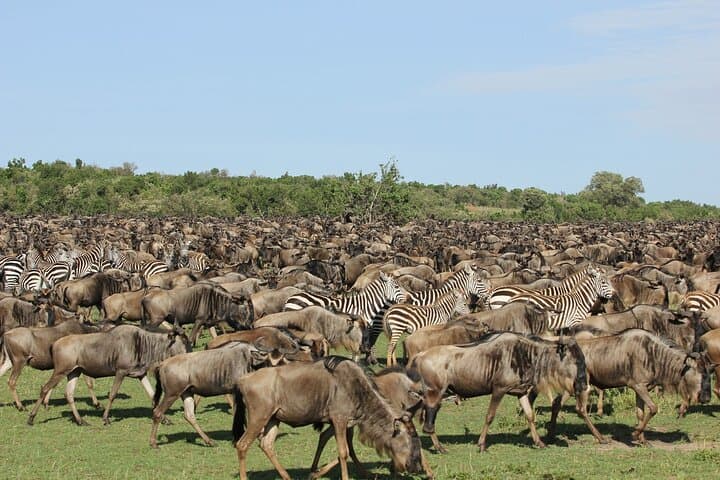


Dawn breaks low over open grass, and the Mara River catches the first light as a rolling wall of wildebeest edges toward the water. Dust coils up like smoke; horns and anxious bleats puncture the quiet. That is the pulse this three-day, group-joining safari aims to deliver—close, kinetic encounters with the Great Wildebeest Migration in Masai Mara.
Dawn breaks low over open grass, and the Mara River catches the first light as a rolling wall of wildebeest edges toward the water. Dust coils up like smoke; horns and anxious bleats puncture the quiet. That is the pulse this three-day, group-joining safari aims to deliver—close, kinetic encounters with the Great Wildebeest Migration in Masai Mara.
Geology here is simple but dramatic: the Mara forms the western edge of the East African Rift, a landscape of broad savanna, riverine forest and escarpment. The reserve (roughly 1,500 km²) supports classic Serengeti–Mara ecology—predator-rich plains, river crossings on the Mara River and seasonal grass pulses that drive the migration. The Maasai people have stewarded these lands for generations; their presence and culture remain visible at reserve edges and local villages.
Expect long game drives from a central tented camp (itinerary notes Rhino Tourist Camp or similar), early starts and full days of searching for crossings, lions, leopards and cheetahs. Optional hot-air balloon flights lift you above the herds for a different vantage. Practical details: plan for roughly 5–6 hours transfer time from Nairobi, elevations near 1,500 m, dusty unpaved tracks and variable temperatures—cold mornings, hot afternoons.
Pack binoculars, layered clothing, sun protection and insect repellent; charge camera batteries and keep playback time for wildlife viewing brief and respectful. Because this is a shared group tour, be ready for flexible pick-up times and a schedule driven by animal movements. The payoff is elemental: massed hooves, river drama and predator choreography that make the Mara one of Africa’s most compelling wildlife stages.